Social media management for agencies means running strategy, content, publishing, community management, and reporting across every client account at once, not just posting on schedule.
The real difficulty isn’t creating content. It’s everything around it: approvals, calendars, team collaboration, and reporting, all multiplied by client count.
This guide covers how agencies should structure that workflow, price it, and choose tools that support long-term growth.
Quick Answer
Social media management for agencies involves planning content, scheduling posts, managing multiple client accounts, handling approvals, engaging with audiences, and reporting on performance.
Using a dedicated platform like SocialBu helps agencies make workflow simple with multi-client management, content scheduling, approval workflows, team collaboration, analytics, and automation.
Why Social Media Management for Agencies Is Complex?
Many businesses think social media management is simply:
For agencies, the reality is much more complicated. Social media marketing has a 100% higher lead-to-close rate than outbound marketing.
A typical agency may manage: 10+ client accounts, multiple social platforms, different approval processes, posting schedules, and reporting requirements.
Every client adds another layer of management. This is why professional social media management companies focus on building systems instead of handling tasks randomly.
What Does Social Media Management for Agencies Include?
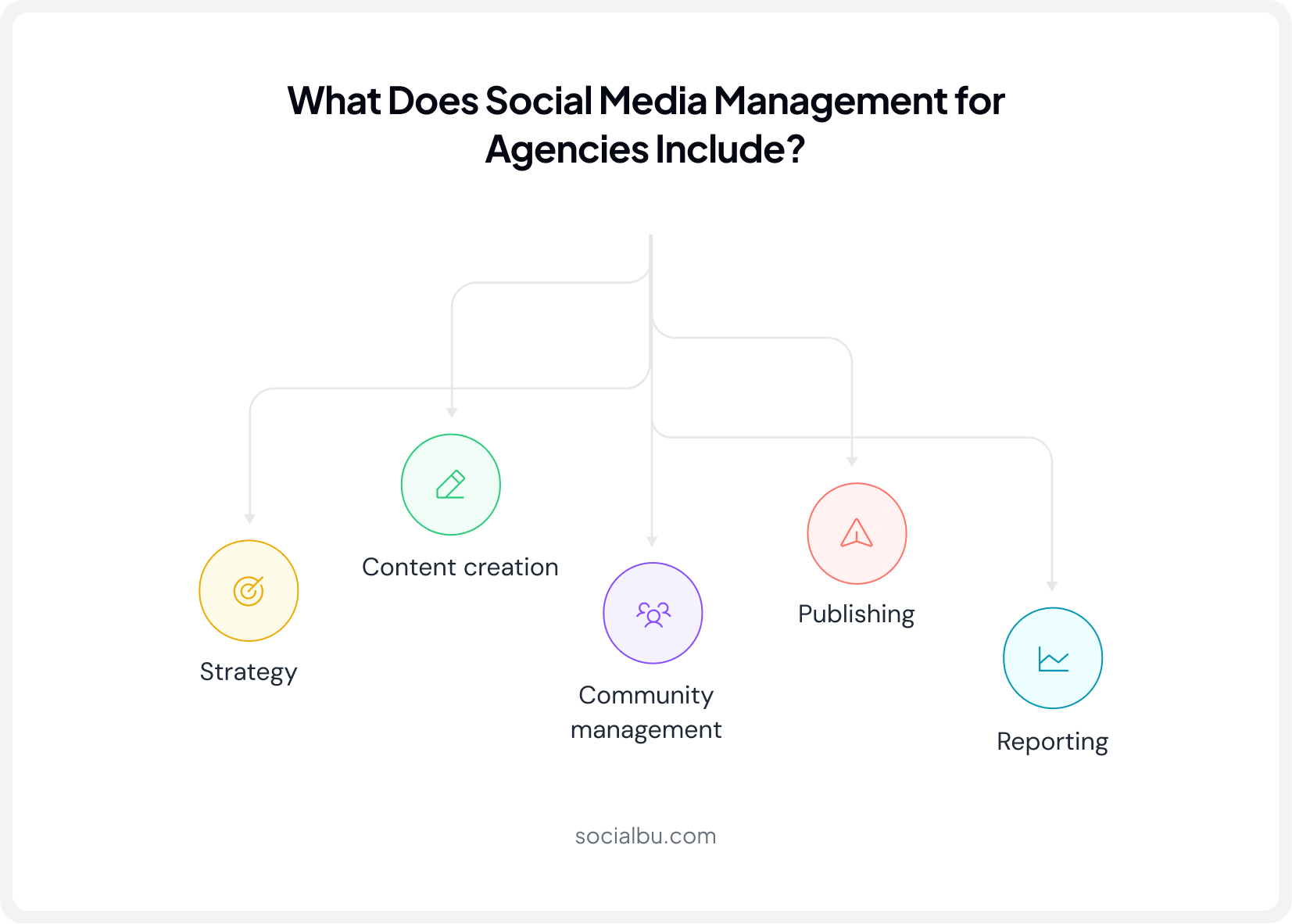
Let’s break them down.
1. Social Media Strategy and Planning
Every successful client relationship starts with social media strategy. Posting without a strategy creates activity. However, it does not create growth. Additionally, before creating content, agencies need to understand:
- Client goals
- Target audience
- Platform selection
2. Content Creation and Management
Social media content creation is one of the most visible parts of agency work. But great agencies know that content is not created randomly. Every post should have a purpose.
A balanced content strategy usually includes:
- Educational content
- Brand content
- Promotional content
- Engagement content
3. Social Media Publishing and Scheduling
Publishing content manually works when an agency has a few accounts. However, it becomes difficult when client numbers increase. Imagine managing:
- 15 Instagram accounts
- 10 LinkedIn pages
- 8 Facebook pages
Each account has different schedules, formats, and approval requirements. This is where social media management programs become valuable.
They help agencies plan content calendars, schedule posts, manage multiple accounts, reduce publishing mistakes, and keep campaigns organized.
 Next to Read: Social Media Publishing Checklist for Agencies (2026)
4. Community Management
Social media is not only about publishing. Instead, it is about conversations. Agencies also manage comments, direct messages (DM), brand mentions, customer questions, and community engagement.
For clients, this is often the part customers notice most. A delayed response can affect brand perception. A helpful response can build loyalty.
This is why many agencies treat community management as a core service instead of an extra task.
5. Analytics and Client Reporting
Clients do not only want content. They want proof that the work is creating value. A professional agency tracks reach, engagement, audience growth, website traffic, leads, and conversion tracking data.
However, reporting is not just about showing numbers. It is about explaining what those numbers mean and tracking social media publishing performance across every client account.
Related Guide: Reach And Impressions: Which One Matters More? Quick Comparison Managing Social Media In-House vs Working With a Social Media Management Agency
One of the biggest decisions businesses face is whether to build an internal social media team or partner with a social media management agency.
Ultimately, both options can work.
The right choice depends on the company’s goals, budget, available resources, and how complex its social media strategy needs to be. Understanding the difference helps businesses choose the approach that fits their growth stage.
In-House Social Media Team
- More control over content
- Better brand knowledge
- Direct team communication
- Quick access to company updates
- Requires multiple specialists
- Higher hiring and training costs
- Needs internal tools and processes
- Harder to scale with growth
Social Media Management Agency
- Access to skilled experts
- Ready-made workflows
- Strategy and content support
- Professional reporting
- No need to hire a full team
- Easy to manage multiple platforms
- Better scaling options
- Saves time and resources
Managing Social Media In-House
Building an in-house social media team means managing everything inside the company. The biggest benefit is control.
The team understands the brand, its customers, and its goals. They work closely with other departments and can quickly create content around company updates, launches, and campaigns.
However, effective social media management needs more than just posting. A complete team may need people for strategy, content creation, design, video editing, community management, and analytics.
This is why many companies explore other options, such as working with professional social media management companies.
Next to Read: How to Use an AI Social Media Manager to Run Social Media for Clients?Working With a Social Media Management Agency
A social media management agency helps businesses manage their online presence with an experienced team and proven workflows.
Instead, businesses can work with specialists who already understand strategy, content creation, publishing, engagement, and reporting. A business may start with one platform but later expand to LinkedIn, Instagram, Facebook, TikTok, and other channels.
For companies that want consistent content, better workflows, and expert support, working with social media management firms can be a good solution.
Which Option Is Better for Businesses?
There is no universal answer.
Large companies with strong marketing departments may prefer an in-house team because they already have the resources and need complete control over every part of their communication.
However, businesses that want professional execution without hiring multiple specialists often choose social media management firms.
It is the system behind the content.
The Biggest Problems Agencies Face When Scaling
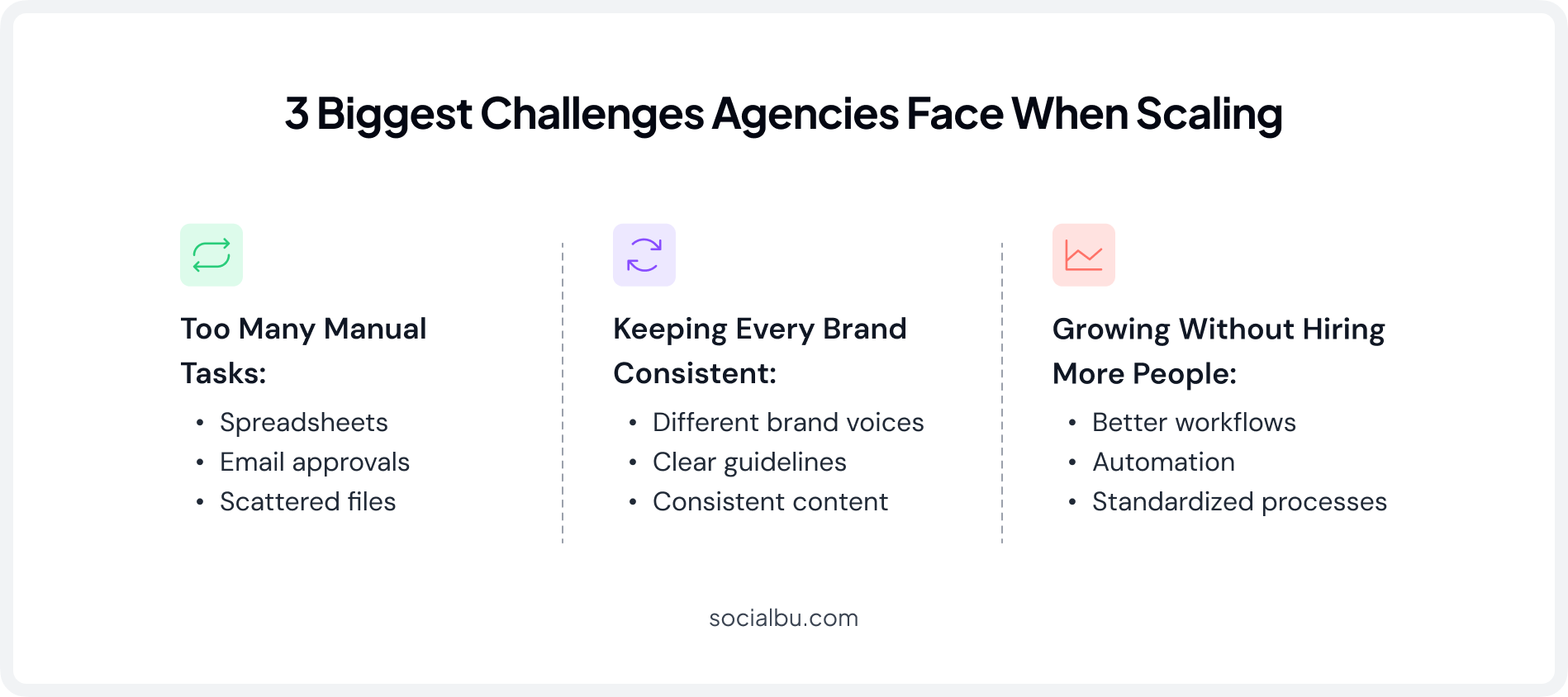
Scaling means growing your agency without creating more chaos. It means serving more clients, increasing revenue, and keeping the same quality without hiring a large team right away.
Growing from five clients to twenty is exciting. As a result, it also brings new challenges. Without the right systems, social media management for agencies becomes more difficult. This includes:
1. Too Many Manual Tasks
Most agencies start with simple tools. They use spreadsheets, Google Drive folders, email approvals, and browser bookmarks. These work well when there are only a few clients.
As the agency grows, these manual tasks take up more time. Team members search for files, follow up on approvals, and update spreadsheets every day. This slows down the entire workflow.
To scale successfully, agencies need simple processes that reduce manual work.
2. Keeping Every Brand Consistent
Every client has a different brand. A luxury brand should sound professional and premium. A startup may use a friendlier, more casual tone. A healthcare company needs clear and careful messaging.
Without clear guidelines, different team members may create content that feels different. As a result, clients may receive an inconsistent brand experience.
Every agency should create simple brand guidelines that include the client’s tone of voice, key messages, visual style, and content rules.
3. Growing Without Hiring More People
Getting more clients is only one part of growing an agency. The bigger challenge is serving those clients without increasing costs too much.
Ultimately, the goal is simple: serve more clients, deliver the same high-quality work, and run the agency more efficiently.
How Much Should Social Media Management Agencies Charge?
One of the most common questions for new social media management companies and agencies is: ‘How much should I charge for social media management?’
There is no fixed price. The right pricing depends on the client’s goals, business size, number of platforms, content needs, reporting requirements, and the level of strategy involved.
A small business focused on growth needing a few weekly posts will have different needs from a growing company. That is why successful social media agencies avoid simple pricing based only on the number of posts.
While rates vary by market and agency experience, the following benchmarks provide a useful starting point.
Small Businesses
$500-$1,000/month
- Content planning
- Post scheduling
- Basic reporting
- Manage 1–2 social platforms
Small to Medium Businesses
$1,000-$2,500/month
- Social media strategy
- Content creation
- Community management
- Analytics & multi-platform management
Growing Brands
$2,500-$5,000/month
- Multi-platform management
- Advanced reporting
- Campaign planning
- Video content & audience engagement
Enterprise Businesses
$5,000+/month
- Dedicated account manager
- Custom social strategy
- Large-scale content production
- Detailed reporting & ongoing optimization
These ranges are intended as industry benchmarks rather than fixed pricing.
Common Social Media Management Pricing Models
Most firms use a combination of these social media management pricing models:
1. Monthly Retainer Pricing
Monthly retainers are the most common pricing model for agencies because they provide predictable revenue and long-term client relationships.
2. Per-Platform Pricing
Some agencies charge based on the number of social media platforms they manage.
For example: Instagram management, LinkedIn management, and full multi-platform management.
However, agencies should avoid treating platforms as simple add-ons.
3. Project-Based Pricing
Project-based pricing works well for clients who need specific services before committing to ongoing management.
4. Tiered Package Pricing
Many agencies create different service packages to serve different types of clients.
Overall, a simple structure may include a starter package, growth package, and a premium package. Tiered packages make it easier for clients to buy and help agencies increase their average retainer value.
Next to Read: Top 17 Affordable Social Media Management Tools Reviewed in 2026The Social Media Management Workflow Agencies Need
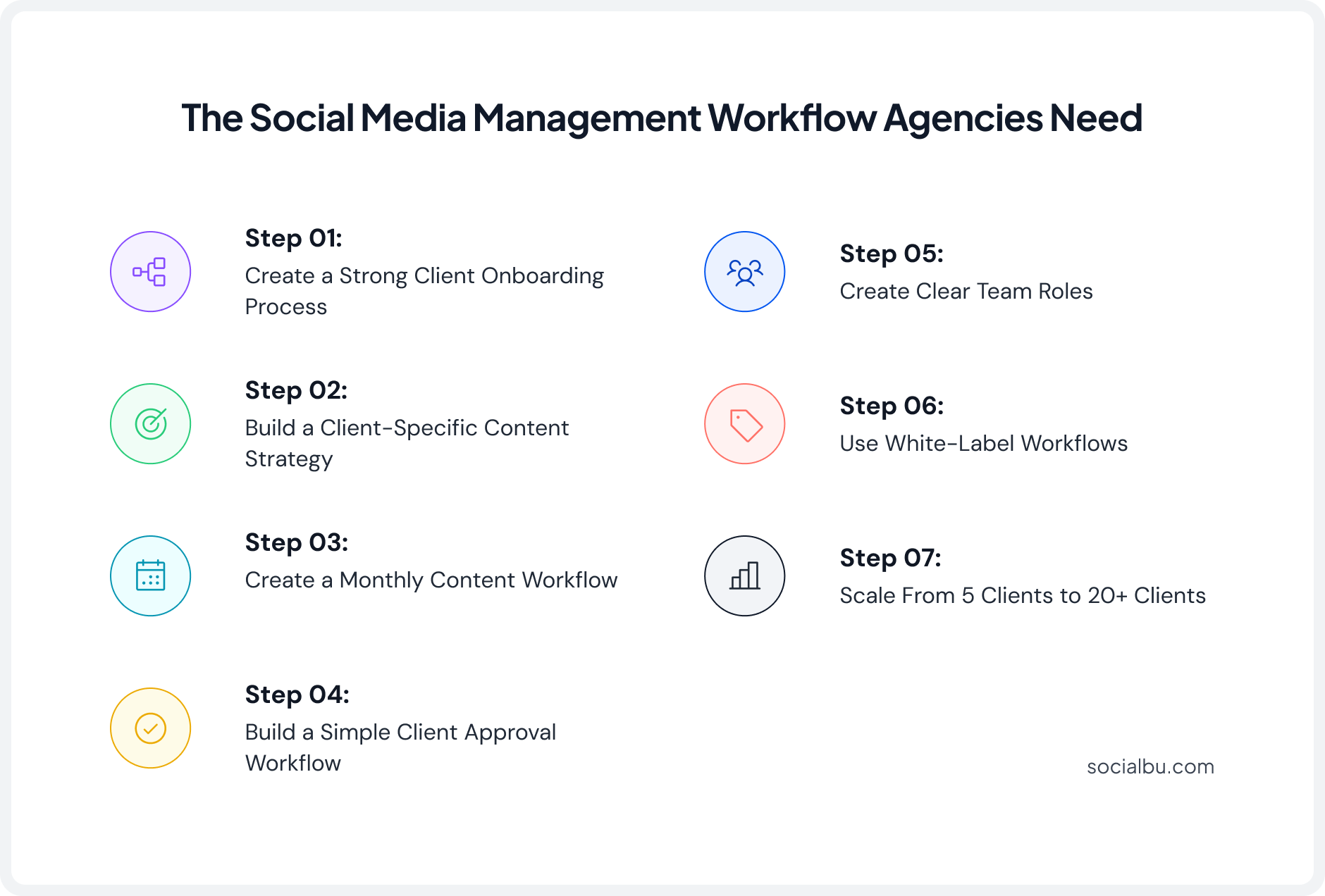
Growing an agency is not only about getting more clients. However, the real challenge is managing those clients without losing quality. A strong social media management workflow for agencies helps teams save time, reduce mistakes, and deliver better results.
Why Social Media Agencies Need a Defined Workflow?
Many agencies start with a simple process:
This works when you have one or two clients. However, as the agency grows. Suddenly, there are 10 different content calendars, multiple approval conversations, different deadlines, and several team members working on the same account. Without a proper system, growth creates confusion.
The problem is not a lack of talent. The problem is the lack of a repeatable workflow.
A successful social media management company builds processes that make every client account easier to manage.
Step 01: Create a Strong Client Onboarding Process
The first step of agency success happens before creating the first post. A weak onboarding process creates problems later. A strong onboarding process creates clarity from day one.
What Agencies Should Collect During Onboarding?
Before starting content production, agencies should understand:
-
Brand Information
Collect brand guidelines, logo files, visual preferences, brand colours, tone of voice, and previous content examples. Moreover, this helps the team create content that feels authentic.
-
Business Goals
Every client should have clear objectives. Ask:
- What does success look like?
- Are you trying to generate leads?
- Increase awareness?
- Build community?
- Drive sales?
Without clear goals, social media becomes a publishing task instead of a marketing strategy.
-
Audience Information
Agencies need to understand ideal customers, customer problems, buying behavior, common questions, and industry trends. Whereas the best content starts with audience understanding.
-
Platform Access and Responsibilities
During onboarding, define which platforms are managed. Ask about:
- Approval owner. Asset provider. Primary agency contact
This prevents confusion later.
Step 02: Define the Scope of Work Before Content Creation
A successful onboarding process should always end with a clearly defined scope of work. This document sets expectations for both the agency and the client before any content is created.
In addition, a well-defined scope of work should answer questions such as:
- Which social media platforms will the agency manage?
- How many posts will be published each month?
- Are Stories, Reels, Shorts, or videos included?
- Will the agency handle community management and direct messages?
- Are paid social campaigns included or limited to organic content?
- How often will performance reports be shared?
- Who is responsible for providing product photos, videos, and brand assets?
- How many revision rounds are included before additional charges apply?
Documenting these details early helps both parties understand exactly what is included in the service and reduces misunderstandings later.
Next to Read: How to Automate Social Media Content Creation with AIStep 03: Build a Client-Specific Content Strategy
Every client should have a documented strategy before content creation begins. A strategy gives the team direction. Without it, content becomes random. A good social media strategy includes:
- content pillars, brand voice guidelines, and platform-specific Strategy.
Step 04: Create a Monthly Content Workflow
A simple content workflow helps the team stay organized.
- In the first week, the team focuses on research and planning. They review past performance, upcoming campaigns, social media trends, and important dates. This helps create a better content strategy.
- In the second week, the team creates content. Writers prepare captions, designers create visuals, and video editors produce short videos and other content formats.
- The third week is for client review. Content is sent for approval, feedback is collected, and changes are made.
- In the fourth week, approved content is scheduled across social media platforms. The team then prepares for the next cycle.
This process creates a repeatable system and makes multi-client management easier.
Next to Read: 5 Client Workflow Hacks for Small Agencies Managing Multiple AccountsStep 05: Build a Simple Client Approval Workflow
Meanwhile, client approvals can slow down via email, WhatsApp messages, and various documents. Agencies still manage approvals through emails, WhatsApp messages, and different documents. This creates confusion and delays.
A better content approval workflow defines clear roles:
- Who creates the content?
- Who reviews it?
- Who approves it?
- Who publishes it?
Agencies should also set approval deadlines. For example, clients should approve content by Friday if it needs to go live the following week.
Feedback should stay in one place.
Step 06: Create Clear Team Roles
Many growing agencies struggle because everyone handles everything. This works with a few clients but becomes difficult as the agency grows. Whereas, a scalable social media agency needs clear roles:
- A social media strategist manages the marketing strategy, audience research, and campaign planning. They decide what content the brand needs and why.
- A content creator or copywriter creates captions, post ideas, and stories that match the brand voice.
- A designer and video editor create graphics, templates, and videos. They help maintain brand consistency across different platforms.
- A community manager handles comments, messages, and customer conversations. They help improve engagement and brand reputation.
- An account manager manages client communication, meetings, feedback, and expectations.
- A reporting specialist tracks analytics, social media ROI, and performance data. They turn results into useful recommendations for clients.
Step 07: Use White-Label Workflows
Many agencies offer white-label social media management for other businesses. This allows one company to provide social media services under its own brand while another team handles the work.
This model is common among marketing agencies, web companies, and consulting firms.
A good white-label workflow needs organized files, clear processes, branded reports, and smooth communication. The client should always get a professional experience, even when multiple teams work behind the scenes.
Step 08: Scale from 5 Clients to 20+ Clients
Getting more clients is exciting. But managing them successfully is the real challenge. However, agencies that scale well improve their systems before hiring more people.
First, create templates for common tasks. Next, automate repetitive work. Finally, review performance regularly to improve future campaigns.
Next to Read: Social Media Team Collaboration: Add Team Members Without Sharing PasswordsChoosing the Right Social Media Management Software for Your Agency
The best social media management tools for agencies are not just publishing platforms.
Instead, they are complete workflow systems that help agencies manage multiple clients, collaborate with teams, collect approvals, schedule content, monitor conversations, and report results from one place.
How Agencies Should Choose Social Media Management Software?
The best social media management tool for agencies depends on the agency’s size, clients, and workflow. Before choosing software, ask:
- How Many Clients Do You Manage?
- Do Clients Need Access?
- Do You Need White-Label Reporting?
- Does the Tool Support Your Platforms?
Further Reading: A Step-by-Step Social Media Management Checklist in 2026What Should Agencies Look For in Social Media Management Software?
Not every social media management tool for agencies is built for agency needs. A tool that works for a single creator may not work for a team managing 20+ clients.
Whereas the right social media management software for agencies should make work easier, reduce manual tasks, and help teams deliver better results for every client.
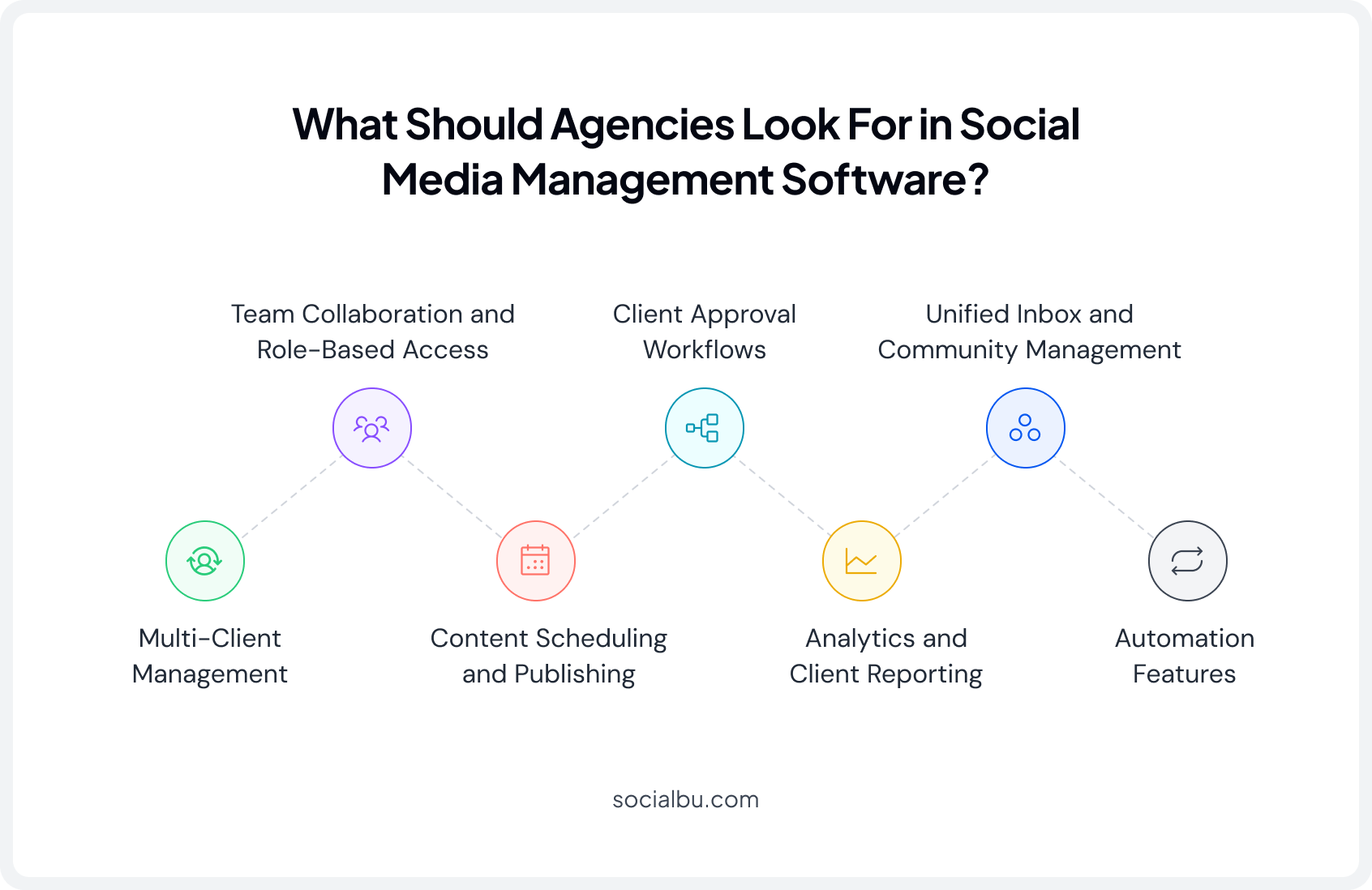
1. Multi-Client Management
Instead of switching between dozens of social accounts, agencies should be able to manage every client from a single dashboard. This reduces mistakes, saves time, and keeps work organized.
Tools like SocialBu help agencies manage multiple social media accounts, schedule content, and keep client work organized from one dashboard.
2. Team Collaboration and Role-Based Access
As agencies grow, different people handle strategy, writing, design, approvals, and reporting. Team collaboration and Role-based access help everyone work together without confusion.
3. Content Scheduling and Publishing
A scheduling tool helps agencies plan content in advance, schedule multiple client posts consistently, and manage multiple platforms from one place.
4. Client Approval Workflows
A built-in approval workflow keeps feedback in one place and makes it easier to move content from draft to publication without endless email chains.
Whereas a good approval workflow should follow a simple process:
This allows everyone to see what stage each post is in.
5. Analytics and Client Reporting
Reporting should do more than display numbers. It should help agencies explain results, identify trends, and recommend the next steps to clients.
6. Unified Inbox and Community Management
A unified inbox brings comments, mentions, and direct messages together, allowing teams to respond faster and manage conversations more efficiently.
7. Automation Features
Automation reduces repetitive work like scheduling posts, sending approval reminders, and generating reports, giving teams more time to focus on strategy and creativity.
Overall, by automating routine tasks, agencies can manage more clients without increasing workload.
There are many social media management platforms available, and the right choice depends on your agency’s size, workflow, and client needs.
Related Guide: 14 Best Social Media Automation Tools in 2026 (Tried & Tested)Social Media Management Tools vs Complete Agency Platforms
Not all tools solve the same problem. Some platforms focus mainly on scheduling. Others focus on analytics. Others provide complete agency workflows.
A complete agency platform should connect:
The fewer disconnected tools your team uses, the easier it becomes to maintain consistency.
Where SocialBu Fits Into Agency Workflows
For agencies, the biggest challenge is usually not creating content. Moreover, it is managing everything around the content. SocialBu helps agencies bring important workflow steps together:
- Managing multiple social accounts
- Scheduling posts
- Collaborating with teams
- Organizing content
- Tracking performance
As a result, instead of managing separate systems for publishing, collaboration, and reporting, agencies can create a more connected workflow.
Managing More Clients Shouldn’t Mean More Chaos
SocialBu brings planning, approvals, scheduling, collaboration, and reporting in one place, helping your team stay organized and deliver better results.
Final Thoughts
Overall, social media management for agencies is not just about creating content and scheduling posts. It is about building an operating system for client success. The agencies that grow in 2026 will not simply be the ones creating the most content.
They will be the ones that create better systems.
FAQs
Q: What does social media management for agencies include?
A: It includes planning, creating content, scheduling posts, managing comments and messages, and tracking results. However, agencies also handle client approvals and reports.
Q: What tools do agencies use to manage multiple clients?
A: They use social media management tools. These help with scheduling, approvals, teamwork, reports, and managing many accounts. SocialBu is one example.
Q: How do agencies manage client approvals?
A: They use a simple process:
Draft → Review → Client Approval → Schedule → Publish
This keeps work clear and organized.
Q: What’s the difference between in-house and an agency?
A: An in-house team works inside the company and gives more control.
An agency brings experts, ready systems, and is easier to scale.
Q: How do agencies organize their teams?
A: Most agencies have:
- Social media strategist
- Content writer
- Designer or video editor
- Community manager
- Account manager
- Reporting specialist
Each person has a clear role.
Q: How do agencies grow without hiring more people?
A: They use templates, automation, and clear workflows. This saves time and helps manage more clients.
Q: What should a social media proposal include?
A: It should include:
- Services
- Platforms
- Number of posts
- Reports
- Approval process
- Timeline
- Client responsibilities
- Pricing
Q: How do agencies show social media ROI?
A: They track reach, engagement, followers, website traffic, leads, and conversions, which help them understand what the results mean.
Q: What’s the best social media management software for agencies in 2026?
A: The best tool should support multiple clients, scheduling, approvals, reports, teamwork, and automation. SocialBu is one option that offers these features.