A social media content calendar is your forward-looking guide for everything you post on your social media platforms, including what goes live, where, in what format, and when.
It replaces reactive posting with a clear, repeatable workflow that keeps your content consistent and your strategy on track.
Here is something worth knowing before you read further. Based on SocialBu platform data from May 2026, the top 10% of publishers account for 84% of all published content.
These are not casual users. They are agencies, professional managers, and in-house social teams running structured content operations. This guide is built for that level of intention, whether you are already there or building toward it.
It covers everything: how to build your social media calendar from scratch, set your content pillars, and choose your posting routine.
👉 Free Social Media Content Calendar Template
Download our free social media content calendar template to help you plan, organize, and manage your entire month’s social media content on the go.
No spam. Unsubscribe anytime.
What Is a Social Media Content Calendar?
A social media content calendar is a forward-planning system or overview that maps out your upcoming social media posts across all platforms in one place. It shows you:
- What content is going live
- On which platform
- In what format
- And at what time
Here’s what it looks like:
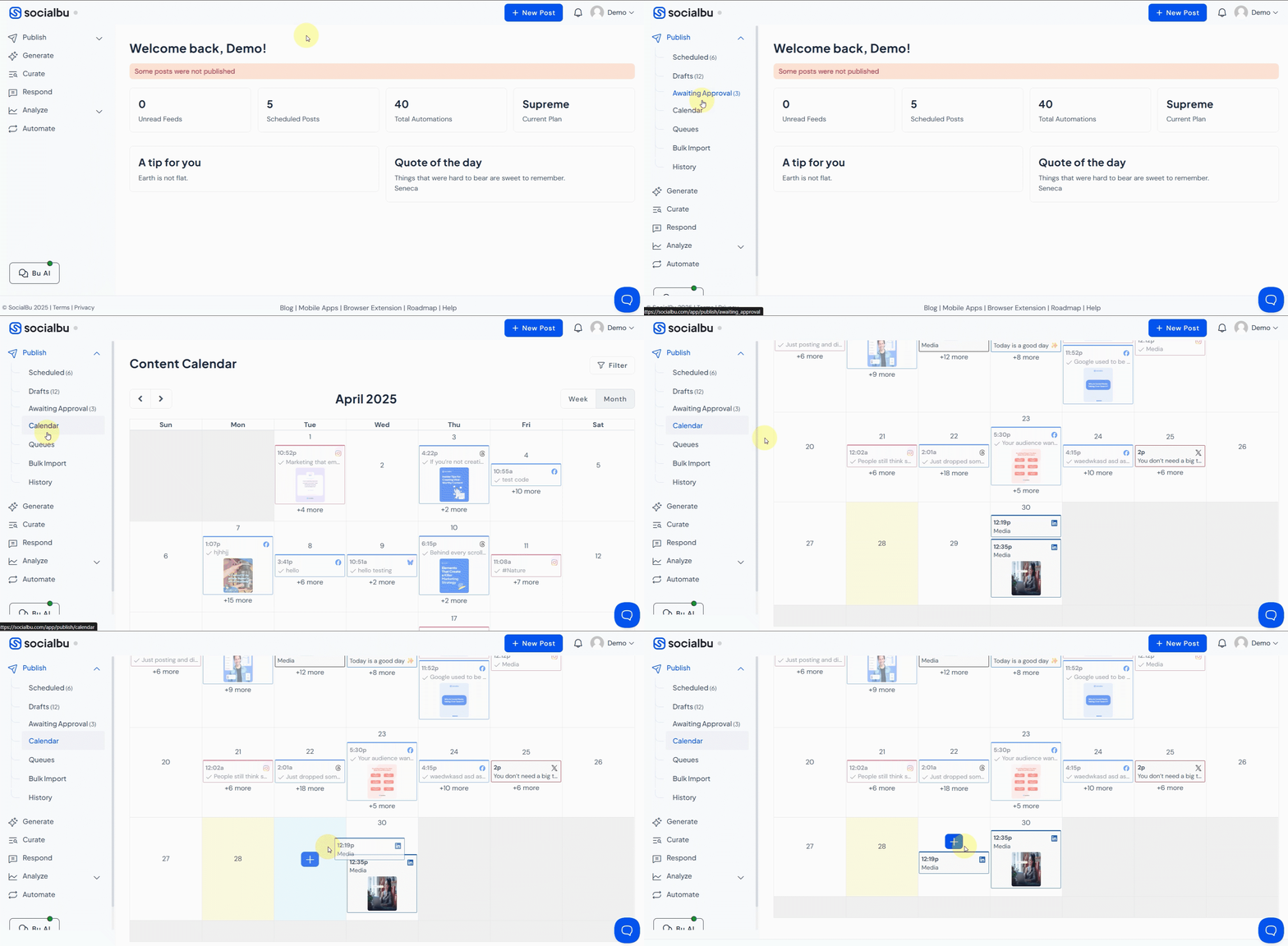
It is organized by day, week, or month and is your editorial command center. Instead of deciding what to post the morning it needs to go live, you plan it days or weeks in advance. What that means is better content, less stress, and a content strategy that actually holds together.
You can build a social media calendar using platforms such as Google Sheets, Notion, Canva, digital calendar templates, or a social media scheduling platform like SocialBu.
What Should Be Included in a Social Media Calendar?
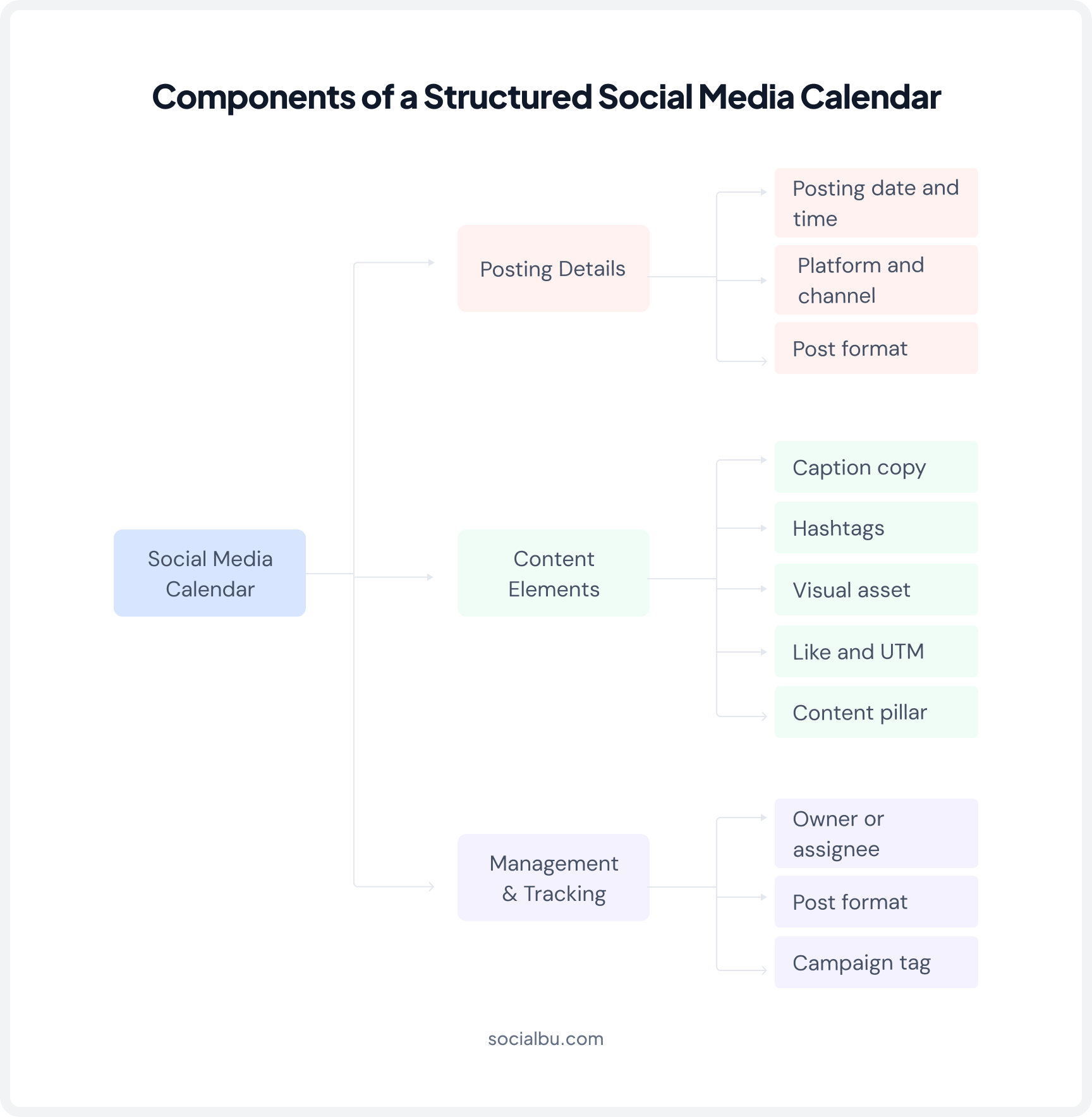
Your well-built, organized content calendar for social media must include these core columns or fields:
- Posting date and time: When the content goes live
- Platform and channel: Instagram, LinkedIn, TikTok, Pinterest, X, YouTube Shorts, Facebook, Threads
- Post format: Reel, carousel, static image, video, Story, Live, thread
- Caption copy: The full post copy or a working draft
- Hashtags: Researched and ready to paste
- Visual asset: Image, video file, or design link
- Link and UTM of campaigns: Destination URL with tracking parameters if applicable
- Owner or assignee: Who is responsible for this piece of content
- Post status: Draft, in review, approved, scheduled, or published
- Campaign tag: Which campaign or push does this content belong to
- Content pillar: Which content category or theme does this post fall under
These are the pillars of a social media content calendar. This matters more than most guides acknowledge.
“Based on SocialBu platform data from May 2026, 68.5% of active publishers manage content across 2 or more distinct networks, and nearly 1 in 3 manage 4 or more simultaneously.
A content calendar without a dedicated platform column is not a content calendar; it is a caption list. The platform column is what separates a planning document from a publishing system.”
However, you do not need to use every column from day one. Start with date, platform, format, copy, and status. And add the rest as your process matures, and your content output grows.
Why Do You Need a Social Media Content Calendar?
Here is why you must have a social media content calendar to maximize your growth and get clarity throughout the process.
1. Improve Posting Consistency
Consistency is the single biggest driver of social media growth.
“Based on SocialBu platform data from May 2026, nearly 70% of active publishers are scheduling 4 or more posts per week.
Only 30% are in the 1-3 range that most beginner guides recommend as a starting point.”
If your content calendar only plans 3 posts a week, you may already be underpowering your strategy compared to what consistent publishers are actually doing.
But consistency is hard to maintain when you are deciding what to post on the day it goes live.
A content calendar solves this problem. You plan your posting in advance and fill the slots with real content. After that, you use social media scheduling tools like SocialBu to automatically publish everything: a smooth, consistent schedule to follow.
2. Time Savings Through Content Batching
Content batching is the practice of creating multiple pieces of content in a single, focused session rather than producing them one by one, day by day.
With a content calendar in place, you can sit down once a week or once a month, plan your content themes, write your captions in bulk, gather your visuals, and schedule everything in one go.
3. Alignment with Marketing Goals and KPIs
Random content does not drive results. Every post you publish should connect to a goal, whether that is brand awareness, website traffic, lead generation, or product conversions. A social media content calendar forces that alignment.
Before a post goes into the calendar, you decide what goal it serves, which content pillar it belongs to, and how it fits into your broader marketing strategy. Over time, this intentional approach produces far better results than posting whatever feels right in the moment.
4. Effortless Team and Client Collaboration
“SocialBu’s users on team plans publish nearly 7x more content per week than those on solo plans, 54 posts on average versus 8.”
That gap is not a coincidence. It reflects what happens when a structured workflow, a shared calendar, and a clear workflow approval process replace individual guesswork. (Based on SocialBu platform data from May 2026)
Scale requires process, and process requires a system that everyone can see and work inside.
Without one, content gets lost in Slack threads, clients give feedback on outdated drafts, and posts go live that were never properly reviewed. With a shared content calendar, everyone in your team knows what is planned, who owns what, and what stage each piece of content is in.
5. Better Content Quality Through Planning Ahead
When you are not panicking about what to post today, you have time to think about what to post well. A content calendar gives you that thinking room.
You can plan themed content weeks in advance and align posts with upcoming campaigns or product launches. Moreover, you can build in seasonal content and marketing holidays for the year, creating a consistent narrative across your platforms rather than a disconnected stream of one-off posts.
6. Easier Content Repurposing
Your best content should not live and die in a single format on a single platform. A content calendar makes it easy to track what performed well and plan how to repurpose content across formats and channels.
A LinkedIn carousel becomes an X thread. A high-performing Instagram Reel gets repurposed as a YouTube Short. A blog post becomes 2-3 educational LinkedIn posts.
When you can see your entire content pipeline in one view, you can easily spot content repurposing opportunities in one view.
How to Create a Social Media Content Calendar: Step-by-Step Guide
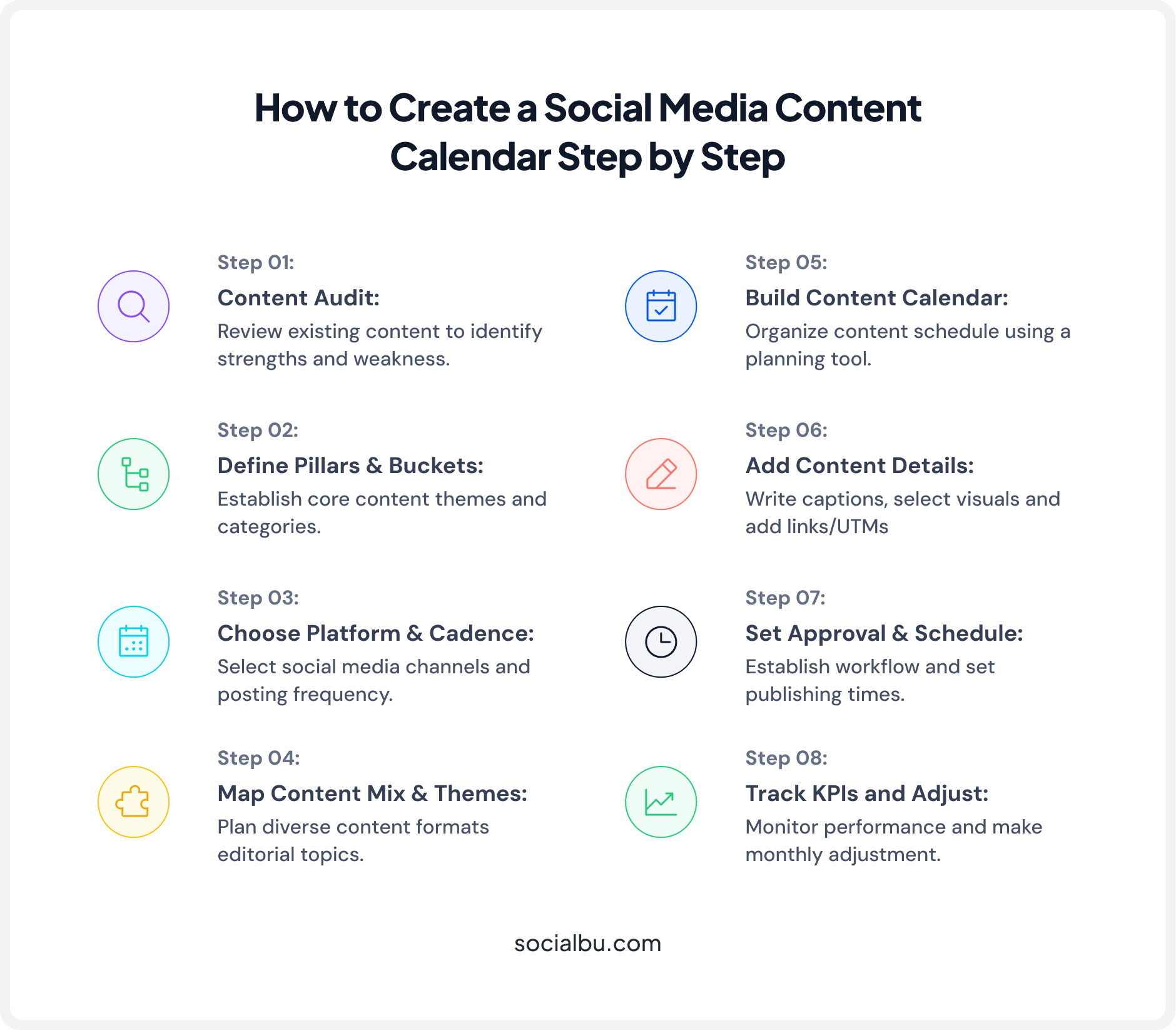
Now, let’s move to the main part. Here is the exact process to build a successful social media content calendar that works, whether you are starting from scratch or replacing a system that has stopped serving your business goals.
Steps Overview
Step 1: Run a Quick Content Audit First
Step 2: Define Your Content Pillars and Content Buckets
Step 3: Choose Your Platforms and Set Your Posting Cadence
Step 4: Map Out Your Content Mix and Editorial Themes
Step 5: Build Your Content Calendar Using the Right Tool
Step 6: Add Your Content: Captions, Visuals, Links, and UTMs
Step 7: Set Up Your Approval Workflow and Publishing Schedule
Step 8: Track Your KPIs and Adjust Monthly
Step 1: Run a Quick Content Audit First
Before you plan anything new, look at what you already have. Your social media content audit does not have to be complicated.
Pull your last 30 to 60 days of posts and ask three questions:
- Which posts got the most engagement and why?
- Which content types (Reels, carousels, static images, threads) performed best on each platform?
- Which topics or themes resonated most with your audience?
The answers tell you what to do more of, what to stop doing, and what content gaps exist in your current content mix. This is your baseline before you build the new calendar.
Step 2: Define Your Content Pillars and Content Buckets
Content pillars are the core themes or topics your brand consistently creates content around. They give your calendar structure and ensure your content mix is balanced, relevant, and on-brand.
Most brands work with 3 to 5 content pillars.
For example, here at SocialBu, our top social media content pillars are the following:
- Education: Industry tips, how-tos, and platform updates.
- Product-specific: Feature highlights, tutorials, and use cases.
- Community: User-generated content, customer stories, and Q&As.
- Inspiration: Industry insights and thought leadership.
- Promotion: Offers, free trials, and campaign-specific content.
Once your pillars are defined, assign them to days of the week. For example, Monday is for education, Wednesday is for product, and Friday is for community. This gives your calendar a rhythm and prevents you from accidentally posting five promotional pieces in a row.
Content buckets are the subcategories within each pillar.
Under “Education,” your buckets might include scheduling tips, platform algorithm updates, content strategy advice, and tool tutorials. Content buckets give you a ready-made list of content ideas to pull from when you sit down to plan.
Step 3: Choose Your Platforms and Set Your Posting Cadence
Not every platform is right for every brand, nor do they perform the same. The goal is not to be everywhere. It is to be consistent with where your audience actually spends time.
Choose 2 to 4 platforms based on where your target audience is most active. Then set a realistic posting frequency for each one.
SocialBu platform data from May 2026 shows where social media managers are actually publishing, and you can follow the same cadence.
- Facebook Pages: ~325K posts across 1,004 users, the highest volume platform
- Instagram: ~72K posts across 1,024 users: most users, lower per-account volume
- X/Twitter: ~87K posts across 490 users: highest average per user after Facebook
- LinkedIn: ~44K posts across ~600 users
- TikTok: ~21K posts, 487 users
- Bluesky: 133 users, 41K posts: 312 posts per user average (standout finding)
Step 4: Map Out Your Content Mix and Editorial Themes
Your content mix is the ratio of different content types and purposes in your calendar.
A commonly used content mix framework is the 80/20 rule: 80% value-driven content (educational, entertaining, community) and 20% promotional content.
For social media managers and agencies, a more granular mix works better:
- 40% educational content
- 25% engagement content (polls, questions, UGC)
- 20% brand or product content
- 15% promotional content
Alongside your regular content mix, map out your editorial themes for the month. These are campaign-level themes tied to seasonal content, marketing holidays, product launches, or awareness days.
For example, a social media management brand might plan content around Social Media Day (June 30), Black Friday campaigns in November, or a new feature launch in Q2.
Having these themes in your calendar before the month starts means you are always on time to produce content. No last-minute confusion exists.
 Also Read: How to Build Solid Content Guidelines: A checklist to help you map out your content consistently with clear guidelines.
 Step 5: Build Your Content Calendar Using the Right Tool
You have several options for where to build and manage your content calendar. Each one serves a different type of team or workflow.
1. Google Sheets
It is the most accessible starting point. It is free, shareable in real time, and fully customizable. Build columns for each calendar component listed earlier and color-code them by platform or content pillar. It’s best for individuals and small teams working with a modest volume of content who need a simple, cost-free planning tool.
Why is it good?
- Custom Templates: Create your own calendar layout with columns for dates, platforms, captions, media links, etc.
- Real-Time Collaboration: Share with your team and edit together.
- Link Media and Resources: Insert links to images, videos, and scheduled posts.
- Color-Coding & Filters: Organize content by platform, post type, or status using filters or colors.
2. Excel
It works the same way as Google Sheets but is better for teams that work offline or prefer Microsoft’s ecosystem. A free social media calendar template in Excel lets you get started without having to build from scratch.
3. Notion
It is a strong option for teams that want a more visual, database-style calendar. You can toggle between board view, calendar view, and table view. Moreover, you can add rich context to each post, including notes, links, and embedded files. The Notion social media content calendar template with AI includes dozens of ready-made options.
4. Airtable
It works well for agencies managing content across multiple brands simultaneously. Its database structure lets you filter, sort, and group content by client, platform, pillar, or status, all within a single workspace.
5. Trello
This is useful if your team prefers a kanban-style board to track content through production stages: idea, in progress, in review, approved, scheduled, and published.
6. SocialBu: All-In-One Social Media Scheduling Tool
This is the step up from all of these. You don’t have to plan your calendar in a spreadsheet and then switch to a separate tool to schedule and publish.
SocialBu combines your content calendar, scheduling, automation, analytics, and team collaboration into a single dashboard. You can drag and drop posts on a visual calendar, schedule across 12 platforms simultaneously, and track performance without leaving the platform.
Spreadsheet templates are a good starting point. But they do not schedule your posts. They do not track performance. And they do not support team approval workflows in any meaningful way. Moreover, they require you to manually transfer content into a separate tool every time you want to publish.
But SocialBu’s visual content calendar eliminates all of that. You plan, write, schedule, and publish from a single dashboard.
Moreover, you can drag and drop posts to reschedule them. You can bulk upload an entire month of content at once. And your analytics feed directly back into the same view where you planned the content.
Why Is It Great?
- Visual Calendar View: Easily drag-and-drop posts to schedule them by date and time.
- Auto-Scheduling: Schedule posts in advance across platforms like Instagram, Facebook, LinkedIn, X (Twitter), and more.
- Automation: Set up automated replies, reposts, or content triggers—perfect for saving time.
- Built-In Analytics: Track post performance and audience engagement and see what’s working.
- Team Collaboration: Assign roles, review drafts, and approve content before it goes live.
- Media Management: Upload and manage images/videos directly inside the platform.
SocialBu is especially helpful if you’re managing multiple accounts or need everything like calendar, automation, and analytics in one dashboard.
Ideal for businesses, social media managers, and content creators who want a smooth, streamlined workflow. Upgrade from spreadsheets and let a single tool handle everything on the go.
The relationship between the tools you use and the content you produce is not theoretical.
Based on SocialBu platform data from May 2026:
- Free plan users post an average of 8 posts per week.
- Standard plan users average 17.
- Supreme plan users post an average of 115 posts per week.
- Super plan users: SocialBu’s highest-volume segment, averaging 193 posts per week.
The system you build directly determines the output you can sustain. A content calendar is where that system starts.
Ready To Post Consistently On Social Media?
Step 6: Add Your Content: Captions, Visuals, Links, and UTMs
When your calendar structure is in place, start filling it with actual content. Work at least one to two weeks ahead so you always have a buffer.
For each post, include:
- A complete caption draft (not just a topic idea)
- The visual asset or a placeholder linking to the design file
- The destination URL with UTM parameters if the post drives traffic
- The hashtag is set for that platform and post type
The more complete each entry is before it gets scheduled, the smoother your publishing workflow becomes.
Step 7: Set Up Your Approval Workflow and Publishing Schedule
For solo creators, this step means reviewing your content before scheduling it and ensuring each post aligns with your brand voice and goals.
For teams and agencies, this step is important.
Define your review stages clearly:
- who writes the first draft,
- who reviews it,
- who gets the client or leadership sign-off,
- and who hits publish.
Every post should move through defined stages before it goes live.
SocialBu supports multi-stage approval workflows. This means you can move posts from draft to in review to approved without anyone needing to chase down feedback over email or Slack.
Once approved, schedule posts in advance using SocialBu’s publishing and scheduling feature, which publishes at the optimal time for each platform based on your audience’s activity data.
Step 8: Track Your KPIs and Adjust Monthly
A content calendar is not a set-it-and-forget-it system. At the end of every month, review what worked and what did not.
Key metrics to track:
- Engagement rate by post type and platform
- Reach and impressions
- Website clicks and UTM-tracked conversions
- Follower growth
- Top-performing content pillars
👉 Free Social Media Content Calendar Template
Download our free social media content calendar template to help you plan, organize, and manage your entire month’s social media content on the go.
No spam. Unsubscribe anytime.
How Do Content Pillars Fit Into a Social Media Calendar?
As mentioned earlier, content pillars are the foundation of a well-structured social media content calendar. Without them, your calendar is just a list of posts. With them, it is a strategic content engine with a clear purpose and focus behind every piece of content.
Here is how to build your content pillar framework and plug it into your calendar.
Content Pillar Example for Social Media Managers
If you manage social media for brands or clients, your content pillars might look like this:
Content Pillar | Purpose | Example Content |
Education | To build authority and trust | How to write captions that convert? |
Behind the Scenes | To humanize the brand | A day in the life of a social media manager. |
Client Results | To give social proof | Client metrics, before/after case studies |
Industry News | To stay relevant | Platform algorithm updates, new features |
Engagement | To build a loyal community | Polls, ‘this or that,’ audience questions |
Assign each pillar to specific days in your weekly planner. This gives your audience a predictable rhythm and prevents your content from feeling random.
Content Pillar Example for Creators and Freelancers
We have seen creators and freelancers often benefit from a more personal content pillar structure:
Content Pillar | Purpose | Example Content |
Expertise | To establish credibility | Tips, tutorials, frameworks |
Personal Story | To build connections | Your journey and lessons learned |
Services or Offers | To drive leads | What you do, how to work with you |
Community | To grow your audience | Shares, collaborations, UGC |
Trending Content | To increase reach | Trending audio, format, or topic tie-ins |
The goal is the same: every piece of content serves a defined purpose tied to a pillar, and your calendar reflects a balanced mix of all five throughout the month.
How to Build a Social Media Calendar for Your Specific Use Case
Your social media content calendar looks different depending on how you work. Here is how to adapt it for three common scenarios.
1. Social Media Calendar for Small Businesses
Small businesses often have limited time and resources. The key is to keep the calendar simple enough to actually use.
Start with 2 platforms maximum. Plan 3 posts per week per platform. Use a monthly social media calendar template with a simple weekly planner view to see the full month without feeling overwhelmed.
Focus your content pillars on Education, Product, and Community. Batch your content creation on one day per week, ideally Monday or Friday, so you never spend time mid-week looking for ideas.
2. Social Media Calendar for Agencies Managing Multiple Clients
The data makes the case for agencies plain.
Based on SocialBu platform data from May 2026, publishers managing a single platform post a median of 7 times per week. Those managing 7 platforms post a median of 26 times per week, nearly 4x the volume. Managing more platforms does not just add posts linearly. It multiplies them.
At that output level, a shared spreadsheet is not a content calendar. It is a liability.
To achieve the most effective agency workflow, use a dedicated social media scheduling tool like SocialBu. You can have a separate workspace for each client, with its own content calendar and approval workflow. Your team can work across all client accounts from a single dashboard without logging in and out or mixing up content.
For each client calendar, build a content pillar framework before you plan any content. Get the client sign-off on the pillars first, then fill the calendar. This prevents constant revision cycles and aligns your team and the client on strategy before the actual execution.
3. Social Media Calendar for Freelancers and Solo Creators
As a freelancer or creator, your content calendar needs to serve two purposes: managing your personal brand content and, if relevant, managing content for your clients.
For your own brand, keep a simple weekly social media planner. Plan 5 to 7 posts per week across your primary platforms, batch create content in one session, and schedule everything through SocialBu so your personal content runs on autopilot while you focus on client work.
For client content, treat each client as a separate workspace and follow the agency approach above.
How Does AI Fit Into Your Social Media Calendar Workflow?
AI tools have become an essential part of the modern content calendar process in 2026.
Among SocialBu’s active publishers, roughly 1 in 5 have already integrated the built-in AI writing tool into their content calendar workflows, according to SocialBu platform data from May 2026.
That means 4 in 5 users are still writing every caption manually.
At 4 to 7 posts per week across multiple platforms, it is a significant time commitment that compounds every week. AI in a content calendar workflow is not about replacing your voice. It is about removing the blank-page problem so you spend your time editing and refining rather than starting from zero.
Here is where AI actually helps in a social media content calendar workflow:
1. Content ideation
AI tools can generate topic ideas, captions, and post hooks based on your content pillars and audience. Use them to fill your idea bank when you are stuck, not to replace original thinking.
2. Caption drafts
AI can produce a working first draft of a caption or even the final one in seconds. However, you still need to edit for brand voice, add specific details, and make it sound human. But starting from a draft is faster than starting from a blank page.
3. Content repurposing
AI content repurposing tools can help you adapt a LinkedIn post into an Instagram caption or turn a list of tips into a Twitter thread, saving significant time when you are cross-platform posting from a single idea.
4. Content batching support
When you sit down to batch-create a month of content, AI can help you generate multiple variations of similar posts so your feed does not feel repetitive.
However, AI cannot define your strategy, develop your brand voice, or understand your specific audience. The calendar, the content pillars, the posting schedule, and the creative direction all still need a human behind them, which we all must use every time.
Create Engaging Social Media Posts Now With Our Free AI Content Generator
What are Some Common Social Media Calendar Mistakes to Avoid?
Even with a content calendar in place, these mistakes quietly undermine your results.
1. You plan too far ahead without flexibility
A calendar planned 8 weeks out with no room to pivot means you will miss trending moments, breaking news, and real-time opportunities that your audience actually cares about. Plan 2 to 4 weeks ahead for core content, and leave 15 to 20% of your weekly slots open for timely or reactive content.
2. You skip the content pillar framework
Without pillars, your content mix becomes random. Three product posts in a row, followed by a meme, then a sales pitch, do not build a coherent brand story. Define your pillars before you fill a single date in your calendar.
3. You use the same format across all platforms
A caption written for LinkedIn does not fit and perform well on Instagram. An Instagram Reel script does not translate directly into a TikTok script. Each platform has its own language, format expectations, and target audience behavior. Your content calendar should flag which format each post uses and what platform-specific adaptations are needed.
4. You build the calendar but never review it
A calendar without a monthly review is just a to-do list. Set a recurring monthly session to review your KPIs, identify what content types and pillars are performing, and use those insights to improve next month’s plan.
5. You set no approval workflow for team or agency content
Skipping the review stage is how posts with typos, off-brand messaging, or factually incorrect claims go live. Even a simple one-step review before scheduling makes a significant difference.
6. You treat the calendar as a content idea list, not a production system
The social media calendar must contain complete content, not just topic ideas. If a post slot says ‘write something about Instagram Reels,’ it is not calendar-ready. It needs a written caption, a visual, a platform, a time, and a status. Incomplete entries create the same last-minute rush you built your social media content calendar to avoid.
Automate Your Social Media Posting Now!
Fill your ready-to-use content calendar, schedule posts, automate tasks, engage smarter, and grow faster, all with SocialBu.
Wrap Up
A social media content calendar is not a nice-to-have. It is the difference between a content strategy that compounds over time and a posting habit that exhausts you without results.
Your first step is to start with your content pillars. Then build your calendar structure. Plan 2 weeks ahead. Review your results monthly. And use a social media scheduling tool that does the heavy lifting so you can focus on the content itself.
SocialBu gives you a visual content calendar, built-in scheduling across platforms, AI writing tools, team collaboration, and analytics, all in one dashboard. No moving between spreadsheets. No tool switching. Just a clean system that keeps your content running.
Start your free 7-day SocialBu trial today and build a content calendar that actually works and content that converts.
FAQs
Q. What is a social media content calendar?
A. A social media content calendar is a planning system that organizes your upcoming social media posts by date, platform, format, and goal. It gives you a complete view of what content is going live and when, across all your channels, usually laid out by week or month.
Q. Why do I need a social media content calendar?
A. Without a content calendar, most social media posting becomes reactive and inconsistent. A social media content calendar helps you post consistently, align content with business goals, collaborate with your team, save time through batch planning, and track what is working so you can improve over time.
Q. How do I create a social media content calendar?
A. Start with a content audit, define your content pillars, choose your platforms and posting schedule, plan your content mix, build your calendar in a tool like Google Sheets, Notion, or SocialBu, fill it with complete content entries, set up your approval workflow, and review your results monthly.
Q. What should be included in a social media calendar?
A. At minimum: posting date and time, platform, post format, caption copy, visual asset, and status. A more complete social media calendar also includes hashtags, destination links with UTM tracking, content pillar tags, campaign tags, and the assigned owner for each post.
Q. How far in advance should I plan social media content?
A. You can plan 2 to 4 weeks ahead for core content. This gives you enough lead time to produce quality content without planning so far ahead that you lose flexibility for trending or timely posts. As an agency owner, you can plan 4 to 6 weeks ahead for client content to accommodate approval cycles.
Q. What is the difference between a content calendar and a posting schedule?
A. A posting schedule tells you when to post. It is a list of time slots: Monday at 9 AM on Instagram, Tuesday at 12 PM on LinkedIn, and so on. A content calendar tells you what to post, when, where, in what format, and for what goal. A content calendar includes your posting schedule as one component, alongside content strategy, copy, visuals, and tracking.
Q. What is the best tool for a social media content calendar?
A. It depends on your workflow. Google Sheets and Excel are great free starting points. Notion and Airtable work well for teams that want more flexibility. SocialBu is the best option if you want your calendar, scheduling, automation, and analytics all in one place without switching between tools.
Q. How often should I update my content calendar?
A. You must review and update your calendar at least once a week during your content batching sessions. Conduct a deeper monthly review to assess performance, refine your content mix, and plan next month’s editorial themes and campaigns.
Q. Can I use Google Sheets for a social media calendar?
A. Yes. A Google Sheets social media calendar is one of the most popular free options, especially for small teams. Set up columns for each key calendar component, use color-coding by platform or status, and share it with your team for real-time collaboration. The main limitation is that it does not connect to your social media publishing tools.