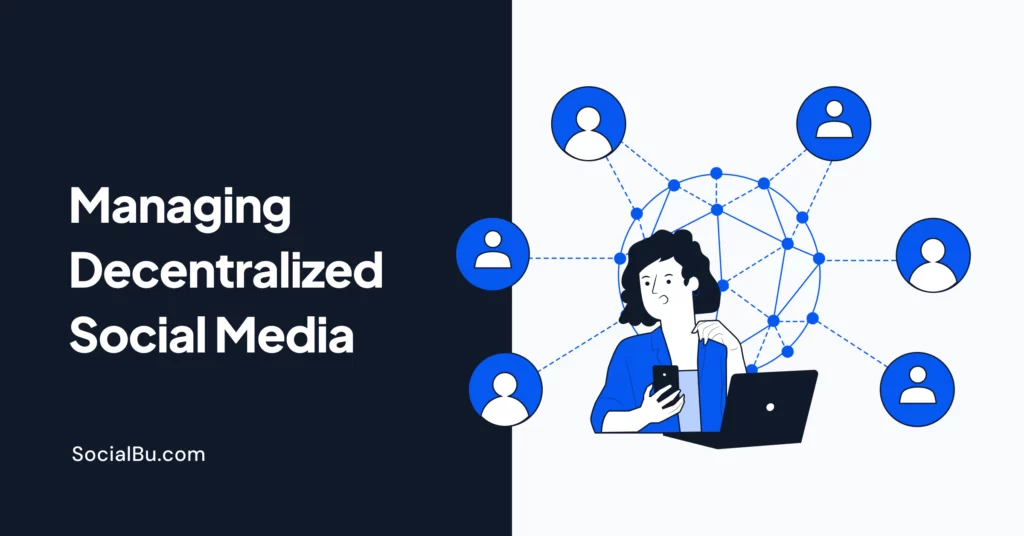
Decentralized social media is changing how people connect online. Instead of one company controlling your account, content, and data. This gives users more ownership, better privacy, and greater freedom.
For creators, businesses, and marketers, learning how decentralized social media works is no longer optional.
This guide will help you learn what decentralized social media is, how it works, why it matters, and how to manage your presence across these emerging platforms.
📌 Key Takeaways
✅ Decentralized social media gives users more control over their data and privacy.
🌐 Mastodon, Bluesky, Farcaster, and Nostr are leading DeSoc platforms.
🔗 The fediverse uses ActivityPub to connect multiple social platforms.
🚀 Bluesky runs on the AT Protocol with account portability and custom feeds.
🔒 Decentralized platforms offer more freedom, transparency, and community control.
📈 Brands and creators can grow faster by adopting decentralized platforms early and managing them from one place.
What Is Decentralized Social Media?
Decentralized social media is a type of social network where no single company owns or controls the entire platform. This means users have more control over their accounts, content, privacy, and online experience.
This approach makes social media more open, flexible, and user-friendly.
Decentralized vs. Centralized Social Media
Understanding the difference between centralized and decentralized social media makes everything else much easier.
Think of it this way:
- Centralized social media is like living in an apartment owned by one landlord. The landlord sets the rules, can change them at any time, and can even ask you to leave.
- Decentralized social media is like owning your own house in a connected neighborhood. You follow shared standards, but no single person controls everyone.
Centralized Social Media | DeCentralized Social Media |
Controlled by one company | Operated by many independent servers or protocols |
Company owns user data | Users have greater control over their data |
One moderation policy | Community-based moderation options |
Limited algorithm choices | Users can choose or customize feeds |
Difficult to move accounts | Some protocols support account portability |
Platform decides future updates | Open-source communities contribute to development |
The biggest difference is control.
Traditional platforms control almost every part of your online experience. Decentralized social media gives much of that control back to users and communities.
 Want to see how AI is changing the way we manage social media? Learn how using an AI social media manager to run social media for clients can be helpful.
 Why Are More People Considering Decentralized Platforms?
|
79% to 81%
People worry about how companies use their personal data online (Pew Research Center)
|
Privacy
Main reason people are moving to decentralized social media
|
Shift
More users want control over their online identity and data
|
People are turning to decentralized platforms because:
- they want more control over their data
- fewer algorithm-driven changes
- better privacy than traditional social media offers
These networks reduce dependence on a single company and give users more freedom over how they interact, share content, and build their online identity. If you manage a brand’s audience data across platforms, it’s worth understanding social media data privacy best practices before you expand into DeSoc spaces.
How Does a Decentralized Social Network Work?
A decentralized social network works by not storing all data in one place. Instead, these social media platforms use many independent servers or open social protocols to share information.
It’s similar to email. Gmail users can still message Outlook users. In the same way, decentralized social media apps can connect and communicate with one another.
This is called interoperable social media, and it powers systems like the fediverse.
What Social Media Platforms Are Decentralized?
Decentralized social media platforms are apps that don’t rely on one company to control all data, users, or rules. Popular DeSoc platforms:
Top Decentralized Social Media Platforms by User Share (2026)
Comparison of leading decentralized social networks based on estimated user activity and popularity.
35%
25%
15%
10%
8%
7%
Note: Figures represent estimated relative popularity/activity and may vary depending on measurement method.
- Mastodon: The largest Fediverse platform, built on ActivityPub, with thousands of independent servers (instances).
- Bluesky: A fast-growing DeSoc platform built on the AT Protocol, focused on account portability and custom feeds.
- Pixelfed: A decentralized, Instagram like photo sharing platform in the Fediverse.
- PeerTube: A decentralized video-sharing alternative to YouTube.
- Friendica: A long-standing federated social network that connects with other Fediverse apps.
- WriteFreely: A minimalist, decentralized blogging platform.
- Farcaster: A Web3-based social network focused on blockchain identity and ownership.
- Nostr: A decentralized protocol-based social network using cryptographic keys instead of accounts.
These platforms are part of the decentralized social media ecosystem, often called the Fediverse.
Workflow Tip: SocialBu helps manage and schedule posts across platforms such as Mastodon, Bluesky, and other social networks from a single dashboard, making decentralized social media easier for creators and brands.
The Best Decentralized Social Media Platforms in 2026
The decentralized social media ecosystem has grown quickly in recent years. While there are thousands of Fediverse servers (over 26,000+), only a few platforms have built large, active communities such as Mastodon and Bluesky.
Here’s a comparison of the leading decentralized social media platforms.
Platform | Protocol | Best For |
Mastodon | ActivityPub | Communities & professionals |
Bluesky | AT Protocol | Creators, journalists, brands |
Farcaster | Ethereum | Web3 creators & developers |
Nostr | Nostr Protocol | Privacy-focused users |
Pixelfed | ActivityPub | Photography |
PeerTube | ActivityPub | Video creators |
Instead of competing directly, many of these platforms solve different problems.
6 Decentralized Social Media Platforms to Know
Decentralized social media platforms use shared systems that give users more control over their data, content, and privacy. Here are six DeSoc platforms you should know about.
1. Mastodon (Fediverse leader)
- Launched: 2016 (by Eugen Rochko)
- Protocol: Uses ActivityPub
- Network: Part of the fediverse
Mastodon remains the most established decentralized social network built on the ActivityPub protocol. Unlike traditional social media, Mastodon isn’t one website.
Recent estimates place Mastodon at roughly 785,000 monthly active users, with independent trackers putting the figure between 750,000 and 1,000,000.
Next to read: How to Schedule Posts on Mastodon Using SocialBu 2. Bluesky (AT Protocol ecosystem)
- Started: 2019 (Twitter-funded research project)
- Public app launch: February 2024
- Protocol: AT Protocol (Authenticated Transfer Protocol)
Bluesky has become one of the biggest success stories in decentralized social media.
Originally incubated by Twitter, it now operates independently using the AT Protocol, which aims to give users greater ownership of their identity and social graph.
Bluesky’s expansion has been remarkable, and as more public figures and brands join, getting verified on Bluesky has become an important trust signal.
Next to read: How to Schedule Posts on Bluesky 3. Farcaster (Web3 social network)
- Launched: 2021 (by ex-Coinbase engineers)
- Type: Hybrid decentralized social network (on-chain identity + off-chain data)
Farcaster is designed for users who want blockchain-based identity and ownership. Unlike Mastodon or Bluesky, Farcaster integrates closely with Ethereum.
Instead of relying solely on usernames, users own cryptographic identities linked to their wallets.
4. Lens Protocol (Web3 social graph)
- Launched: 2022 (by Aave Companies)
- Type: Blockchain-based social graph
A decentralized social media platform where people own their posts and profiles like digital assets, and different apps can use the same user network in Web3 social media.
In January 2026, Aave handed over the management of Lens protocol to mask network. Aave still supports the project as a technical advisor but is no longer responsible for leading its development.
5. Nostr
- Launched: 2020–2021 (by Fiatjaf)
A simple decentralized social media app where users send posts through many servers (relays), so no single company can control or block it.
6. Steemit
- Launched: 2016
- Type: Blockchain-based blogging platform (Steem blockchain)
A decentralized social media platform where people write posts and earn crypto rewards for likes and comments on a blockchain.
Choosing the Right Decentralized Social Media Platform
One good thing about today’s decentralized social media world is that there is no single ‘best’ platform for everyone. The best DeSoc choice depends on what you want to do, your audience, and what type of content you make.
If you’re a creator
Bluesky Social is good for writers, journalists, and thinkers because it has strong discovery tools with custom feeds. It is a growing Bluesky decentralized social media option built on the AT Protocol, helping users find content more easily.
If you’re building communities
Mastodon is one of the strongest decentralized social media platforms because it runs on the fediverse, which uses ActivityPub. Each community (instance) can manage its own rules and moderation flexibly.
If you’re exploring Web3
Platforms like Farcaster and Lens Protocol are popular in Web3 social media. They focus on decentralized social media crypto, where users own their identity and content using blockchain technology.
If you’re a visual creator
Pixelfed is a great decentralized social media app for photographers and artists. It works like an Instagram alternative but without heavy ads or strong algorithm control, making it closer to an algorithm-free social feed experience. Whichever platform you choose, keeping your visuals on-spec matters. This social media image sizes guide is handy for formatting posts correctly across new and emerging networks.
The key idea in DeSoc is simple: don’t try to use every platform. Instead, match your content style to the platform that best fits it for better reach and engagement.
Power Your Decentralized Social Strategy
Join thousands of marketers using SocialBu to automate social media management, schedule content across platforms, and deliver measurable results for businesses.
Benefits of Decentralized Social Media
Whether you’re an individual creator or a global brand, decentralized social media offers several advantages.
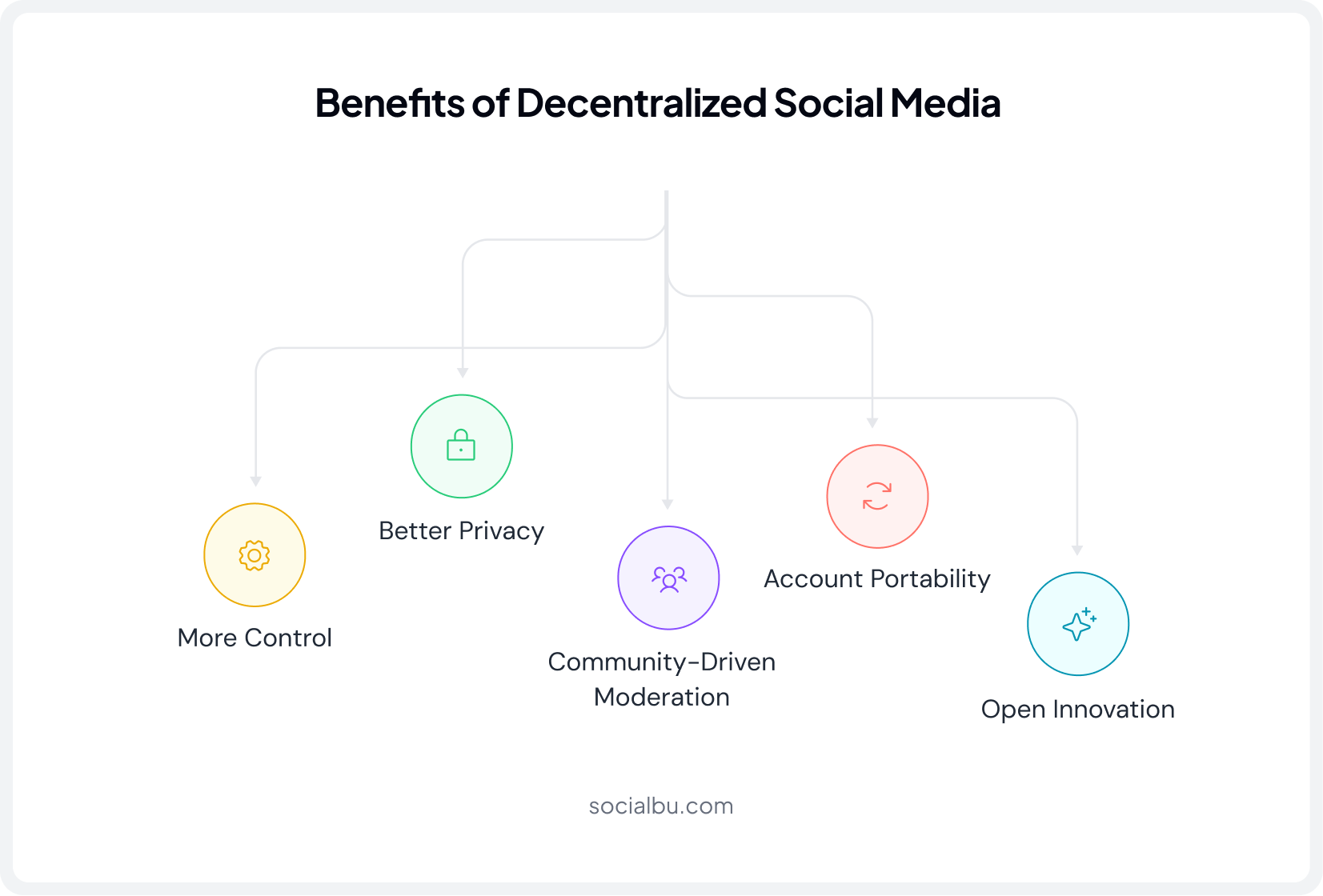
1. More Control
Users have greater control over their accounts and online identity.
2. Better Privacy
Many decentralized platforms collect less user data than traditional social networks.
3. Community-Driven Moderation
Communities often create their own moderation policies, allowing different spaces to maintain standards that fit their members.
4. Account Portability
Some protocols are designed so users can move between hosting providers without starting over.
5. Open Innovation
Developers can build new apps, tools, and experiences without asking permission from one company.
Challenges You Should Know
Decentralized social media isn’t perfect. Some common challenges include:
- Learning new terminology like ‘instances’ and ‘protocols’
- Smaller communities compared to major social networks
- Different moderation policies across servers
- Fewer built-in marketing and advertising tools
- Limited analytics on some platforms
However, these challenges are becoming easier to manage as the ecosystem improves and user-friendly tools continue to improve. Pairing a DeSoc presence with a dedicated social media analytics tool can help close the reporting gap that many of these newer platforms still have.
Final Thoughts
Decentralized social media is changing how people connect online. With open standards like ActivityPub and the AT Protocol, users get more control, better privacy, and greater ownership of their content.
For brands and creators, decentralized social media platforms are a chance to reach new communities and build authentic relationships.
As the fediverse and other DeSoc networks continue to grow, businesses that adapt early will be better positioned to build a strong, lasting presence.
Now is the perfect time to explore decentralized social media and stay ahead of the curve.
FAQs
Q: What is decentralized social media?
Decentralized social media is a type of social network where no single company controls the platform. Instead, users have more control over their accounts, data, privacy, and online experience through independent servers or open protocols.
Q: How is decentralized social media different from traditional platforms like Facebook or X?
Traditional platforms are owned by one company that controls user data, moderation, and algorithms. Decentralized social media is operated by multiple independent servers or protocols, giving users more privacy, flexibility, and control.
Q: What are the most popular decentralized social media platforms in 2026?
Some of the leading DeSoc platforms in 2026 include Mastodon, Bluesky, Farcaster, Nostr, Pixelfed, PeerTube, and Lens Protocol. Each platform serves different audiences and content types.
Q: Is Bluesky actually decentralized?
Yes. Bluesky is built on the AT Protocol, an open protocol that supports account portability, custom feeds, and a more open social network. While it’s still evolving, its goal is to provide a DeSoc experience.
Q: What is the Fediverse, and how does it work?
The Fediverse is a network of independent social platforms that communicate using the ActivityPub protocol. It allows users on platforms like Mastodon, Pixelfed, and PeerTube to interact with one another across different servers.
Q: What’s the difference between ActivityPub and the AT Protocol?
ActivityPub is an open standard that powers the Fediverse, including Mastodon and Pixelfed. The AT Protocol powers Bluesky and focuses on account portability, custom algorithms, and user-controlled identity.
Q: Can I manage Mastodon and Bluesky from the same social media tool?
Yes. Social media management tools like SocialBu let you schedule, publish, and manage content across Mastodon, Bluesky, and other supported platforms from one dashboard.
Q: How do I choose the right Mastodon instance for my brand?
Choose an instance that matches your industry, audience, and community guidelines.
Q: Is decentralized social media good for business marketing?
Yes. Decentralized social media helps brands connect with engaged communities, build trust, and establish an early presence on emerging platforms. Success depends on creating valuable content and participating authentically.
Q: What are the challenges of managing a brand presence on decentralized platforms?
Some common challenges include smaller audiences, different moderation policies, fewer advertising tools, and learning new concepts like instances and protocols. However, these platforms are becoming easier to use as the ecosystem grows.
Q: Can you schedule posts on Mastodon and Bluesky in advance?
Yes. Many social media management platforms, including SocialBu, allow you to schedule and publish posts on Mastodon and Bluesky ahead of time, making it easier to stay consistent.
Q: How does content moderation work on decentralized networks?
Instead of one company setting the rules, moderation is often handled by individual communities or servers. This allows each community to create guidelines that best fit its members.
Q: Is decentralized social media safer or more private than centralized platforms?
Many decentralized platforms collect less user data and give users more control over privacy settings. While privacy can be improved, the level of security depends on the platform or server you choose.
Q: Can you migrate your followers between decentralized platforms?
Some decentralized protocols support account portability, allowing users to move their identity between providers more easily. However, the migration process varies depending on the platform and protocol.
Q: Do decentralized social media platforms support analytics and reporting?
Some platforms offer basic analytics, but reporting features are generally more limited than those of traditional social networks. Many creators and businesses use third-party social media management tools to access deeper insights and performance reports.