Simple Lock Keeps Optical Cavities Tunable Across 100 MHz for Atom Experiments
A two-laser locking scheme stabilizes a Fabry-Pérot cavity while allowing dynamic tuning over 100 MHz with sub-megahertz precision.
An exactly solvable model shows how cavity photons create long-range interactions, allowing a one-dimensional spin chain to develop magnetic order at finite temperatures.
Researchers demonstrate magnetic control of light-emitting quantum condensates in a layered semiconductor, achieving energy shifts up to ten times larger than previous methods.
Author(s): Paolo CrivelliA device that stores a single positron and controls its quantum states could measure its magnetic moment with unprecedented precision, testing a symmetry p...
Ytterbium ions coupled to a superconducting resonator generate synchronized microwave and optical frequency combs, offering a potential link between quantum devices.
Author(s): Ryan WilkinsonA new method lets quantum gas microscopes measure not only where atoms are but also how they move.[Physics 19, s129] Published Wed Oct 21, 2026
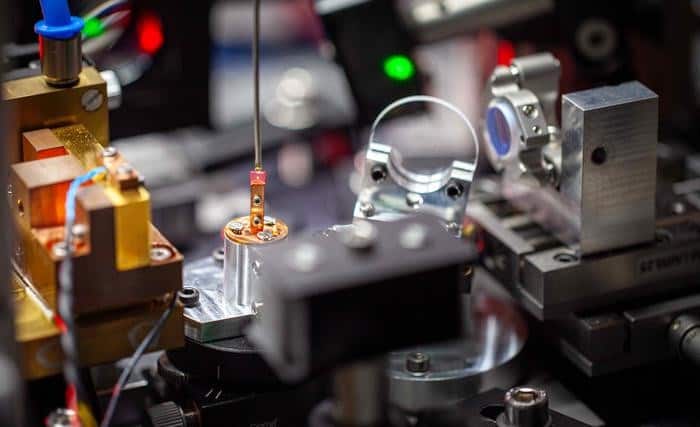
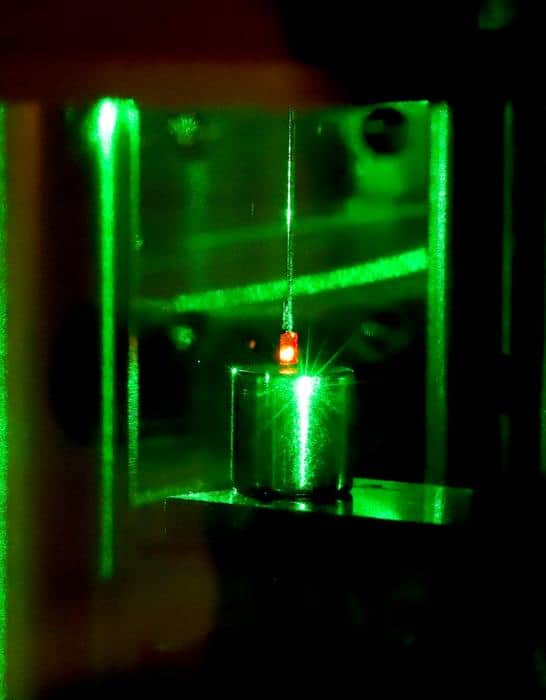
For the first time, scientists can make quantum measurements on a positron particle
Author(s): Marric StephensResearchers have proposed a feasible way to manipulate the ring-like magnetic configurations of certain molecules.[Physics 19, s146] Published Wed Nov 18,...
Author(s): Michael SchirberResearchers observe atoms trapped in an optical lattice mimicking particles created in a strong electric field.[Physics 19, s131] Published Thu Oct 01, 2...
Engineers reshape and focus ultrafast laser light to switch magnetic states without an external field, advancing prospects for faster optical data storage.
AI-generated impression of a nanosphere levitated in an optical tweezer inside an optical cavity, where its motion becomes entangled with light. (Francesco Marin/OpenAI)
Researchers in China and Singapore show that particle shape and rotation angle can reverse optical torques and freeze rotation in optical tweezers, enabling shape-based optical sor...
System achieves 100% optical contrast The post Laser cavity boosts nitrogen–vacancy magnetic sensor appeared first on Physics World.
Newly predicted magnetophononic polaritons could enable ultrafast, light-controlled topological switches.
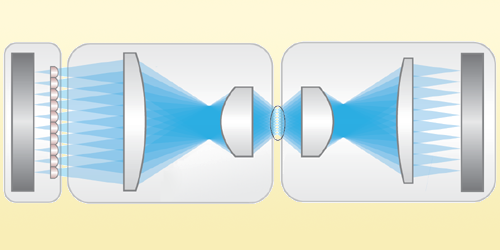
Author(s): Sophia ChenA new device in which more than 600 atoms are manipulated within a single optical cavity could allow for the scaling up of neutral-atom quantum computers.[Phy...
Diamond sample propelled up to 1.5 microns by its own nitrogen-vacancy centres The post Electron spin force moves a macroscopic object appeared first on Physics World.
Optical cavities are pairs of light-trapping mirrors and underpin the operation of lasers, atomic clocks and many types of precision sensors. If the distance between the mirrors is...
Molecular cages helped chemists remove one electron from terbium, making an unusual form easier to study for possible uses in quantum computing and advanced sensors. Rare-earth met...
A magnetic switch buried deep within an atom’s heart has been flipped in a baffling new experiment, giving physicists both a mystery to solve and potentially a handy new tool in qu...
Atomic-scale see-saws control spin interactions as scanning tunnelling microscopy tunes coupling between spins in a 2D metal-organic framework and metal electrons.
A quantum gas microscope reveals Mott insulating behavior and competing magnetic correlations in the first three-component Hubbard system with tunable interactions, advancing quant...
Use SocialBu to discover ideas, generate post drafts, and schedule them across your social channels.