Cross-platform social media publishing is one of the most highly used activities in modern content marketing, but only when done right. Most brands get it wrong by treating it as a volume game: post everywhere, post often, copy-paste the same content across channels, and hope something sticks. The brands growing consistently in 2026 are doing something different. They have a system.
This guide covers the 9 best practices for cross-platform social media publishing. All these social media publishing workflow best practices will help you plan smarter, create less while distributing more, adapt content natively for each platform, and build a workflow your team can actually sustain.
Let’s look into the details.
What Is Cross-Platform Social Media Publishing?
Cross-platform social media publishing is the practice of planning, creating, and distributing content across multiple social media channels in a coordinated, intentional way. It is not the same as cross-posting.
- Cross-posting means sharing the same piece of content across platforms with minimal or no adaptation.
- Cross-platform publishing means building a content strategy that treats each platform differently. This means the same message, in a different format, tone, and execution, distributed through a centralized workflow.
A social media user actively moves between 6.75 different platforms every month. Your audience is not sitting in one place. A cross-platform publishing strategy is how you meet them wherever they are. And that too without rebuilding your entire content operation for each channel.
Why You Should Cross-Publish Across Various Social Media Platforms
The aim of cross-platform publishing is not just to reach more people. It is about building a sustainable content operation that compounds over time.
Here is what well-executed best practices for cross-platform social media publishing strategy actually do for your business:
- Wider audience reach: Different platforms attract different audience demographics. LinkedIn users are not the same people as your TikTok audience
- More content mileage: One strong idea gets adapted into five platform-native formats instead of five different ideas
- Consistent brand presence: Your audience sees you on the platforms they actually use, not just the ones you prefer
- Resilience: If one platform changes its algorithm or loses users, your audience is distributed; you are not starting over
- Better data: Multiple platforms give you richer performance data to understand what content actually resonates
The brands that show up consistently across platforms build recognition faster. According to stats, 33% of businesses reported that a consistent brand presence helps them increase their revenue by 20% or more.
And the ones that post on one channel, disappear, and reappear somewhere else three months later, spend most of their time rebuilding the momentum they already had.
What Practices Can You Adopt for Cross-Platform Social Media Publishing in 2026?
Here are the 9 best practices for cross-platform social media publishing for 2026:
1. Start with a Cross-Platform Content Strategy
The most common mistake brands make when expanding across multiple platforms is starting with the posting schedule rather than the strategy. They decide to post on Instagram three times a week and LinkedIn twice a week, before they have answered the more important questions:
- What are we trying to achieve on each platform?
- Who are we trying to reach?
A cross-platform content strategy answers these questions before you write a single post:
- What is the goal on each platform? Brand awareness on TikTok, lead generation on LinkedIn, community on Instagram, and traffic on Pinterest can all be true simultaneously. However, each goal requires a different approach.
- Who is the audience on each platform? Your LinkedIn audience is likely to be decision-makers and professionals. Your TikTok audience may be earlier in their awareness journey. Your Instagram audience could be current customers. Same brand, different people to target and educate.
- What content pillars will anchor your publishing? Content pillars are the 3 to 5 core themes your brand consistently creates content around. They give you a multi-platform calendar structure and prevent you from posting whatever feels timely at random.
- What does your content mix look like? A practical starting ratio: 40% educational, 25% engagement, 20% brand or product, 15% promotional. Adjust by platform and audience.
So, answer these questions first and build a multi-platform content calendar. This way, every piece of content you cross-publish has a purpose, a rationale for each platform, and a measurable outcome.
2. Build Your Content Around a Hub and Spoke Repurposing Model
Creating original content for 6 to 7 platforms from scratch every week is not sustainable. The brands that publish consistently at scale do not create more; they repurpose content smarter.
To do that, you must follow the hub-and-spoke model, which works like this:
- You create one high-quality piece of content (the hub), then adapt and distribute it across platforms in native formats (the spokes).
- The hub does the creative heavy lifting once. The spokes carry it everywhere.
Example
A good example of this is the GaryVee Content Model. Here, Gary Vaynerchuk’s team took one keynote (the pillar), repurposed it into 30+ pieces of content, and distributed it across platforms, resulting in over 35 million total views. The content was not created 30 times. It was created once and adapted intelligently.
Here is what that looks like in practice:
Hub Content | Spokes (Platform-Adapted Formats) |
Long-form YouTube video | YouTube Shorts clips + TikToks + Instagram Reels + LinkedIn carousel + X thread + Pinterest infographic |
Podcast episode | Audio clips for Stories + LinkedIn text posts + blog post + X thread of key takeaways |
Blog post | Instagram carousel + LinkedIn article excerpt + Pinterest pin + Facebook post with key stat |
Webinar or live stream | Highlight clips for TikTok + Instagram Reels + YouTube Shorts + LinkedIn native video + email newsletter |
And here it is, what it looks like in a visual form:
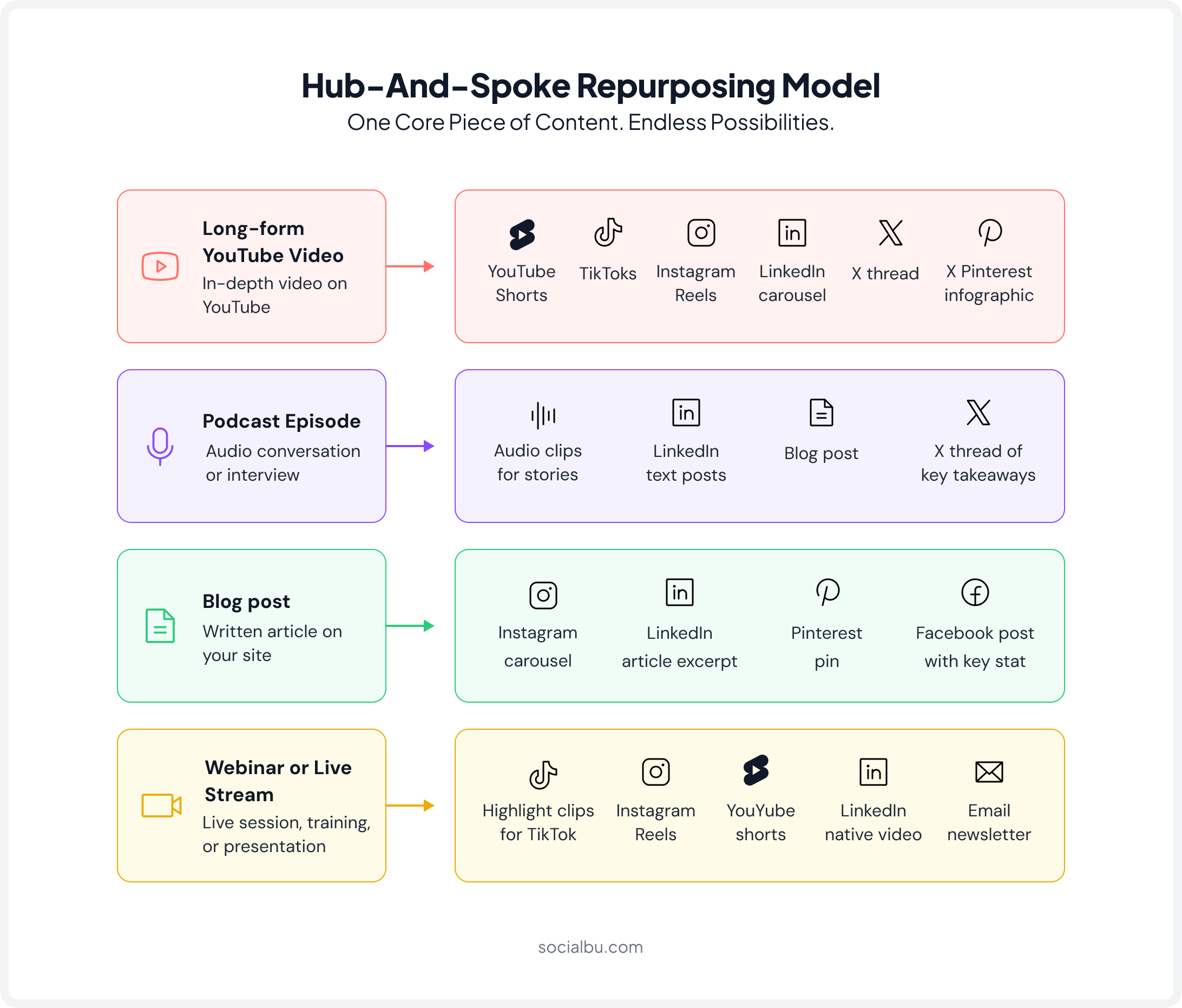
The keyword for this concept is “adapted.” You are not copy-pasting the YouTube description into TikTok. You are taking the core idea and translating it into the format, tone, and length that works natively on each platform.
3. Adapt Content Natively for Each Platform: Captions, Hashtags, and Image Dimensions
This is where most cross-platform strategies fall apart. Brands know they should adapt content for each platform, but in practice, for them, “adapting” means rewriting the caption. That is not enough.
Native platform-wise adaptation means rethinking the format, length, tone, and structure of the content for how each platform actually works.
Here is what best practices for cross-platform social media publishing per channel look like:
1. Instagram
Instagram captions’ character limits: 2,200 characters
Hashtags: 3 to 5 highly relevant and niche-focused per post or Reel
Instagram rewards visual quality and Reels reach. Your caption hook needs to land within the first 125 characters; everything after that hides behind a “more” tap. Carousels drive saves. Stories drive quick engagement. Hashtags work best at 3 to 5 niche tags, not 30 broad ones.
2. TikTok
TikTok captions’ character limits: 2,200 characters
Hashtags: 3 to 5 per TikTok
Your content is shown beyond your followers and to the people who are interested in it. That means hooks need to work for cold audiences. On-screen text matters because most people watch with sound off at least some of the time.
And critically: never post a TikTok watermarked video to Instagram Reels. Instagram’s algorithm actively reduces reach on watermarked content.
3. LinkedIn
LinkedIn captions’ character limits: 3,000 characters
Hashtags: 3 to 5 per post
LinkedIn rewards depth and professional insight. Long-form text posts perform well here. Carousels (uploaded as PDFs) get strong organic reach. Hashtags work, but 3 to 5 are enough. The tone should be professional yet human.
4. Pinterest
Pinterest pin description character limits: 500 characters
Hashtags: 2 to 5 per pin
Pinterest is a search engine. Content has a long shelf life, so a well-optimized pin can drive traffic for months or years after publication. Vertical images, keyword-rich descriptions, and evergreen topics perform best.
5. Facebook
Facebook captions’ character limits: 63,206 characters
Hashtags: 1 to 3 most relevant per post
Facebook works best for community-led content, video, and longer-form posts that start conversations. Organic reach on brand pages has declined significantly. Facebook now increasingly rewards content that gets meaningful engagement (comments, shares) over content that just gets likes.
6. X (Twitter)
X (Twitter) captions’ character limits: 280 characters (free) and 25,000 characters (paid)
Hashtags: 1 to 2 relevant per post
X is a real-time platform. Short, punchy takes and threads for depth. Timing matters more here than on most other platforms. Trending topics and immediate reactions to industry news outperform evergreen content.
The point is not to create six completely different pieces of content from scratch. It is to take one core idea and execute it in the way each platform’s audience expects to receive it.
Image Sizes: Ensure that the content you’re cross-publishing (videos and images) meets each social media platform’s recommended dimensions.
4. Keep Brand Voice Consistent While Adapting Tone Per Platform
While you post on various platforms, the one thing you have to keep consistent is your brand voice.
However, note that brand voice and tone are not the same thing.
Brand voice is who you are. It is the personality behind your content, the way you think, the words you use, and the perspective you bring. It stays the same across every platform, every post, every format.
Tone is how you sound in a specific context. On TikTok, your tone might be casual and quick. On LinkedIn, it must be professional. And on X, it might be sharp and punchy. The voice does not change; the delivery does.
Example:
Duolingo is the best example of this. Their brand voice is playful, self-aware, witty, and unhinged. And it reads the same whether you are watching their TikToks, reading their tweets, or seeing their Instagram posts.
But the format, length, and delivery adapt completely to each platform’s native behavior. That consistency across 6 very different channels is exactly why their brand is so recognizable.
How to define and protect your brand voice across platforms:
- Write down 3 adjectives that describe your brand’s personality (e.g., direct, warm, expert, or bold, playful, honest)
- For each adjective, write one sentence showing what it looks like in practice and one sentence showing what it does not look like
- Document how each adjective translates to each platform’s tone: same voice, different register.
- Share this with every team member who writes content for your brand
Without this documentation, different team members will write in different voices, and your brand will feel inconsistent across platforms even if the visual identity is perfectly coherent.
5. Build a Content Calendar for Multiple Platforms Before You Create Anything
A multi-platform content calendar is a must-have planning tool to assist your cross-platform publishing across socials.
Most teams use their content calendar to track what they have already created and when it is going out.
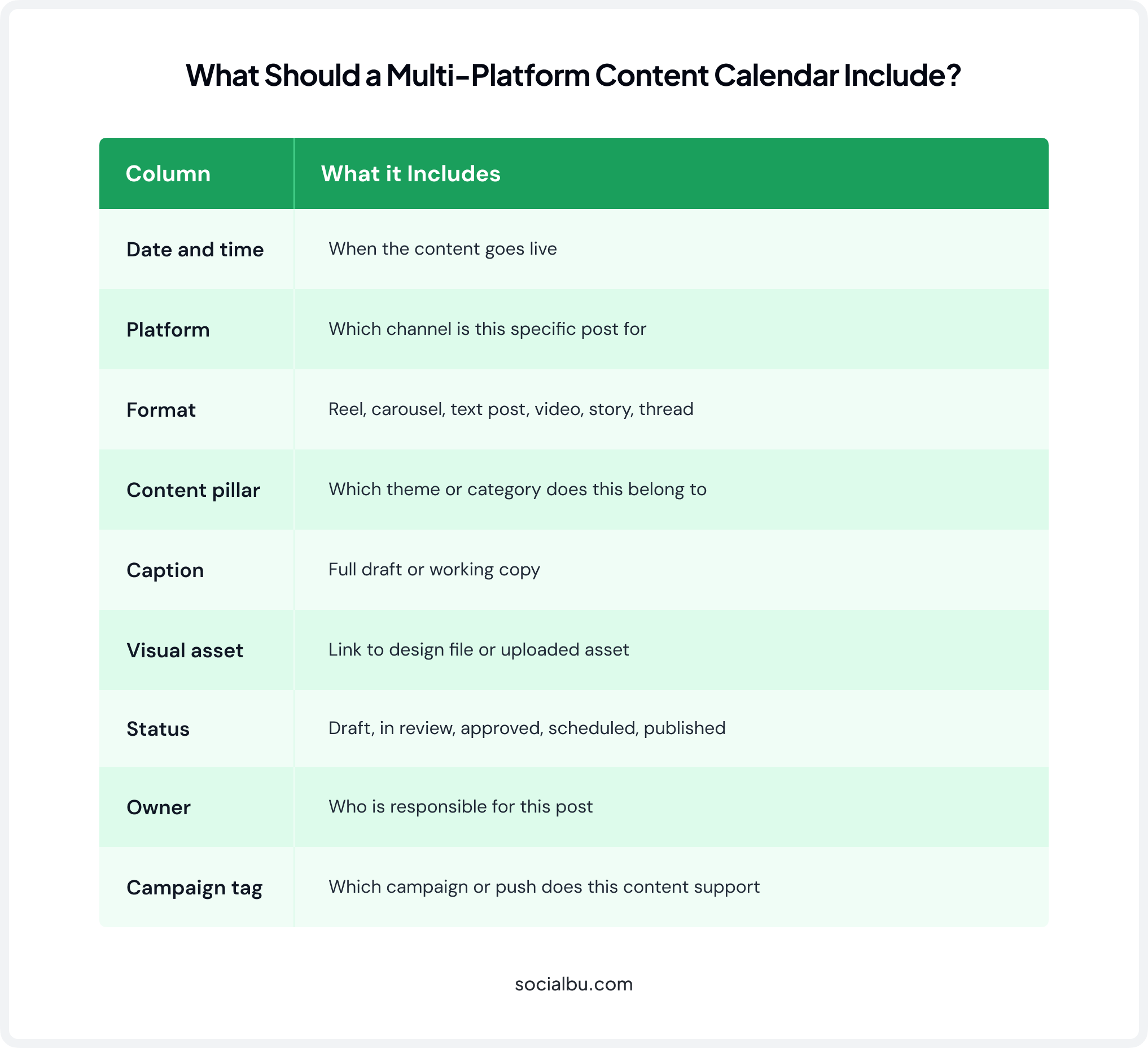
A properly built cross-platform social media content calendar is used before creation begins and helps you plan the following:
- What needs to exist,
- On which platform,
- In what format,
- And for what goal?
That planning step is what makes the creation process faster, more focused, and less chaotic.
Here is what your multi-platform content calendar must include:
How far in advance should you plan?
- 2 to 4 weeks ahead for regular publishing content
- 6 to 8 weeks ahead for campaign content tied to product launches, seasonal moments, or major events
Planning that far ahead is the only way to produce campaign-level content that is cohesive, well-designed, and properly timed across every platform simultaneously.
6. Set the Right Publishing Frequency and Best Times Per Platform
Consistency matters more than frequency. A brand that posts three times per week every single week outperforms a brand that posts daily for two weeks and then goes quiet for a month.
That said, each platform has a different optimal publishing cadence. Here is a 2026 benchmark to start from:
Platform | Recommended Frequency | Notes |
3 to 5 times per week | Reels for reach, carousels for saves, Stories daily | |
TikTok | 1 to 3 times per day | TikTok's own guidance: consistency signals to the algorithm |
3 to 5 times per week | Weekdays only; engagement drops sharply on weekends | |
3 to 5 times per week | Video and community posts outperform feed posts | |
X (Twitter) | 3 to 5 times per day | Real-time relevance matters more here than on any other platform |
5 to 10 pins per week | Evergreen content compounds | |
YouTube Shorts | 3 to 5 times per week | Consistency drives subscriber growth more than volume |
These publishing frequencies are starting benchmarks. You can start with what you can sustain and build from there. Publishing 3 times per week consistently for 6 months is worth more than posting 10 times per week for three weeks and then burning out.
 Check out this Best Time to Post on Social Media guide to find out the research-backed optimal posting window for your social media.
Platform algorithm differences in 2026 are worth knowing:
- Instagram and TikTok both reward engagement velocity in the first 30 to 60 minutes after posting
- LinkedIn’s algorithm heavily weights meaningful comments over reactions
- Pinterest distributes content based on keyword relevance and pin quality, not recency
- Facebook increasingly favors content that sparks conversation in the comments
7. Build a Team Workflow and Approval SOP for Cross-Platform Publishing
A documented workflow is essential to keep your team on the same page throughout your social media publishing process. This will ensure that your content is going live on time and correctly.
A cross-platform publishing SOP defines who does what and when, at every stage of the content process.
Here is a simple four-stage framework:
- Create: Content writers outline options, develop a visual brief, and create platform-specific content.
- Review: The content lead or editor reviews the copy for brand voice, accuracy, and platform-native formatting.
- Approve: The manager or clients give the final sign-off before scheduling.
- Content Scheduling: The social media manager posts the content into the scheduling tool with the correct date, time, and platform settings.
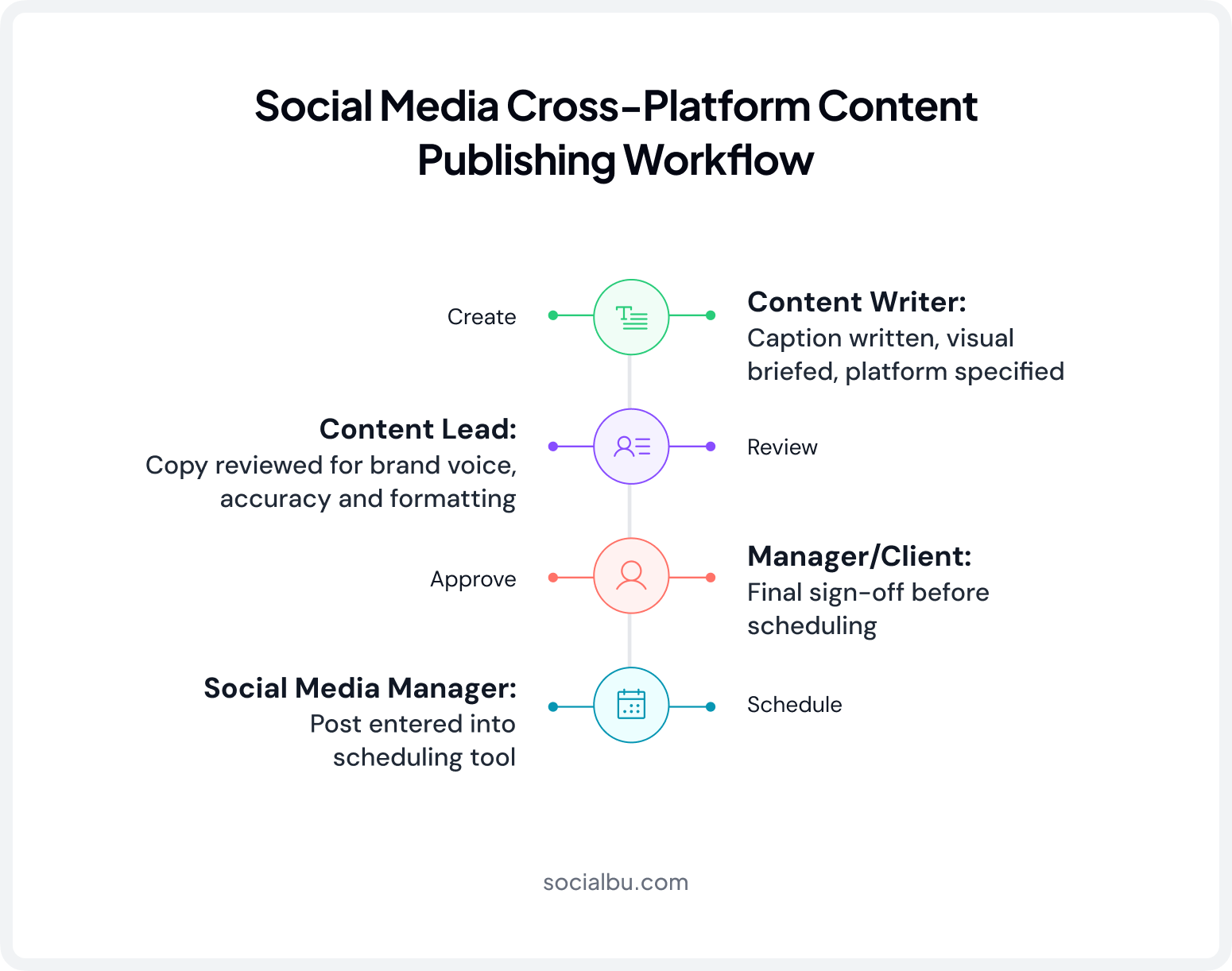
Along with the workflow stages, your SOP should document platform-specific requirements so every team member follows them consistently:
Such as:
- Instagram: Caption hook within 125 characters, 3 to 5 hashtags at the end, no TikTok watermarks on Reels
- LinkedIn: No hashtag stacking, professional but human tone, PDFs for carousels
- TikTok: Short captions, trending audios, on-screen text for accessibility
- Pinterest: Keyword-rich descriptions, vertical format, and evergreen content preferred
When these requirements live in a shared document, you stop having the same conversations over and over. New team members can onboard to your publishing process within hours, not weeks.
Pro tip: Don’t run back and forth between different apps to collaborate with your team and get clients’ approvals.
Try SocialBu’s team collaboration feature. It enables you to assign posts to team members and move content through the draft, review, and approval stages without email chains or Slack threads.
8. Use AI and Automation to Handle the Repeatable Parts of Publishing
The second last best practice for cross-platform social media publishing is to use AI tools. They have become a real part of how effective social media teams operate in 2026. These are not a replacement for strategy or original thinking. In fact, these AI tools are a productivity layer that handles the repetitive, time-consuming parts of content publishing that do not require human input.
Here is where AI actually helps in your cross-platform publishing workflow:
Caption Generation: AI tools for content creation generate first drafts of captions for each platform in seconds. You can still edit for brand voice and accuracy, but starting from a draft is faster than starting from a blank page. This is also helpful when you are writing platform-specific versions of the same core message.
Content Ideation: When your idea bank runs dry, AI tools can generate topic angles based on your content pillars, recent high-performing posts, or trending conversations in your industry.
Content Repurposing: AI can adapt a LinkedIn post into an Instagram caption or restructure a blog intro into an X thread. It significantly speeds up the execution.
Scheduling and Automation: Auto-publishing your content removes the manual step of logging in and hitting post at specific times across six platforms. Content recycling automation re-queues your best evergreen posts so they keep working without manual re-entry.
However, there are some parts that AI cannot replace, and those are:
- Your content strategy,
- Your brand voice decisions,
- You take on what your specific audience actually cares about,
- And your real-time engagement with your audience.
AI only handles the repetitive execution, so you have more bandwidth for the things that require your human creativity.
9. Track Performance Across Platforms and Use the Data to Improve
If you’re just publishing without tracking performance, it’s like running a content strategy with no feedback loop. You are spending time, budget, and creative energy without knowing what is working or what to do differently next month.
Cross-platform analytics require a slightly different approach than single-platform reporting. The metrics that matter on Instagram are not the same ones that matter on LinkedIn. Comparing raw engagement numbers across platforms will mislead you. Instead, track platform-appropriate KPIs and compare performance within each platform over time.
Here are the key metrics to track by platform:
Platform | Primary KPIs | What to Watch |
Engagement rate, Reels views, saves, profile visits | Which formats drive saves vs. comments vs. reach | |
TikTok | Views, watch time, shares, follower growth | Share rate is the strongest signal of resonant content |
Impressions, engagement rate, click-through rate | Comments signal algorithm favors more than reactions | |
Impressions, saves, link clicks, outbound clicks | Saves are the primary signal of content quality | |
Reach, engagement, video views, shares | Shares drive organic distribution more than likes | |
X (Twitter) | Impressions, link clicks, retweets, replies | Engagement rate matters more than raw follower count |
Here is a practical monthly review process to follow:
- Pull the last 30 days of posts per platform, sorted by engagement rate (not raw numbers).
- Identify the top 3-performing posts on each platform and look for patterns in format, topic, posting time, and caption structure.
- Identify the bottom 3 posts and ask what was different about each.
- Check whether your content pillar mix is balanced or skewed toward one category.
- Set one specific thing to test differently next month, based on what you found.
Ready to Follow the Best Practices for Cross-Platform Social Media Publishing?
Cross-platform social media publishing is not about being everywhere on each platform at once. It is about building a system that creates strategically, adapts intelligently, and distributes consistently across every platform your audience uses.
To follow the best practices for cross-platform social media publishing, here is what you have to do:
- Define your strategy before you plan your schedule.
- Build content around repurposing.
- Adapt natively for each platform.
- Document your workflow.
- Track what works and improve monthly.
- And use tools that eliminate manual, repetitive tasks, so your team can focus on what actually requires human judgment.
SocialBu gives you the infrastructure to run that system: multi-platform scheduling, bulk publishing, AI caption tools, team collaboration, automation, and unified analytics, all from one dashboard.
Build a Cross-Platform Publishing Workflow Now!
Schedule, auto-publish, automate, track, and collaborate with the team, all in one place.
Frequently Asked Questions
Q. How do you publish content across multiple social media platforms without looking repetitive?
A. To avoid repetitive content, adapt each post based on the platform’s audience, format, and algorithm. Use social media content repurposing to turn one idea into platform-specific formats, such as short TikTok videos, Instagram carousels, and professional insights for LinkedIn. Maintain a consistent brand voice while customizing the message for each channel.
Q. Should you post the same content on every social media platform?
A. You should not copy and paste the same post across every platform. What you must do is use a cross-platform content strategy to adjust captions, visuals, hashtags, and formats based on audience preferences on each network.
Q. What are the best practices for cross-platform social media publishing?
A. The best practices for cross-platform social media publishing include creating a content calendar for multiple platforms, customizing posts for each channel, maintaining brand voice consistency, and tracking performance across platforms. A strong workflow also includes scheduling content, analyzing social media KPIs, and optimizing posts based on audience engagement.
Q. How do you customize social media posts for different platforms?
A. Customize posts by adapting content formats, captions, publishing frequency, and engagement strategies for each platform. For example, use short-form videos on TikTok, visual storytelling on Instagram, professional content on LinkedIn, and community-focused updates on Facebook. A platform-specific content strategy helps maximize reach and engagement.
Q. What tools are best for scheduling posts across multiple social media accounts?
A. Social media scheduling tools like SocialBu, Buffer, and Later help brands manage multi-platform social media publishing from one dashboard. These tools support bulk social media scheduling, content approval workflows, analytics tracking, and automated publishing to improve efficiency.
Q. How often should you cross-post content on different social media platforms?
A. The ideal cross-posting frequency depends on your audience, platform goals, and content type. Instead of posting the same content everywhere every day, follow a consistent social media posting schedule and adjust the frequency based on performance data, engagement rates, and platform-specific best practices.