
For years, marketers treated X like a guessing game. Some swore posting frequency mattered most. Others chased hooks, hashtags, or engagement hacks, hoping something would trigger reach. Then the X algorithm open source releases changed the conversation.
For the first time, we can partially see how the platform retrieves, ranks, and distributes content. The newer X algorithm 2026 updates exposed more of the recommendation architecture, ranking systems, and engagement prediction models behind the For You feed.
But most coverage still misses the point.
The real opportunity is not gaming the algorithm. It is understanding what the system consistently rewards. And the clearest takeaway so far is this:
The modern X For You algorithm increasingly optimizes for predicted satisfaction rather than follower count alone.
We still do not know the exact ranking formula. But we now understand the platform’s direction far better than before. This article will provide a practical content playbook for marketers operating inside a relevance-driven feed. So, without further ado, let’s get into the topic.
What the X Algorithm Open Source Release Actually Reveals
The original Twitter algorithm open source release in 2023 gave marketers a partial look at how feed recommendations worked. It exposed ranking logic, engagement scoring, and recommendation pipelines, but most production systems remained hidden.
The newer X algorithm 2026 updates go further. Recent repository analysis reveals more about retrieval systems, ranking infrastructure, engagement prediction, and feed assembly architecture tied to Grok-era recommendation models.
For marketers, the value is not discovering a “secret formula.” It is understanding the platform’s priorities.
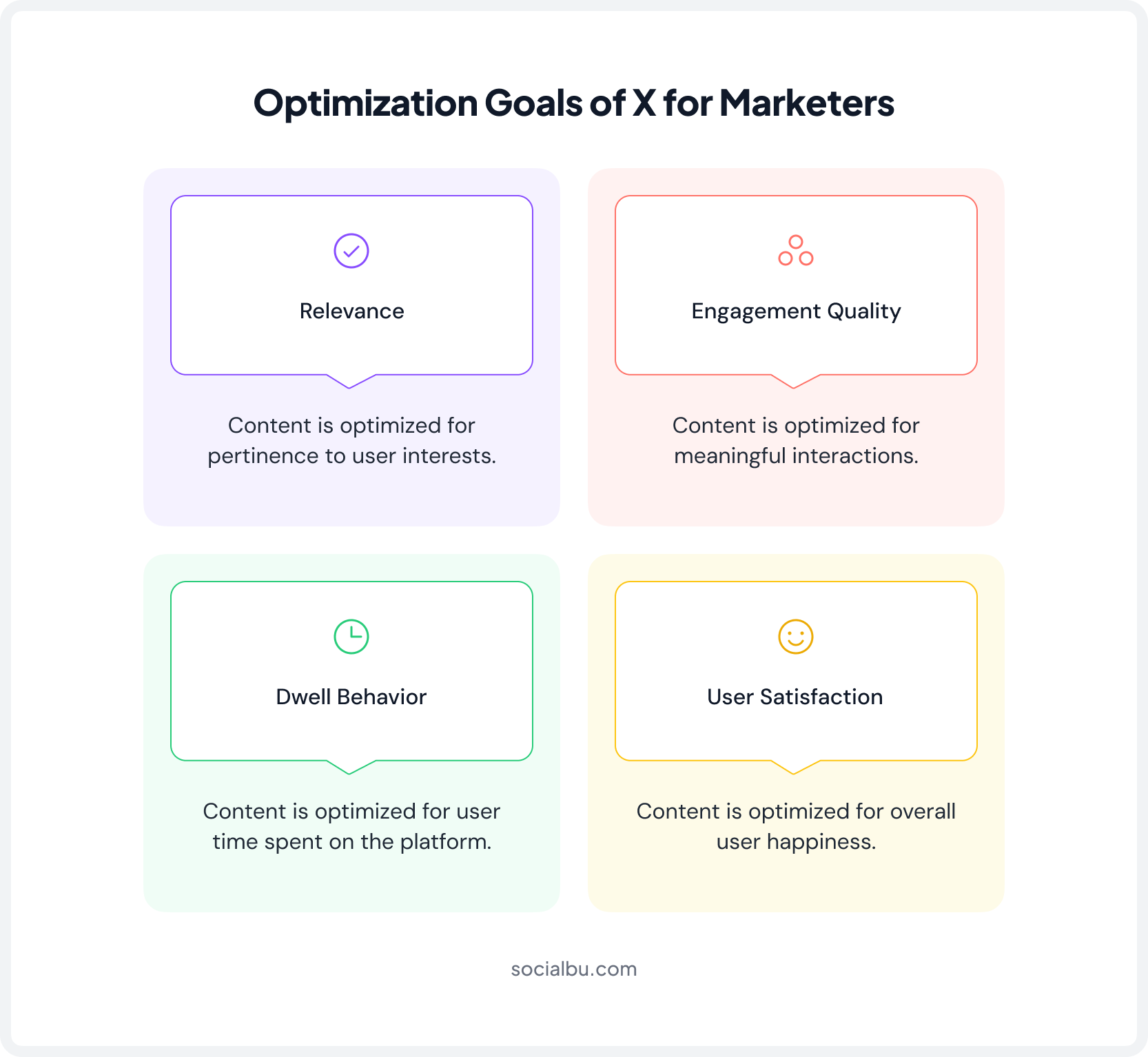
The release suggests X is increasingly optimized for:
- relevance,
- engagement quality,
- dwell behavior,
- and user satisfaction.
Several architectural systems are now more visible, including:
- candidate retrieval,
- ranking layers,
- Home Mixer orchestration,
- and engagement scoring infrastructure.
At the same time, key systems remain private:
- model weights,
- training data,
- moderation layers,
- and experimental tuning.
So while we better understand how the X algorithm works, nobody outside X fully understands the production ranking model.
What the release really confirms is the platform’s direction: X is becoming more relevance-driven than follower-driven.
Now that you know what the X algorithm open source revealed, let’s get to know how the X algorithm actually works in 2026.
 Also Read: Understand Social Media Algorithms: A Detailed Guide for Marketers
How the X Algorithm Works in 2026
The modern X For You algorithm operates in three stages:
- Retrieval
- Ranking
- Filtering
Retrieval answers:
“What content might this user care about?”
The system pulls candidates from:
- followed accounts,
- out-of-network recommendations,
- interest clusters,
- trending conversations,
- and topic-based content lanes.
Infrastructure such as Phoenix Retrieval, Thunder, Home Mixer, and two-tower models help organize these candidates before ranking begins.
Once that is done, the ranking stage predicts which posts are most likely to generate meaningful interaction. That includes replies, profile clicks, follows, reposts, and dwell time.
The system also evaluates:
- audience relevance,
- content quality,
- ad blending,
- and brand safety.
Lastly, filtering removes repetitive, low-quality, or risky content before feed assembly.
Understanding this algorithm is necessary to get the key takeaway, which is:
The Biggest Shift in the X Algorithm 2026: Dwell Time Over Vanity Metrics
One of the clearest changes in the X Algorithm 2026 ecosystem is the growing importance of engagement depth.
The feed increasingly rewards the following:
- read time,
- thread completion,
- replies,
- profile clicks,
- and long-form interaction.
Likes still matter, but they are no longer enough on their own.
A post that generates quick reactions but no sustained engagement may receive visibility without the strength of long-term distribution. Meanwhile, a founder thread that keeps readers engaged for two minutes sends much stronger quality signals.
This changes how brands think about how to get more reach on X.
High-performing content now tends to create pause behavior on Twitter:
- curiosity,
- emotional tension,
- specificity,
- or a strong perspective.
For example, a founder breaking down a failed launch, a teardown of a detailed launch, or an opinion tied back to real experience. And the common trait in all these is depth. So, the X algorithm open-source, revealed that the system rewards content that users spend most of their time on.
Also Read: 25+ X (Twitter) Statistics to help you know the key insights to monetize the platform fully.Why Generic Brand Content Struggles in the New X For You Algorithm
Generic content struggles on X because the feed increasingly deprioritizes repetitive and weakly engaged content. If your post is built around recycled growth advice, vague thought leadership, AI-generated threads, or engagement baits, there is a high chance it’ll fail to get engagement.
Community analysis also points to author-diversity systems that reduce the frequency with which identical posting styles appear in a user’s feed session.
The problem is not posting frequency; instead, it’s sameness.
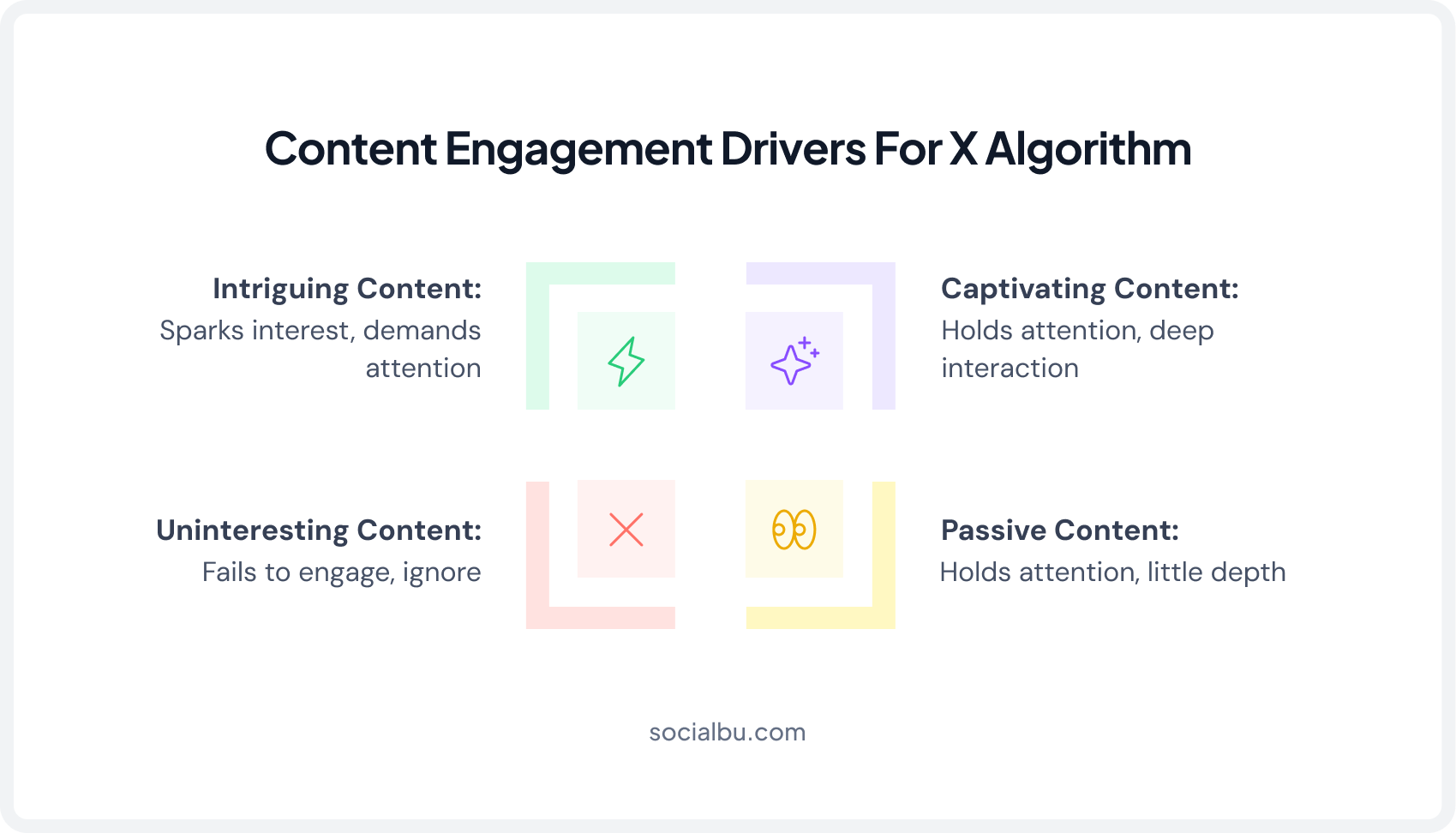
A high-volume account with strong audience specificity can still perform well. But repetitive, low-context posting quickly creates fatigue.
Negative signals matter here too:
- mute,
- block,
- not interested,
- and rapid scroll-away behavior.
That is why technically polished content can still underperform if it lacks perspective, tension, specificity, and audience relevance. That’s why the X algorithm’s open-source code shows that the feed increasingly rewards content users pause on, rather than content that simply fills the timeline.
X Algorithm for SaaS Founders: Why Founder-Led Content Wins
The modern X algorithm for SaaS founders naturally favors founder-led content because founders generate richer engagement signals than faceless brands.
Founder accounts tend to drive:
- stronger replies,
- higher-profile curiosity,
- more discussion,
- and clearer expertise positioning.
A SaaS brand announcing a feature release often generates shallow engagement.
A founder explaining why customers ignored that feature for months creates context and conversation. That distinction matters.
A strong founder-led X content strategy usually combines the following:
- operator insight,
- topical consistency,
- ICP alignment,
- and niche expertise.
Posts like pricing lessons, customer acquisition mistakes, product teardowns, and industry opinions create stronger audience matching than generic promotional content. The feed increasingly rewards people who consistently contribute valuable content insight within a clear topic area.
X Algorithm for Agencies: What Social Teams Need to Change
Traditional impressions-first reporting is becoming less useful.
The newer ranking systems suggest deeper engagement signals matter more than passive visibility.
Agencies should pay closer attention to:
- profile clicks,
- follow conversion,
- reply quality,
- conversation depth,
- and audience relevance.
A smaller post that generates high-quality discussions may now outperform a high-impression post with low-quality engagement.
This also changes how teams think about content calendars.
Consistency still matters. But rigid scheduling without differentiated ideas creates diminishing returns.
The challenge is no longer posting consistently. It is staying differentiated consistently.
X Algorithm for Creators: The Rise of Attention Retention Content
Creators trying to learn how to get more reach on X increasingly need content that sustains attention after the first impression. That starts with stronger hooks, emotional contrast, curiosity gaps, and native storytelling.
The best creator posts create ongoing interaction:
- reading,
- replying,
- expanding threads,
- revisiting,
- or clicking profiles.
There is also a major difference between engagement bait and conversation bait. Engagement bait asks for reactions. Whereas the conversation bait gives people something worth discussing. The recent X algorithm open source confirms that the platform is increasingly better at recognizing the difference.
Create On-Brand X Posts with SocialBu’s AI Tweet Generator
What Marketers Still Misunderstand About the Twitter Algorithm Open Source Movement
The biggest misconception about the Twitter algorithm’s open-source release is that marketers now understand the exact ranking formula. But the truth is, they don’t
The public repositories provide:
- directional understanding,
- infrastructure clues,
- and visibility into ranking priorities.
But critical systems remain hidden, including training data, experimentation layers, and production weighting.
That is why oversimplified conclusions miss the point. For instance, statements like “followers are dead” or “posting more hurts reach” are not entirely accurate.
The real insight is that all signals now exist within a broader relevance-and-engagement prediction system.
Automate Your X (Twitter) Growth Now
Schedule and automate posts, engage smarter, and grow faster—all with SocialBu. Simplify your workflow with SocialBu’s all-in-one automation tools.