Somewhere right now, a customer is complaining about a shipping delay, a creator is filming an unboxing video, and a competitor’s follower is asking your community for a comparison. None of them tagged your brand’s handle. That’s the problem social media listening is built to solve.
In simple terms, social media listening is the practice of tracking conversations across social platforms, forums, review sites, and even news comments to understand not just what people are saying about your brand, but why they’re saying it and how they feel.
This guide goes deep on every angle of the topic: the core definition of social listening, how it actually works behind the scenes, how to build a strategy from scratch, the mistakes most teams make, and a full walkthrough of how to do it in SocialBu.
Key Takeaway:
- Social media listening means tracking and analyzing conversations about your brand, competitors, and industry; not just responding to direct mentions.
- Social listening vs. social monitoring is a “why vs. what” difference: monitoring tracks activity, while listening uncovers insights that drive decisions.
- Social media listening helps improve marketing, customer support, product development, brand reputation, and competitive strategy.
- Modern social listening tools combine AI-powered monitoring with publishing, scheduling, and engagement features.
What Is Social Media Listening?
What is social media listening, exactly? The simple explanation is:
It’s the process of tracking what people say about your brand, product, or industry across social media. Then using that information to understand sentiment, spot patterns, and make better decisions.
Think of it as the difference between hearing and actually listening. You’re not just collecting mentions; you’re interpreting what they mean.
Social media listening hasn’t changed dramatically over the years; what has changed is the scale and speed at which it now happens, largely thanks to AI.
What is Social Listening in Marketing?
It’s one of the few marketing disciplines that runs offense and defense at the same time. Marketers lean on it for:
- Customer Insights: Understanding real language, pain points, and preferences, straight from the source, rather than inferring them from surveys.
- Campaign optimization: Reading live reactions to a launch rather than waiting for a quarterly report to know whether the messaging landed.
- Product feedback: Catching recurring complaints of feature requests before they show up in a churn report.
- Reputation management: Spotting a negative shift in sentiment early enough to respond before it compounds.
- Competitor analysis: Seeing how rivals are perceived, not just how they perform on their own channels.
If you also want to formally track how your competitors are showing up online, our guide to competitor analysis tools pairs well with everything in this section.
How Does Social Media Listening Work?
Behind every dashboard, the same five-stage pipeline is running:
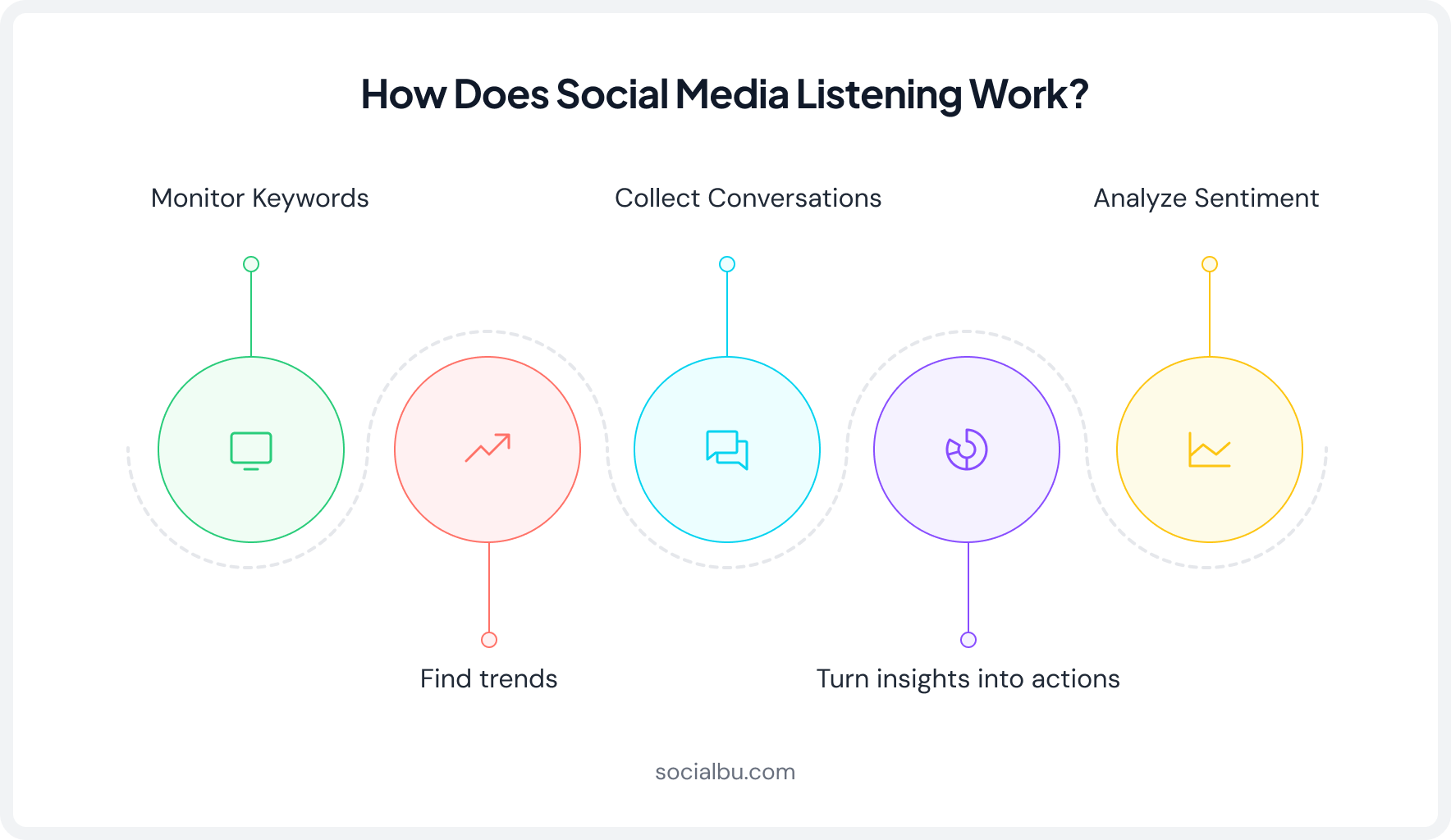
- Monitor Keywords: A listening tool is configured with your brand name, product name, executive names, common misspellings, and relevant industry terms; this is called query building, and it defines everything the tool will “hear.”
- Collect Conversations: Mentions are continuously pulled in from social media channels, news sites, blogs, forums, and review platforms, often within minutes of being posted.
- Analyze Sentiment: Each mention is scored as positive, negative, or neutral using sentiment analysis, typically powered by natural language processing (NLP) and, increasingly, by large language models for nuance.
- Find Trends: Recurring themes, volume spikes, and emerging topics are surfaced automatically, so patterns don’t get lost in the noise of individual posts.
- Turn insights into actions: The findings get routed to the team that owns them. Marketing adjusts messaging, product logs a feature request, support flags a recurring bug.
For a deeper look at the alerting side of this process, see how keyword alerts work to notify you the moment a relevant conversation starts.
What Are the Types of Social Listening?
Not all listening serves the same purpose. It’s useful to think of social listening in two broad modes, which most teams end up running side by side.
1. Reactive Listening
This is closely tied to monitoring and is about catching individual mentions as they happen so you can respond quickly. A customer tweets that a product arrived damaged; reactive listening flags it immediately, allowing support to step in.
This mode is measured in minutes, not weeks, and is the backbone of real-time customer service and crisis management.
2. Proactive Listening
Proactive listening looks at aggregated data over time to answer a different question: what does this pattern of conversation reveal about our audience, our category, or our product?
Rather than reacting to a single post, it identifies that dozens of customers over a month have independently mentioned wanting a specific feature, or that sentiment around a particular ingredient or material is trending positive across your whole category.
How Is Social Listening Different from Social Media Monitoring?
This is one of the most searched questions on the topic, and for good reason. Social listening and social monitoring sound like the same thing, but they really aren’t.
Social media monitoring is the tactical day-to-day layer: tracking mentions and responding to them. Listening, on the contrary, is the strategic layer built on top of that data, understanding the “why” behind the conversation.
Increasingly, a third layer is discussed as well: social intelligence, which weaves listening insights into cross-functional business decisions across marketing, product, support, and even HR.
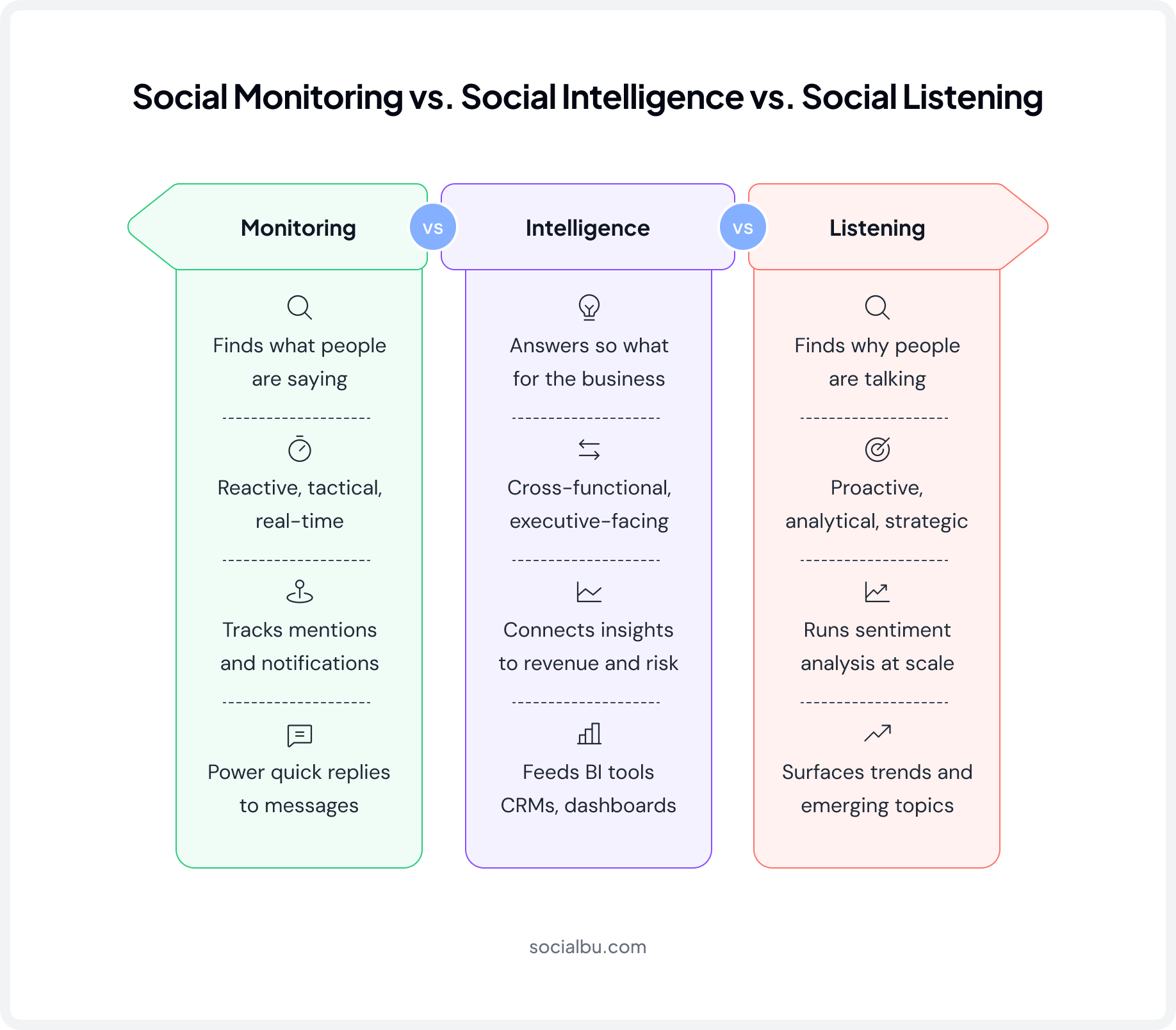
So, which one do you actually need? In practice, all three. This is a question of social media monitoring vs. listening working together rather than competing.
Monitoring gives you the raw feed, listening gives you the meaning, and intelligence connects that meaning to business outcomes. We go deeper into building the monitoring layer and how to build an effective social media monitoring strategy.
A Simple Way to Remember the Difference
Imagine a customer posts that their candle jar shattered in transit. Monitoring catches that specific post and triggers a replacement. Listening notices that “shattered” or “damaged” has appeared across dozens of unrelated posts over the past month and flags a packaging problem.
Intelligence links the packaging problem to a measurable dip in repeat-purchase rate, giving leadership a business case for replacing it.

Why Is Social Media Listening Important?
A few structural shifts have made social media listening non-negotiable rather than a nice-to-have.
1. Customers Expect Brands to Listen, Not Just Broadcast
The one-way broadcast model of social media marketing is largely over. Audiences expect a response when they raise a concern publicly, and they notice when brands stay silent. Consistent engagement is now a visible signal of how much a brand actually values its customer experience.
2. Most Brand Conversations Happen Outside Your Notifications Tab
Most of the conversation about your brand doesn’t happen in your own comments section. It happens in group chats, community forums, comment threads on other people’s posts, and review sites.
All places a traditional notifications tab will never surface. This is exactly why audience listening has to extend beyond direct mentions.
3. Viral Trends Move in Hours, Not Weeks
A shift in category conversation; a new ingredient trend, a competitor controversy, a meme format; can peak and fade within a single day. By the time a trend shows up in a monthly report, the window to act on it has often already closed.
4. Competitors Are Already Doing This
Listening has moved from an enterprise-only capability to something accessible at nearly every budget tier. That means every day without a social listening strategy is a day of leaving the information advantage to competitors who already have one.
5. AI Has Changed the Economics of Listening
What used to require a team of analysts reading every mention manually can now be automated with a social listening platform that scores sentiment, clusters themes, and flags anomalies in real time; at a volume no human team could keep up with.
Top Benefits of Social Media Listening
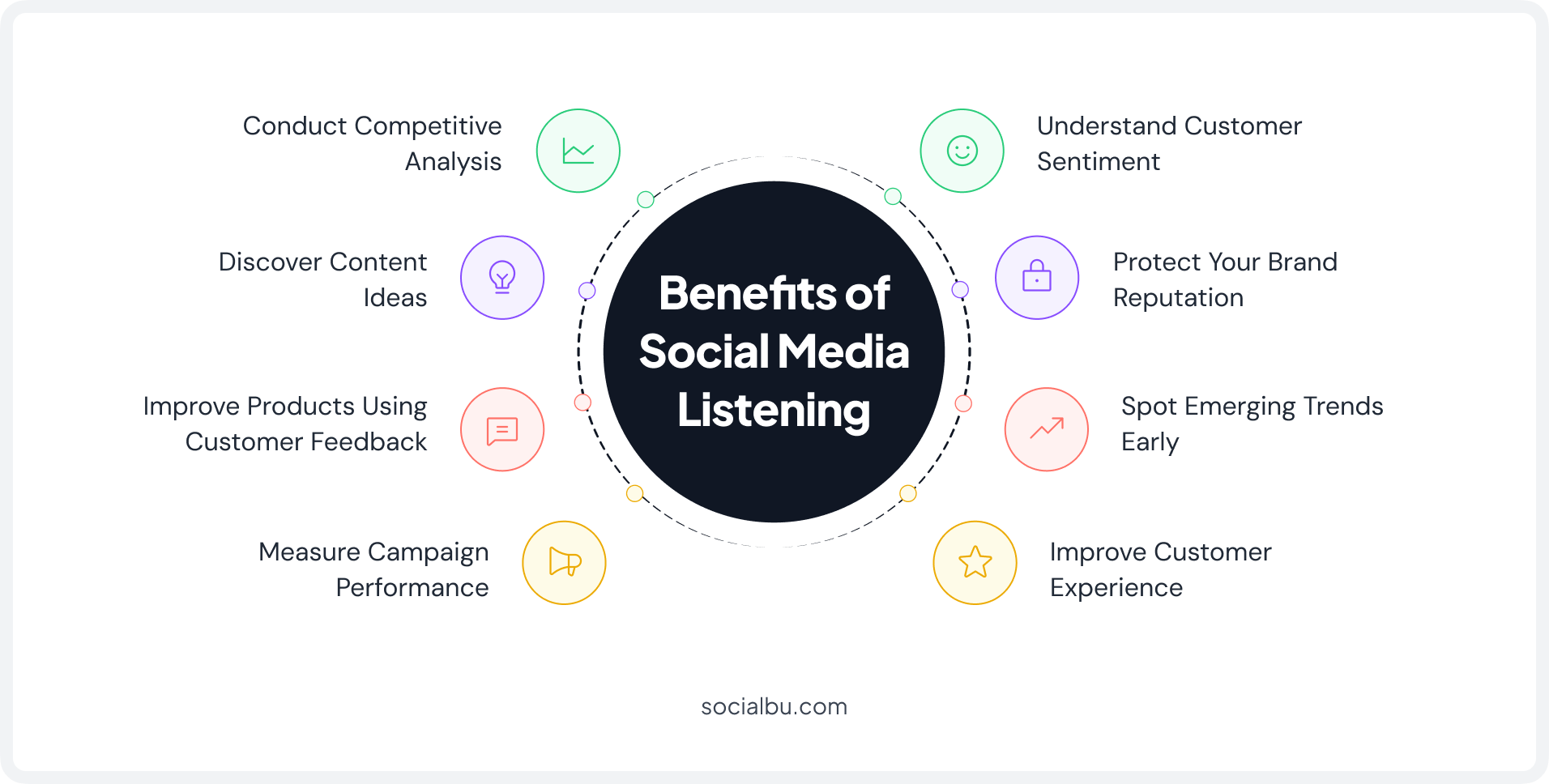
The benefits of social media listening extend well beyond marketing. Here’s where teams see the clearest return, in depth.
1. Understand Customer Sentiment
Sentiment analysis turns vague impressions into a measurable signal you can track over time, segment by product line, and compare against competitors.
Instead of guessing whether a launch landed well, teams can point to a defined shift in positive-versus-negative conversation volume.
This happens most often when sentiment is trending in a direction leadership doesn’t expect; a quiet decline over several weeks is far easier to reverse than one that shows up only after it appears in churn numbers.
2. Protect Your Brand Reputation
Reputation management is one of listening’s oldest use cases: catching a negative sentiment spike early enough to respond before it becomes a full crisis management situation.
Our guide on handling a social media incident response covers what to do once things escalate beyond routine monitoring.
The earlier the spike is caught, the more response options a team has. Early detection often means a quiet correction is possible, while late detection often means a public apology is the only option left.
3. Spot Emerging Trends Early
Listening tools consistently surface shifts in conversations before they show up in traditional research. Brands that actively listen tend to catch emerging social listening trends: new ingredients, formats, or cultural moments, well ahead of brands relying on quarterly surveys or focus groups alone.
4. Improve Customer Experience
Every complaint, question, or compliment posted publicly is a data point about customer experience. Aggregated at scale, this becomes one of the richest, most honest sources of feedback a brand has access to, precisely because it wasn’t solicited or filtered through a formal survey.
5. Conduct Competitive Analysis
Competitive analysis through listening shows you how competitors are actually perceived. Not just what they post, but how their audience genuinely reacts to it, including complaints they may not be addressing publicly.
6. Discover Content Ideas
The questions, complaints, and requests people bring up unprompted are often better content performance signals than any keyword tool, because they reflect real intent rather than inferred search volume.
7. Improve Products Using Customer Feedback
Customer feedback gathered through listening feeds directly into product development. Recurring complaints about a specific feature are often the clearest roadmap signal a product team can get, arriving before a support ticket volume even reflects the issue.
8. Measure Campaign Performance
Beyond likes and shares, listening shows you the qualitative reaction to a campaign. Whether the sentiment shift was actually positive, and whether it drove the kind of conversation the brand intended, rather than an unrelated or negative one.
What Can You Track With Social Media Listening?
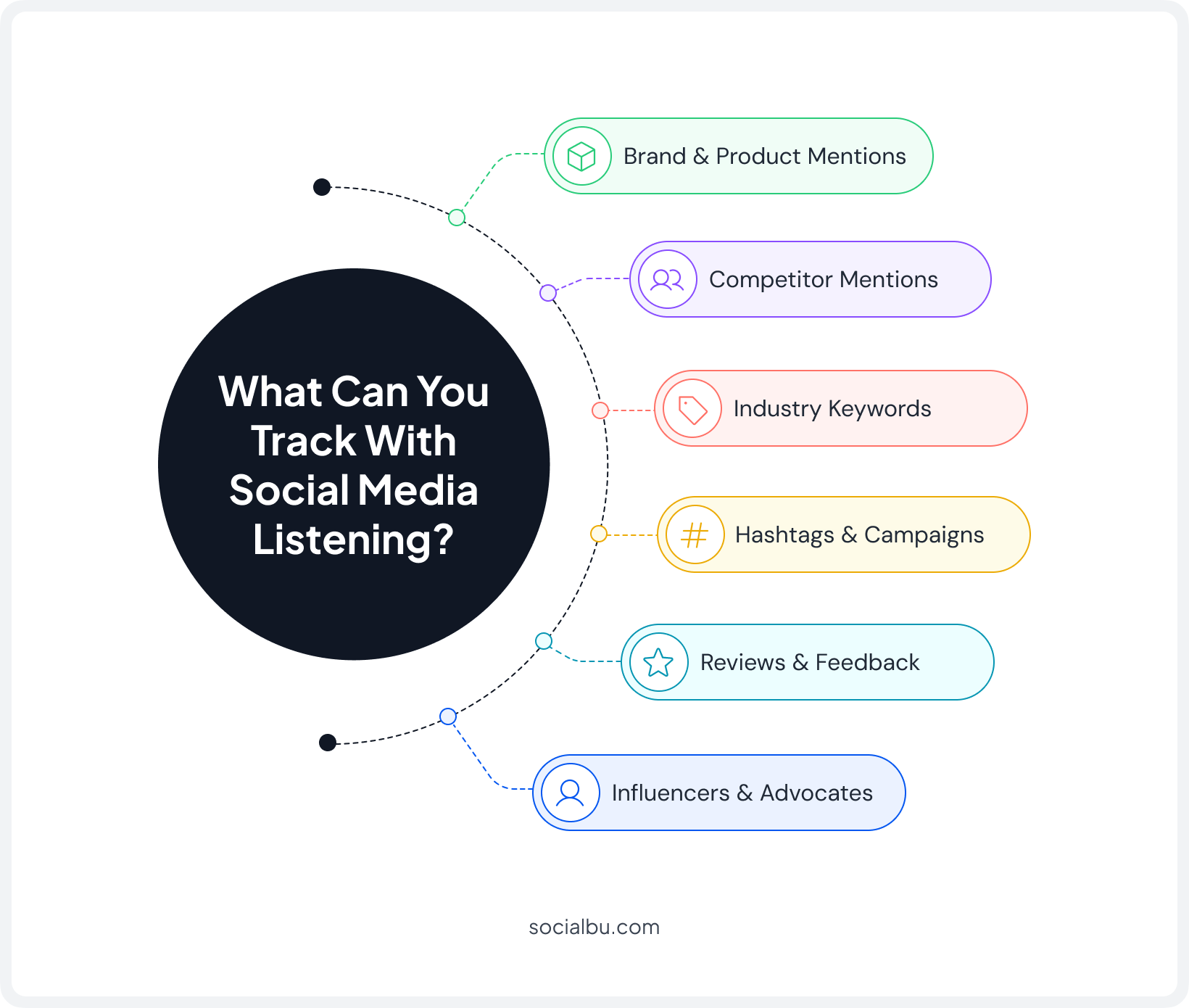
A mature social listening strategy usually covers far more than just your own brand name. Here’s what’s typically in scope, and why each category matters.
1. Brand & Product Mentions
Direct references to your brand and product names, including common misspellings. This is often the largest volume category and the easiest starting point.
2. Competitor Mentions
Tracking rival brand names surfaces sentiment gaps and unmet needs their audience is voicing publicly.
3. Industry Keywords
Unbranded category terms reveal conversations happening whether or not anyone thinks of you specifically yet.
4. Hashtags & Campaigns
Branded and unbranded hashtags show reach and how a specific campaign’s conversation is evolving in real time.
5. Reviews & Feedback
Star ratings and written reviews across marketplaces and app stores round out the picture beyond social platforms alone.
6. Influencers & Advocates
Listening often surfaces creators already talking about your product organically, before any formal partnership exists.
Widening your audience listening scope to include misspellings and unbranded industry terms is often where the most valuable, unexpected insights show up. Customers rarely spell brand names correctly in a frustrated comment.
For a closer look at managing the review side of this, see our guide to managing social media reviews and feedback.
Which Industries Need Social Media Listening?
Social listening isn’t limited to consumer packaged goods or big retail. It shows up across nearly every industry, in slightly different forms.
1. Retail & Ecommerce
Retail brands lean on listening for reputation management and trend-spotting, using it to catch shipping or quality complaints early and to identify which products are already being organically recommended by creators.
2. SaaS & Technology
SaaS companies track mentions of product names across community forums and social platforms to surface feature requests and bugs long before they appear in a formal support queue.
3. Travel & Hospitality
Review-heavy by nature, this industry uses listening to manage reputation across scattered platforms and to catch service issues, like a pricing error or a booking bug, while they’re still small enough to fix quietly.
4. Healthcare
Healthcare organizations use listening carefully and often at an aggregate level, tracking patient sentiment trends around care experiences and conditions to shape support programs and messaging, always with privacy front of mind.
5. Banking & Financial Services
Financial brands rely heavily on listening for both reputation management and compliance risk detection, given how quickly a customer complaint about fees or service can escalate publicly.
6. Agencies
Agencies run listening across multiple client accounts simultaneously, using it to demonstrate campaign impact and prove ROI beyond vanity metrics.
If you manage several brands, our guide to social media management tools for agencies covers the workflow side of this in more detail.
Real-World Social Listening Examples
Here are several realistic social listening examples of how this plays out in practice. Some hypothetical, and some drawn from reported industry case studies.
1. A Restaurant Discovers Recurring Complaints
A local restaurant group notices, through listening, that “slow delivery” appears far more often in unbranded reviews and comments than in their direct feedback form. They restructure delivery partner SLAs before they show up as churn statistics.
2. A SaaS Company Prioritizes a Requested Feature
A SaaS brand tracking product-name mentions notices the same integration request appearing across three separate community forums. It jumps to the top of the roadmap, informed entirely by unprompted customer feedback.
3. An Ecommerce Brand Finds Creators Already Recommending Its Products
An ecommerce brand runs a broader digital listening sweep and discovers several mid-size creators already featuring their product organically, without ever being tagged. That becomes the start of an influencer partnership.
4. A Brand Stops a PR Crisis Before It Grows
A sudden spike in negative sentiment around a shipping issue is caught within the hour, rather than the next morning, giving the brand’s crisis management team time to respond publicly before the story spreads further.
5. Hong Kong Airlines Turns a Pricing Error Into a PR Win
According to a case study reported by Talkwalker, an airline caught a pricing error via social monitoring, corrected it quickly, and leaned into the resulting attention rather than hiding from it. Turning what could have been a costly mistake into a significant engagement spike.
A Sport Team Reshapes Its Content Strategy Around Fan Sentiment
The same report describes a professional sports team using listening tools to analyze fan sentiment during the offseason, discovering that audiences responded far more strongly to behind-the-scenes content than promotional posts. This finding directly reshaped their content calendar.
How to Build a Social Media Listening Strategy
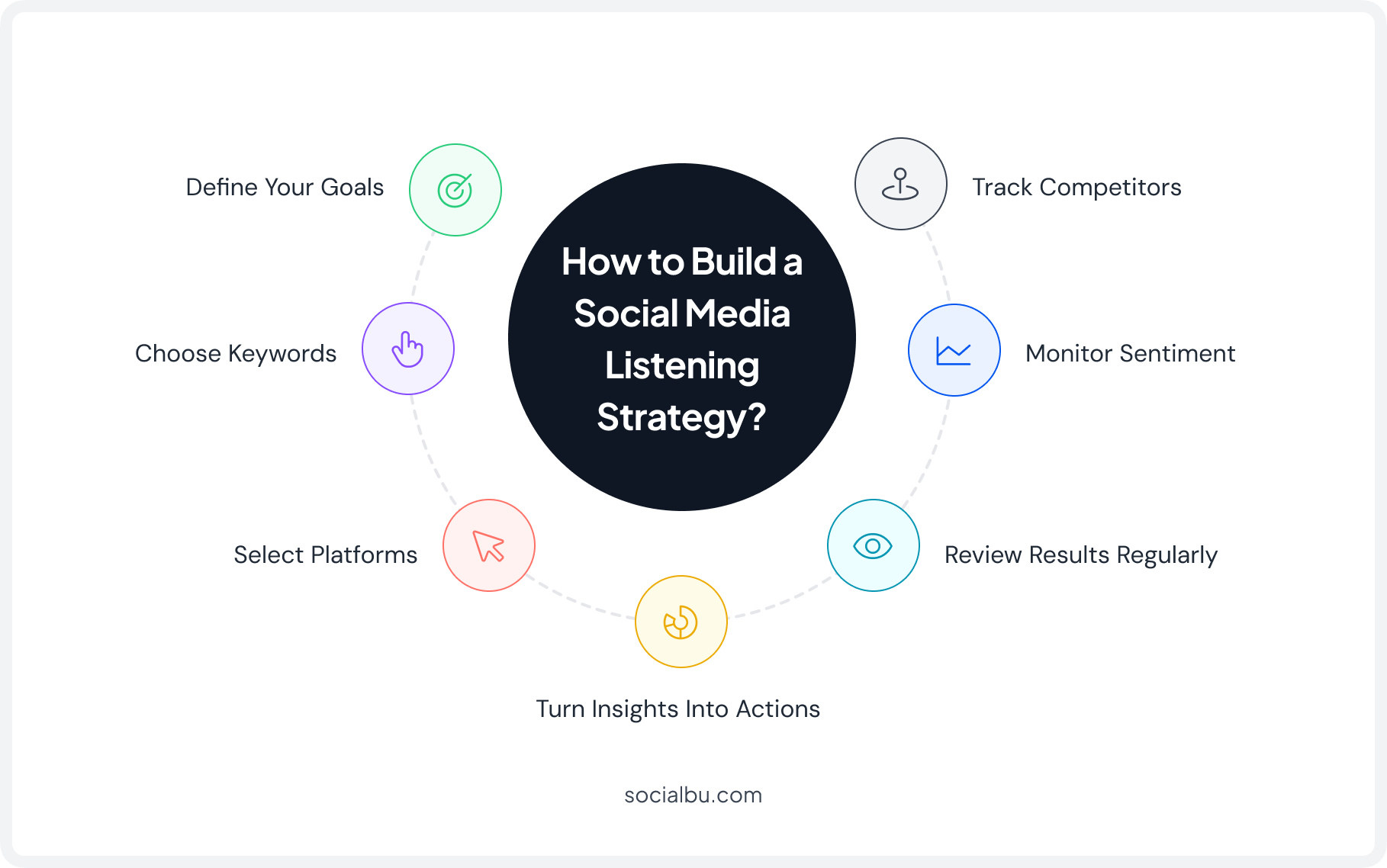
A working social media listening strategy tends to follow the same seven steps, regardless of company size.
1. Define Your Goals
Reputation management, product feedback, and campaign measurement each call for a different setup; be specific. A goal like “increase positive sentiment by 10% this quarter by responding to 90% of mentions” is far more actionable than “listen more.”
2. Choose Keywords
Brand names, product names, executive names, common misspellings, and unbranded industry terms all belong in your query.
3. Select Platforms
Prioritize where your audience actually talks. This is rarely every platform equally, and video-first platforms increasingly need their own tracking approach.
4. Track Competitors
Build a parallel keyword set, so your competitive analysis stays current alongside your own brand tracking.
5. Monitor Sentiment
Set thresholds so a real spike in negative sentiment triggers an alert, not a monthly report that arrives too late to matter.
6. Turn Insights Into Actions
Route findings to the team that owns them. Support, product, or marketing, rather than letting them sit in a dashboard no one checks.
7. Review Results Regularly
A social listening report is only useful if someone actually reviews it on a set rhythm. Whether that’s weekly for fast-moving campaigns or monthly for broader brand health.
Once your listening strategy is generating actionable insight, it should tie back into how you measure overall performance. See our guide to the top social media metrics to track for how these signals fit into a broader reporting framework.
How to Measure Social Listening ROI?
One of the most common objections to investing in a social listening service is the difficulty of proving it’s working. In practice, it’s measurable, just not through vanity metrics like raw mention count alone.
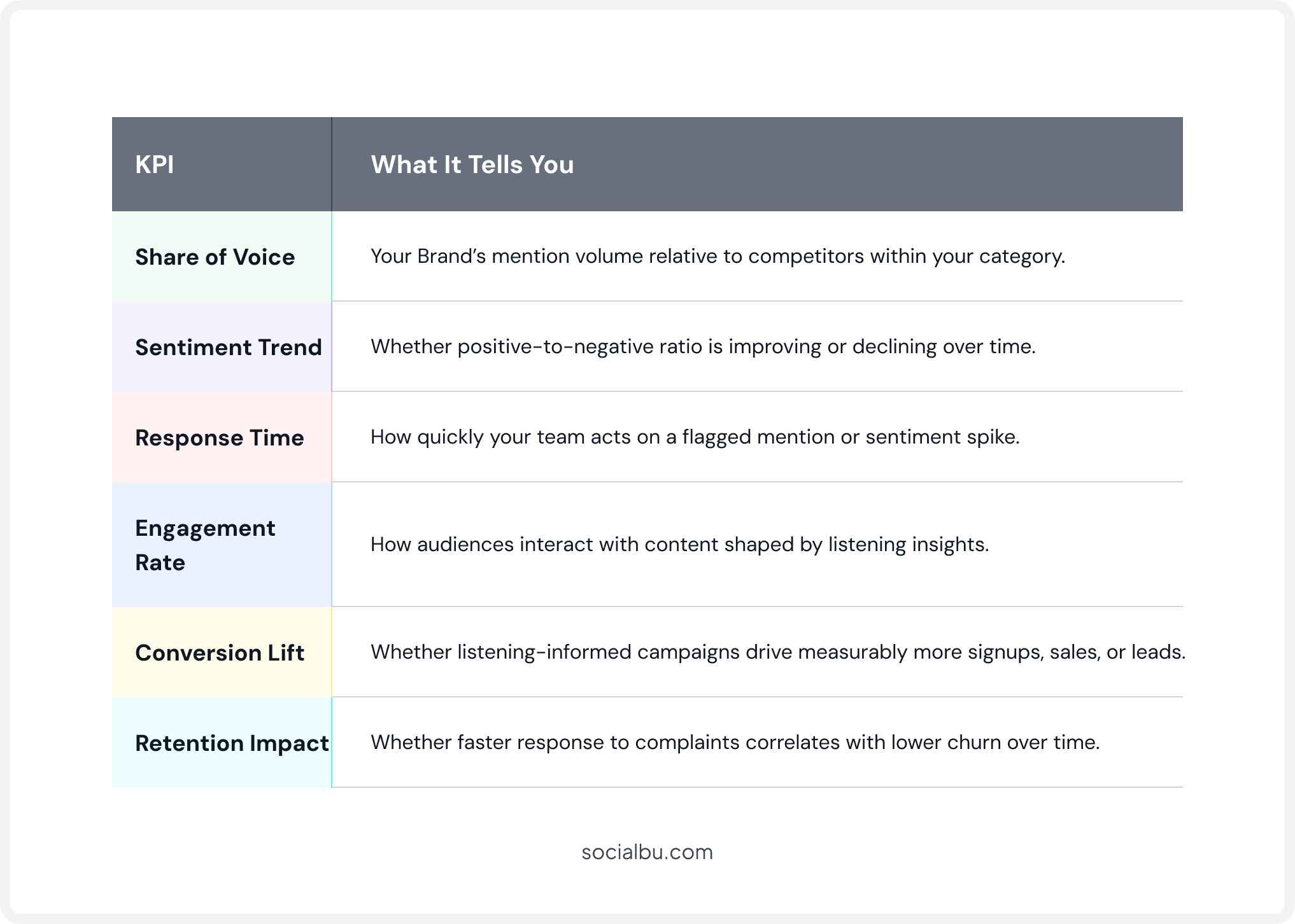
The clearest way to prove ROI is to connect these KPIs to outcomes your leadership already tracks: retention, campaign performance, or support cost, rather than treating listening as a standalone metric.
Our guide on tracking social media publishing performance covers how to connect this kind of data to business outcomes using UTM tracking and an analytics layer.
Social Media Listening Best Practices
A few social listening best practices separate teams that get real value from those that just collect data.
- Monitor beyond direct brand mentions: Track category and product-level conversation too, since most relevant discussion never tags your account.
- Track common misspellings of your brand and product names, which often account for a surprising share of total mentions.
- Treat listening as continuous, not a monthly check-in. The value compounds when trends are caught early rather than retrospectively.
- Combine qualitative and quantitative reading: Social listening data tells you volume and direction, but reading actual conversations tells you why.
- Use AI-assisted analytics responsibly: Verify edge cases such as sarcasm, slang, and mixed sentiment rather than blindly trusting automated scores.
- Create recurring reports rather than one-off experts, so trends are visible over time rather than as isolated snapshots.
- Share insights across teams, not just marketing. Product, support, and leadership all benefit from the same underlying social listening insights.
Common Mistakes to Avoid
Even well-sourced teams run into the same handful of pitfalls when they first adopt listening.
1. Tracking Only Exact Brand Name Matches
Narrow keyword sets miss misspellings, nicknames, and unbranded category conversations, where some of the richest insights live.
2. Treating Sentiment Scores as Infallible
Automated sentiment analysis still struggles with sarcasm, regional slang, and mixed emotion. Scores should guide attention, not replace human judgment on ambiguous or high-stakes mentions.
3. Collecting Data Without a Review Cadence
A dashboard no one checks regularly delivers zero value regardless of how sophisticated the underlying social listening analytics are.
4. Keeping Insights Siloed in Marketing
Product, support, and leadership teams frequently need the same conversation data marketing already has access to; failing to share it is one of the most common ways listening value gets left on the table.
5. Ignoring Data Privacy and Compliance
As listening tools scale, especially in regulated industries like healthcare and finance, teams need to be deliberate about what data is collected and how it’s stored, in line with relevant privacy regulations.
What Is a Social Listening Tool?
A social listening tool is software that automates the collection, sentiment analysis, and reporting of online conversations, so no one has to manually scroll through every platform to search for mentions.
Manual listening simply doesn’t scale; a single viral moment can generate more mentions in an hour than a person could read in a week.
A good social listening tool should offer real-time alerts, sentiment scoring, multi-platform coverage, and reporting that’s actually usable by non-analysts.
Types of Social Listening Tools
Not every social listening tool is built the same way, and understanding the categories helps you choose the right fit.
1. All-In-One Platforms
Combine scheduling, publishing, engagement, and a lighter listening layer in one dashboard. Best for small and mid-size teams that want one tool for the whole workflow.
2. Dedicated Listening Suites
Enterprise-grade platforms focused purely on deep sentiment analysis, narrative tracking, and crisis detection. Built for large brands with dedicated analyst teams.
3. Media Monitoring/PR Tools
Cover social plus traditional media, i.e., print, broadcast, and news, for teams whose reputation exposure extends beyond social platforms alone.
4. Free & Lite Trackers
Basic keyword alert tools with limited historical data and sentiment depth. A reasonable starting point for very small teams or solo founders.
What Does Social Listening Cost?
Pricing of social listening software varies widely by category. Free and lite tools can get a small business started with basic keyword tracking at no cost. Mid-tier, all-in-one platforms typically run in the $20- $100+ per month range, depending on the plan and account volume.
Dedicated enterprise social media listening suites often start at around $1,000 per month for a set volume of tracked mentions, scaling significantly with data volume and seats.
What Makes a Good Social Listening Platform?
Before choosing a social listening platform, run it against this checklist.
- Keyword tracking across multiple variations and misspellings
- Built-in sentiment analysis that goes beyond simple positive/negative scoring
- Coverage across multiple platforms, not just one social network
- Competitor tracking alongside your own brand
- Clear, exportable dashboards that non-analysts can actually read
- AI-assisted insight summaries that surface themes, not just raw counts
- Scheduled, shareable reporting for recurring stakeholder reviews
- Real-time alerts for sentiment spikes and crisis-level mentions
How to Do Social Media Listening with SocialBu
Here’s exactly how to do social listening using SocialBu, step by step:
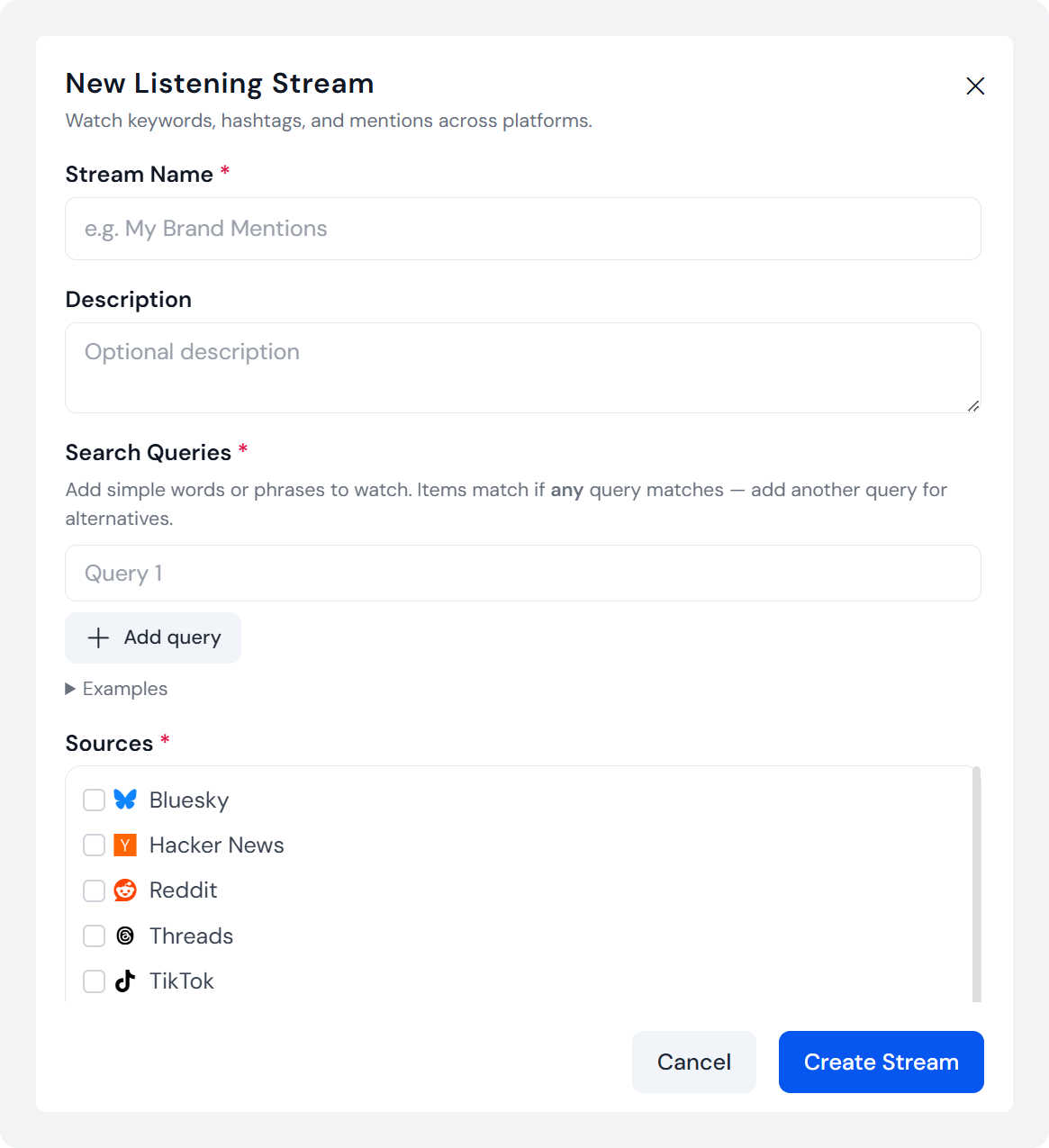
1. Open the Listening Dashboard
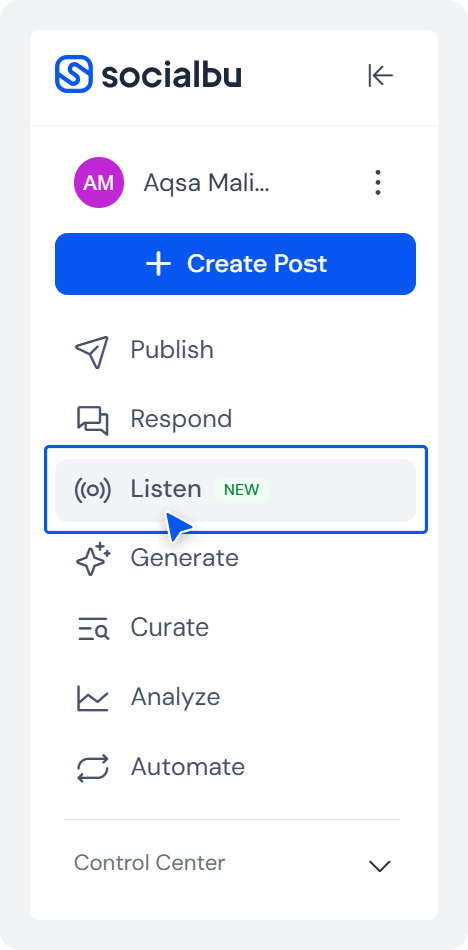
Log in to your SocialBu account and select “Listen” from the left-hand menu pane.
2. Add a New Stream
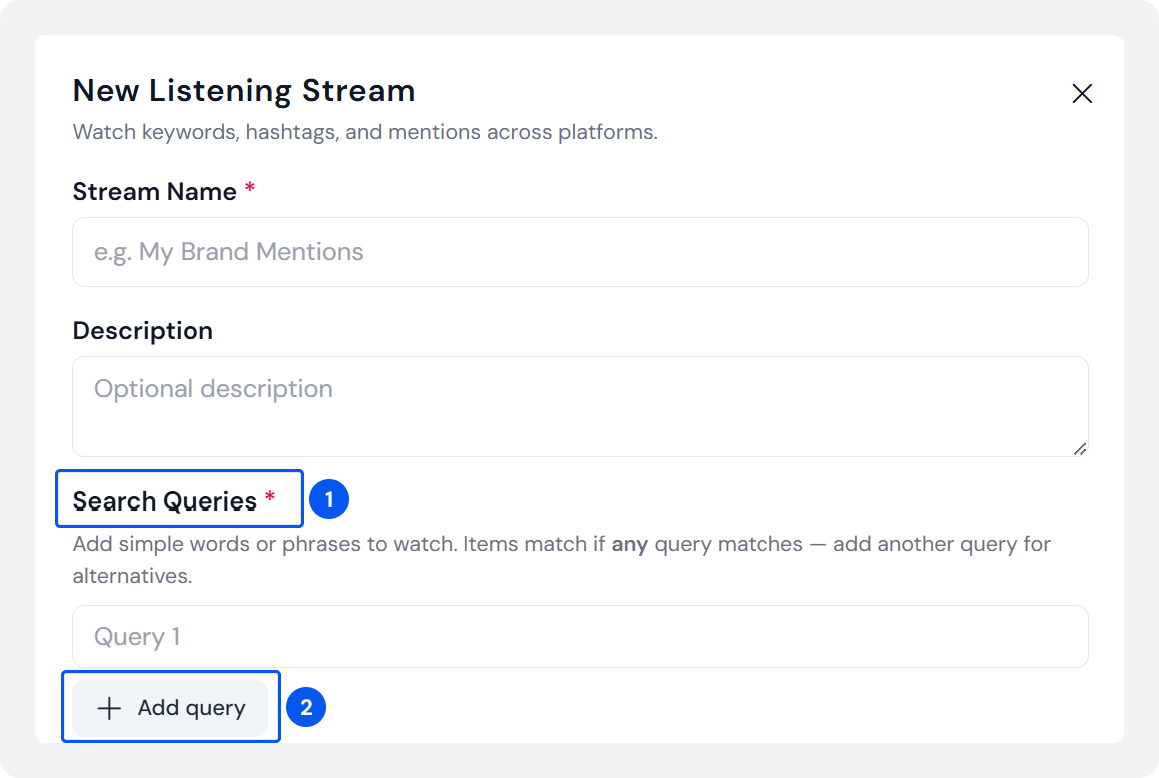
Click “New Stream” at the top. Name your Stream and add a short description specifying what you want to achieve with this listening stream.

3. Add Search Queries
In the Search Queries section, type in the keywords and phrases you want to track. You can click “Add query” if you want to add more search queries.
4. Select the Platforms
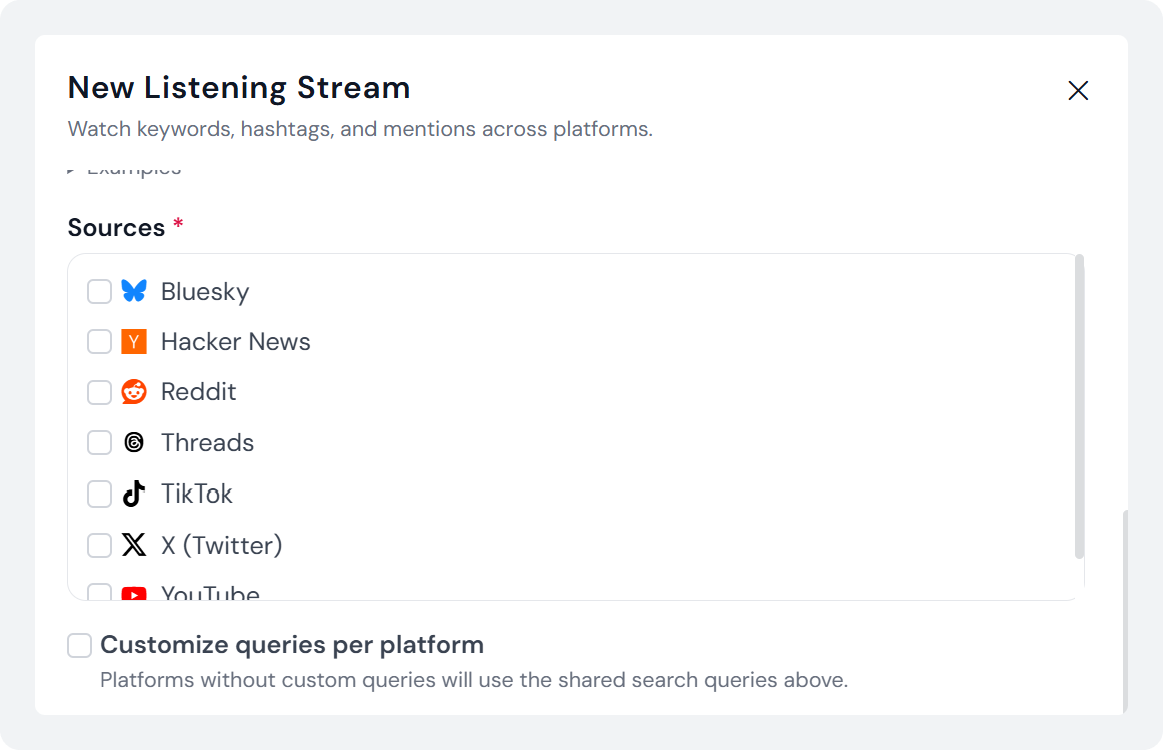
You can now select the social media platforms you want to listen to. If you don’t want to customize queries per platform, you can do that too.
5. Select AI Analysis Features
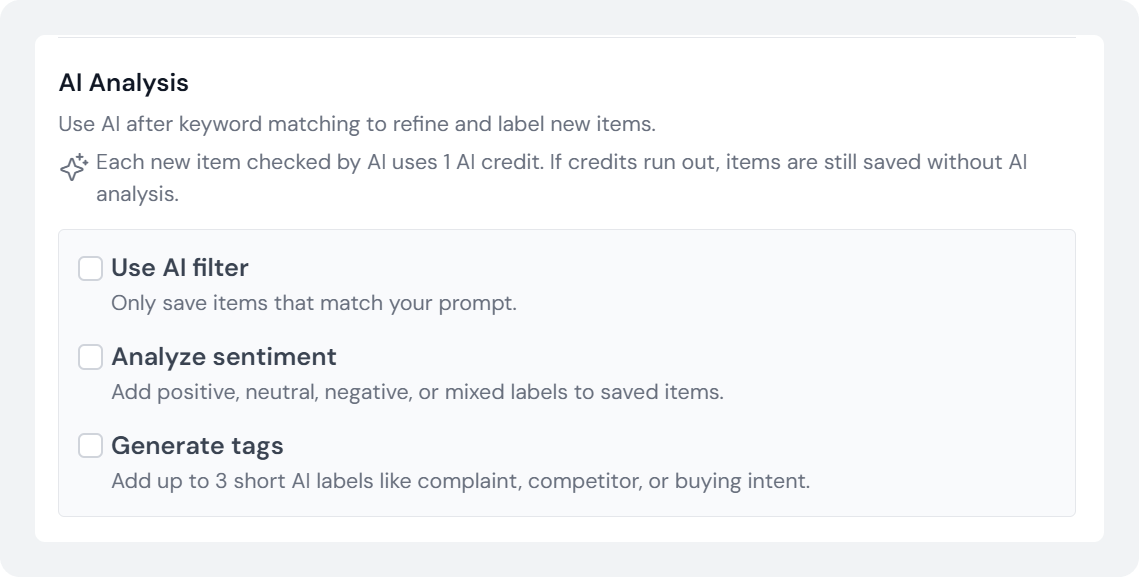
To make the whole process easier and more straightforward for you, SocialBu allows you to select AI analysis. This includes AI filter, sentiment analysis, and tags generation.
6. Create the Stream
Once you’ve selected everything, click “Create Stream” at the end. Your stream will be successfully created.

7. Turn Insights into Content and Engagement
Route what you find into your content calendar or directly into a reply from the unified inbox.
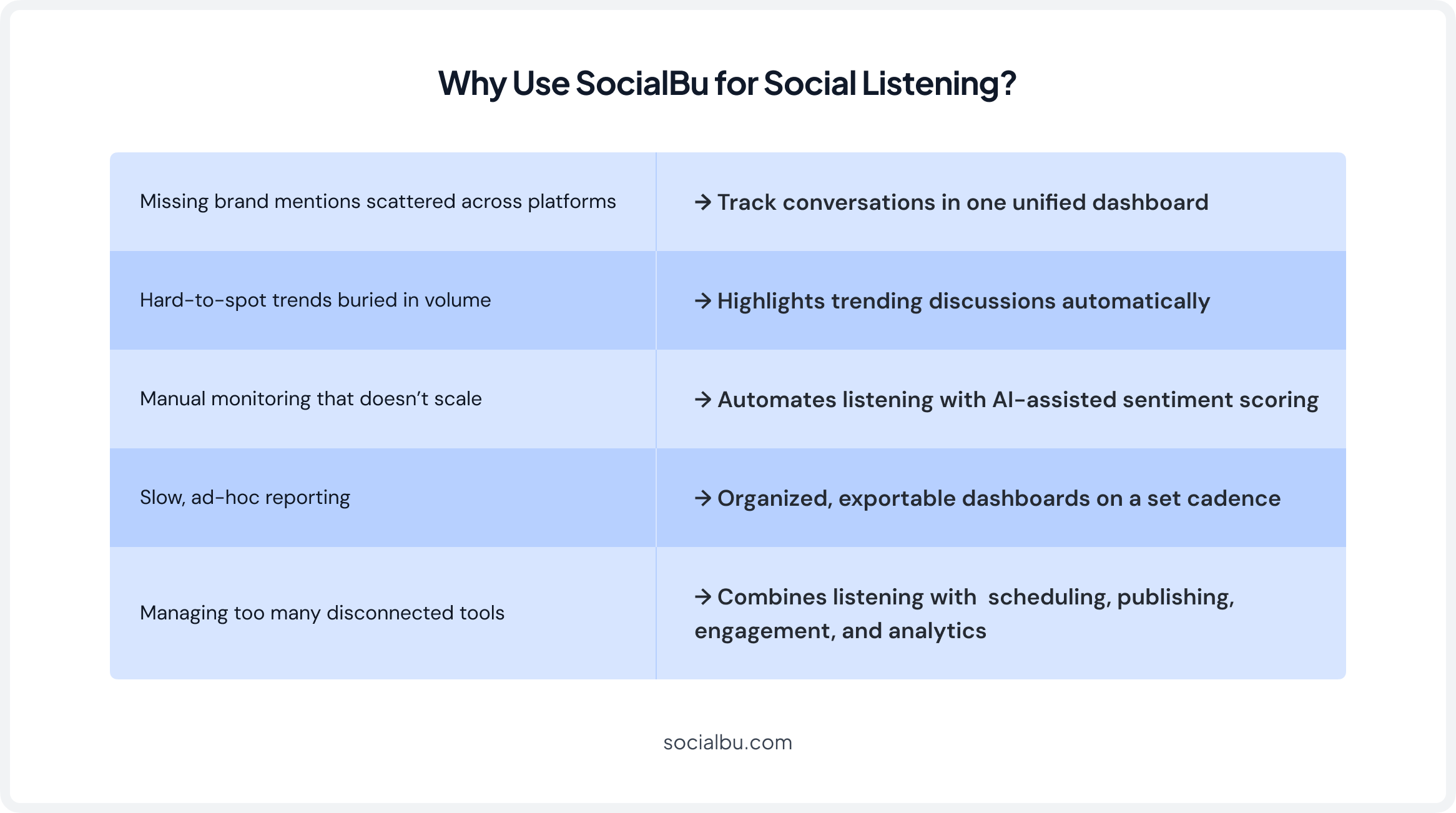
Why Use SocialBu for Social Listening?
Rather than a feature dump, here’s how SocialBu answers the actual problems teams run into.
See What Say About Your Brand!
SocialBu combines social listening with scheduling, publishing, and a unified inbox.
The Future of Social Media Listening
A few shifts are worth watching as social listening tools mature.
- AI-powered insights that move past basic positive/negative scoring into emotion and intent detection.
- Predictive analytics that flag a likely trend or crisis before it fully forms, rather than reporting on it after the fact.
- Voice and video listening, as more conversation moves into short-form video and audio formats that text-based tools historically missed.
- Better sentiment detection, including sarcasm, mixed emotion, and cultural or regional nuance.
- Cross-platform intelligence that unifies signals from social, review sites, forums, and even private messaging apps.
- Deeper business-intelligence integration, with listening data flowing directly into CRMs and executive dashboards rather than living in siloed reports.
- Privacy considerations, as regulation increasingly shapes what listening data can be collected and how it’s sorted.
An industry analysis from Mordor Intelligence notes that generative AI is already being used to classify sentiment across languages and formats at a level of nuance that was previously impossible to automate, which is likely to keep pushing the underlying social listening software forward quickly.
Conclusion
Every brand already has an audience talking about it; the only question is whether anyone’s listening.
A solid social listening strategy turns scattered mentions into actionable insights, protects brand health before small issues become a crisis, and gives marketing, product, and support teams the same real-time data to work from.
Whether you’re just starting to explore what social media listening is or ready to build a more structured listening strategy, the right tools make all the difference.
With SocialBu, you can monitor brand mentions, track conversations, engage with your audience from one dashboard, and turn valuable insights into smarter social media decisions. Instead of juggling multiple tools, you can manage listening, publishing, and engagement in one place.
Start using SocialBu today to stay ahead of every conversation, understand your audience better, and build a stronger brand with confidence.
Ready to Start Listening?
Track brand mentions, analyze sentiment, and turn conversations into content, all from one dashboard.
FAQs
Q: Why is social media listening important?
Conversations about your brand happen constantly, often without a direct tag. Listening lets you catch reputation risks early, understand real customer sentiment, and act on trends before they pass.
Q: How does social media listening work?
It typically follows five steps: monitoring keywords, collecting conversations, analyzing sentiment, identifying trends, and turning those insights into action across marketing, product, or support teams.
Q: What is a social listening strategy?
A social listening strategy is a documented plan that covers goals, tracked keywords, platforms, competitor terms, sentiment thresholds, and a regular review cadence to turn insights into action.
Q: What are some examples of social listening?
Examples include a brand catching a shipping complaint trend before it escalates, a SaaS company prioritizing a feature based on forum requests, or a brand discovering creators organically recommending its product.
Q: What are the different types of social listening tools?
Types range from standalone listening and sentiment platforms to all-in-one social media management tools with built-in listening, like SocialBu, to media-monitoring suites for PR-heavy teams.
Q: Can small businesses benefit from social media listening?
Yes. Social listening gives small businesses a way to understand their niche audience, track local competitors, and identify growth opportunities without a large research budget.
Q: Is social media listening free?
Basic listening is available for free with lightweight keyword-alert tools, but these options typically offer limited historical data and shallow sentiment analysis compared to paid platforms.