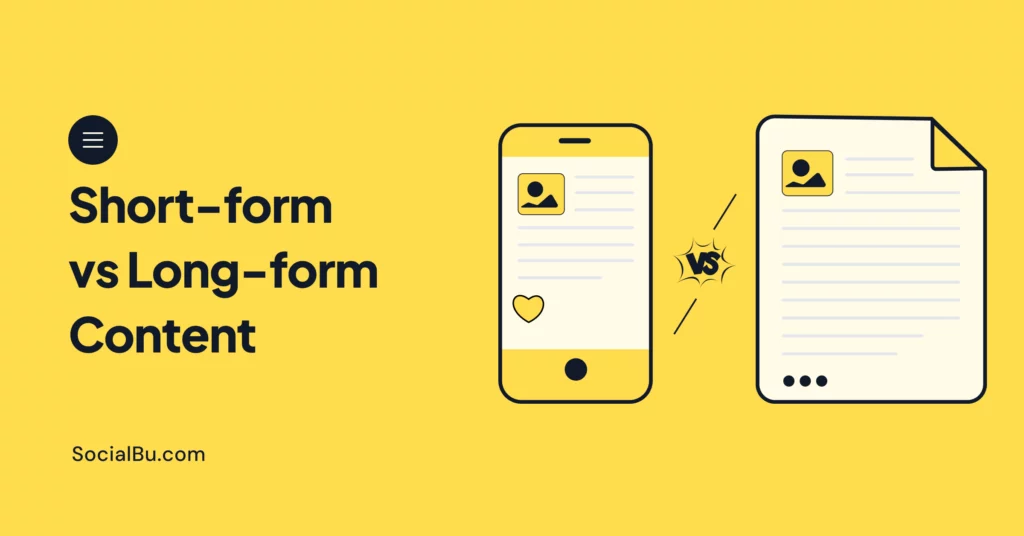
Let me be honest with you. When someone asks me about Short-Form vs. Long-Form Content, I generally don’t have a one-line answer, because the reality is much more complex.
I’ve watched brands go all-in on 60-second reels and build audiences of hundreds of thousands, only to find they couldn’t convert a single one of them. I’ve also seen B2B companies publish a single 3000-word guide that ranks on Google and generates warm leads for three years straight. And I’ve seen the opposite of both.
Here’s what I know for sure: the short-form vs. long-form content debate isn’t really about format. It’s about strategy.
In this guide, we’re covering everything: the data, the platform nuances, the real-world use cases, and the exact moments when you should reach for a 30-second Reel versus a 2,500-word pillar post.
Let’s get into it.
Key Takeaways
- Short-form content wins attention.
- Long-form content wins trust.
- Your goal should determine the format.
- The best strategy is hybrid.
- Different platforms reward different behaviors.
- Attention spans aren’t shrinking; tolerance for weak content is.
- Consistency matters more than volume.
- The smartest brands use short-form for discovery and long-form for conversion.

First Things First: What Do We Actually Mean?
Before moving towards the part where we discuss which content type actually works, let’s first have a look at what we actually mean by short-form and long-form content.
What Is Short-Form Content?
Short-form content is anything designed to be consumed quickly, usually in under a minute or two. On social media, that means:
- TikTok videos and Instagram Reels (under 90 seconds)
- YouTube Shorts (up to 3 minutes)
- Instagram Stories, carousels, and single-image posts
- X (Twitter) posts, LinkedIn micro-posts
- Short blog posts or news articles under 800-1,000 words
- Email newsletters with quick takes or curated links
The defining quality of short-form content isn’t just length; it’s immediate value delivery. The audience gets something useful, entertaining, or thought-provoking within the first few seconds.
What Is Long-Form Content?
Long-form content goes deep. It gives ideas room to breathe, arguments space to develop, and readers reason to stick around. On social media and blogs, this includes:
- Long-form YouTube videos (10+ minutes)
- Detailed blog posts and guides (1,500-5,000+ words)
- LinkedIn long-form articles and newsletters
- Podcasts, webinars, and in-depth interviews
- Ebooks, whitepapers, and case studies
- Pillar pages and resource hubs on your website
The State of Content: What the Data Actually Tells Us?
Before we talk strategy, let’s look at the landscape. What’s actually happening with content consumption right now when it comes to Short-Form vs. Long-Form Content? The numbers are striking, and they paint a more nuanced picture than the “short-form is taking over” narrative you might have heard.
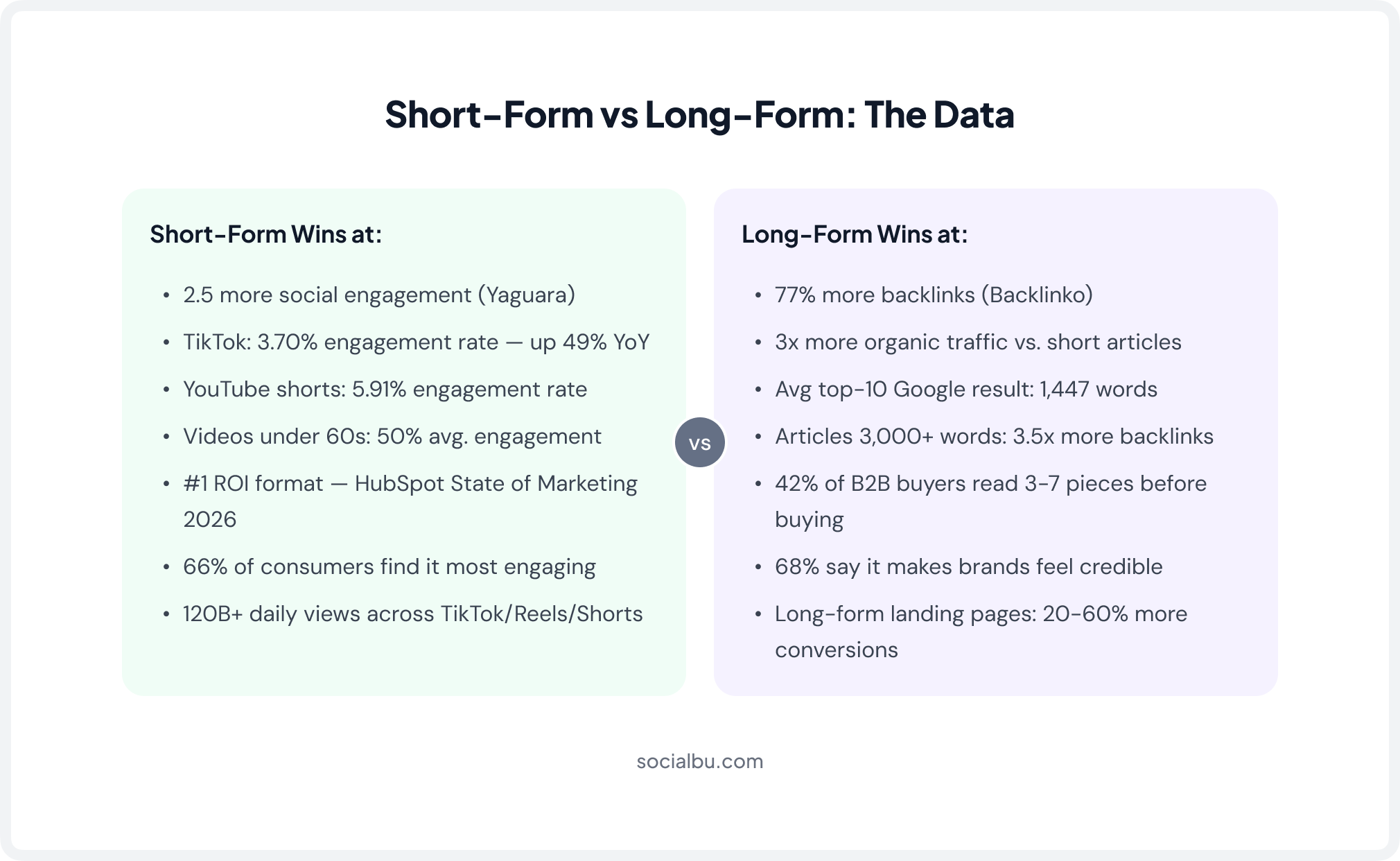
Short-Form Is Winning the Attention Game
There’s no denying it: short-form video is dominating the social media landscape in 2026. Here’s what the data looks like:
Short-Form Content Statistics 2026 |
Short-form videos get 2.5x more engagement than long-form on social platforms. (Yaguara) |
66% of consumers find short-form videos the most engaging content type. (Yaguara) |
TikTok’s engagement rate surged to 3.70% in 2025, up to 49% year-over-year. (Thekeyword.co) |
YouTube Shorts has 2 billion monthly users and generates 200+ billion views per day. (DemandSage) |
Instagram Reels drive 67% of total Instagram engagement. (InfluenceFlow) |
Videos under 90 seconds retain ~50% of viewers of viewers on average. (MarketingLTB) |
47% of marketers say short-form videos are the most likely format to go viral. (Yaguara) |
The attention economy has clearly shifted. People are scrolling faster, deciding quicker, and demanding that content earn their attention in the first 3 to 5 seconds. That’s not a trend; it’s a fundamental behavior change. Short-form content strategy in 2026 isn’t optional for brands that want visibility and reach.
But Long-Form Is Winning the Trust Game
Here’s what gets interesting. While short-form content dominates reach and engagement metrics, long-form content is doing something entirely different: building authority, driving SEO, and converting visitors into customers.
Long-Form Content Statistics 2026 |
Long-form blog posts (1,500 + words) generate 3x more organic traffic than short articles. (Marketing LTB) |
Articles over 3,000 words get 2x more social shares than articles under 1,000 words. (Marketing LTB) |
Long-form content (2,000 + words) earns 77.2% more backlinks than short-form pieces. (Marketing LTB) |
The average top- 10 Google result is ~1,447 words long. (Backlinko) |
Long-form landing pages can increase conversions by 20-60%, depending on industry. (Marketing LTB) |
68% of consumers say long-form articles make a brand feel more credible. (Marketing LTB) |
LinkedIn long-form posts get 3x more dwell time than short status updates. (Marketing LTB) |
42% of B2B buyers read 3 to 7 long-form content pieces before contacting sales. (Marketing LTB) |
So if you’re a brand asking, “Is long-form content still relevant for SEO in 2026?” the answer is an emphatic yes. In fact, Google’s evolving algorithms and AI-powered search features reward depth and expertise; a long-form content strategy in 2026 is arguably more important than ever.
Short Form vs. Long Form: Pros and Cons (Honestly)
Both formats have real advantages and real limitations. Here’s the honest breakdown of Short-Form vs. Long-Form Content without the usual marketing spin that one format is universally superior.
Pros and Cons of Short-Form Content
The case for short-form:
- Easier for audiences to consume
- Discovery-first algorithms push it to non-followers
- Faster and cheaper to produce at scale
- Highly shareable and re-watchable (short videos get shared 1,200% more than links and text combined ∼ DemandSage)
- Immediate feedback loop – you know within 24 hours whether the content resonated
The honest downsides:
- Can’t cover complex topics with depth
- Short shelf life
- Hard to believe genuine authority in competitive niches with short-form alone
- Can feel repetitive without a well-planned content strategy
Pros and Cons of Long-Form Content
The case for long-form:
- Ranks on Google (the average top-10 result is 1,447 words ∼ Backlinko)
- Earns backlinks (content over 2,000 words earns 77% more backlinks than short content ∼ Resourcera)
- Builds authority and trust
- Evergreen value
- Better conversions
- Repurposing; one long-form piece becomes 10+ short-form assets
The honest downsides:
- More time and resources to produce long-form content
- Lower immediate social engagement
- Slower feedback loop; SEO results take weeks or months to show up
- If the content doesn’t provide value, it ranks for nothing and converts no one
How to Choose Between Short-Form and Long-Form Content?
Regarding the Short-Form vs. Long-Form Content, here’s where most content strategy guides fail; they give you a generic “use both” answer and call it a day. That’s not useful. You need a decision framework. Here’s the one that actually works.
1. Identify Your Goals First
The single most important factor in choosing your content format is what you’re trying to accomplish with that specific piece. Different formats are built to do different jobs, and using the wrong format for a job is like using a hammer to drill a screw.
Use long-form content when:
- You want to rank on Google for high-intent keywords
- You’re building brand authority and thought leadership in a competitive niche
- You’re nurturing B2B leads who need multiple touchpoints before buying
- You want to create an evergreen asset that keeps generating traffic and leads
- You’re covering a complex topic that genuinely requires both
Use short-form content when:
- You want to grow your social media following fast
- You are building brand awareness with audiences who don’t know you yet
- You’re promoting something timely: a product launch, a sale, a trending topic
- You want high engagement: comments, saves, and shares on social platforms
- You’re repurposing insights from a long-form piece you’ve already created
Think about it this way: if someone asked you to convince a stranger to buy a $5,000 B2B software subscription, would you do it in a 30-second video? Probably not.
But if you wanted to introduce a stranger to your brand for the first time? A 30-second Reel is perfect. Format follows goal; every time.
2. Understand What Your Audience Actually Wants
Knowing your audience’s preferences changes everything. An audience of senior B2B decision-makers behaves very differently from an audience of Gen Z consumers. One group wants depth, evidence, and authority signals. The other wants speed, entertainment, and an authentic personality.
The platform your audience uses is a major clue. Audiences on TikTok and Instagram are primed for short-form; they’re in discovery mode, scrolling, looking to be entertained or quickly educated. Audiences using Google search or LinkedIn newsletters are in research mode; they’re actively seeking depth.
What to look for when analyzing your audience:
- Age & platform preference: Younger audiences prefer short-form content, while B2B audiences prefer long-form content.
- Purchase complexity: Higher-ticket products and longer sales cycles require more extensive trust-building.
- Content consumption behavior: Do they watch videos to completion? Do they save posts? Do they click through to blog links?
- Where they enter the funnel: Are they discovering you via TikTok or via Google?
SocialBu’s analytics dashboard shows you platform-by-platform performance data: engagement rate, reach, saves, clicks, and audience growth for every post across every connected platform.
After 30 days of consistent posting, you’ll see a clear picture. Which platform responds better to short-form, which audience engages with long-form promotions, and which format drives the most clicks to your website. That data should drive your short-form-to-long-form ratio, not gut feeling.
3. Consider the Platform (Each One Has Its Own Rules)
Every platform is built around a specific content behavior. Ignoring this is one of the most expensive content strategy mistakes a brand can make. Here’s what every platform is actually built for:
Platform | Built for | Best Format | Key Metric |
TikTok | Discovery, Entertainment, Virality | Short video: 21-34 sec | Completion Rate |
Instagram Reels | Reach non-followers | Short video: 15-30 sec | Saves & Shares |
Instagram Carousels | Education and saves | 7 to 10 slides | Saves |
YouTube Shorts | Channel discovery engine | Short video: 30-60 sec | Views & Subscribers |
YouTube Long-Form | Watch time, loyalty, monetization | Video: 10-30 min | Watch Time |
LinkedIn Posts | Daily professional visibility | Text: 150-300 words | Dwell Time & Comments |
LinkedIn Articles | Thought leadership and authority | Written: 800 to 2,000 words | Followers & Reads |
Blog (Google SEO) | Search traffic and backlinks | Written: 1,500 to 3,000+ words | Organic Traffic |
Email Newsletter | Direct audience relationship | Short: 300-500 words/ Long: 1,200-2,400 words | Open Rate & CTR |
X (Twitter) | Real-time conversation and news | Post: under 280 characters or thread | Impressions |
Community engagement and groups | Video: 30-60 sec or long video in groups | Reach |
Managing a multi-platform content strategy manually, where each platform needs a slightly different format, caption length, and posting time, is where most small teams hit a wall.
SocialBu’s multi-platform scheduler lets you create one post and customize it for each platform before scheduling, with different caption lengths, hashtags, and formats, all managed from a single content calendar.
You can bulk schedule weeks of content in one sitting: Reels, TikToks, LinkedIn Posts, YouTube Shorts, X threads, and more. One dashboard. No tab-switching. No manual cross-posting.
4. Think About Search Intent (Especially for Blog Content)
When deciding on Short-Form vs. Long-Form Content, think about search intent first. If you’re creating content that you want to rank on Google, search intent is the single most important factor in determining your format. Search intent is the reason someone typed a specific query, and Google ranks the content that best matches that intent.
There are four types:
- Informational: What is short-form content? Users want to learn in this stage.
- Commercial: Best social-media scheduling tool; User is comparing options.
- Navigational: SocialBu login; User wants to go somewhere specific.
- Transactional: Buy SocialBu Pro; User is ready to act.
The rule of thumb: informational and commercial intent = long form. The user is in research mode, and Google rewards comprehensive, authoritative content. Transactional intent = short-form landing pages with a clear CTA and minimal friction.
5. Evaluate Topic Complexity
Some topics need depth. Others don’t. A simple rule: if you can genuinely answer the question in 30 seconds, short-form is right. If a 30-second answer leaves the viewer with more questions than when they started, it needs to be long-form.
- Topics that need short-form: Quick tips and hacks, product announcements, trending topics, motivational content, behind-the-scenes moments, simple how-tos.
- Topics that need long-form: How strategies actually work (not just what they are), comprehensive how-to guides, topic comparisons, research-backed analysis, case studies, B2B buyer education.
A common mistake: publishing “short-form” versions of complex topics, i.e., 500-word blog posts on “how to build a content strategy” that rank for nothing because they’re neither comprehensive enough to rank nor short enough to deliver immediate value. That’s the content dead zone. Don’t live there.
6. Figure Out What Can Be Repurposed
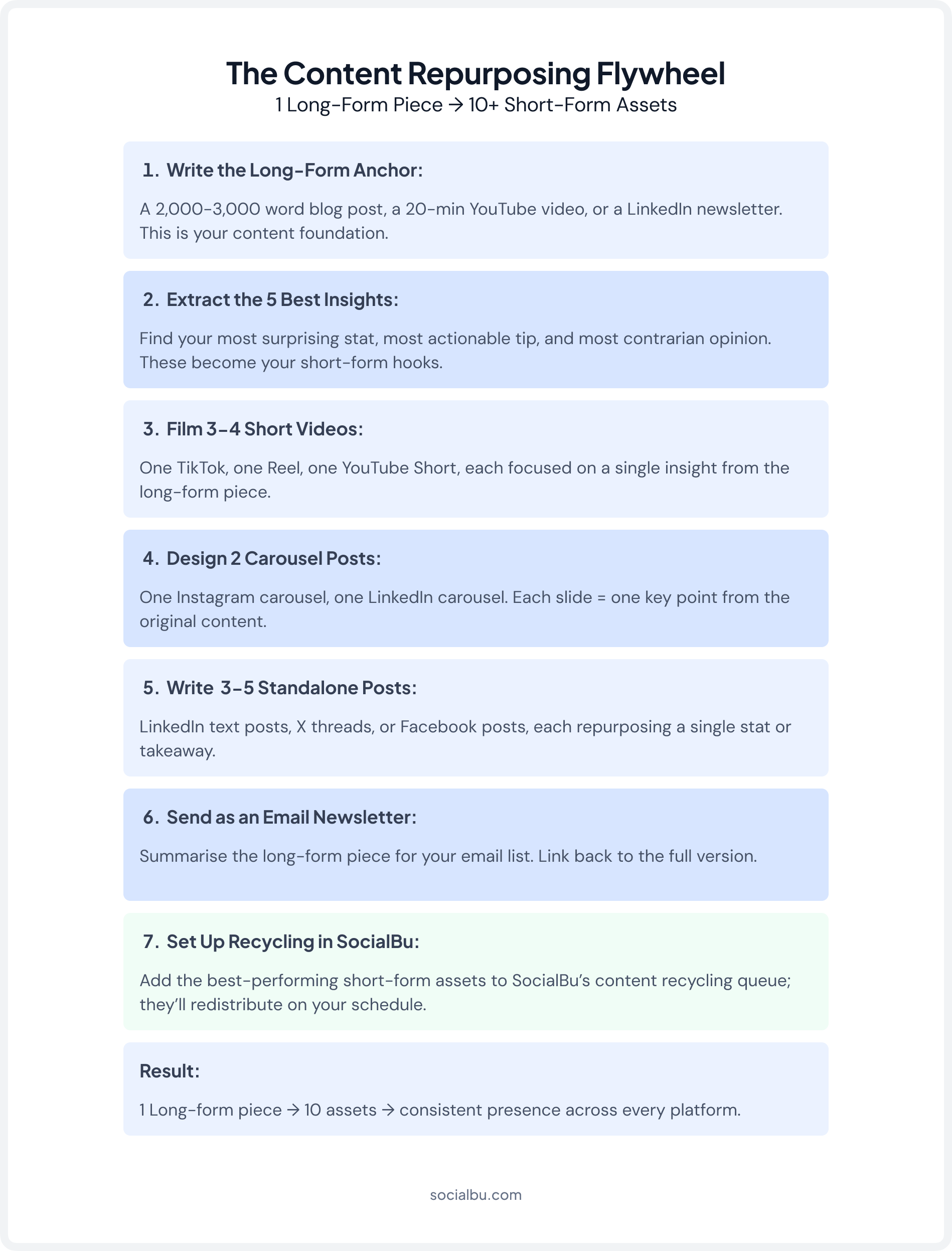
One of the most underused content strategies in 2026 is starting with long-form and repurposing it. Instead of trying to create original short-form content every day, you create one comprehensive long-form piece per week and turn it into 8-10 short-form assets.
 Also Read: Learn how you can Repurpose Long-Form Content into Posts and Videos to scale your content creation.
This means your short-form content always has substance, because it comes from something deeper. And your long-form content gets the distribution it deserves through short-form amplification.
Once your long-form blog post or YouTube video is ready, open SocialBu’s AI Writer.
Paste in your long-form content (or paste the key points). The AI generates platform-specific captions tailored for TikTok, Instagram, LinkedIn, and X, with different tones, lengths, and hook styles for each platform.
In 10 minutes, you have a full week of short-form content delivered from one long-form piece. No blank-page syndrome. No rewriting the same idea five times manually.
Then use SocialBu’s bulk scheduler to queue everything up at once, and you’re done.
Streamline Your Content Strategy with SocialBu
Create short-form content faster, repurpose long-form content effortlessly, and manage every platform from one place.
Short-Form Content Across Platforms: What Works Where?
Platform strategy is where generic content advice falls apart. What works on TikTok will often flop on LinkedIn. Here’s what the data actually says per platform, and how to approach each one.
Instagram: Reels for Reach, Carousels for Saves
Instagram in 2026 has two clear winners: Reels get reach (the algorithm pushes them to non-followers) and carousels get saves (the most powerful engagement signal on the platform because it means “this is worth coming back to”).
- Reels under 30 seconds outperform longer Reels on completion rate, which is Instagram’s primary distribution signal.
- The first 1-3 seconds of a Reel are everything; treat it like a headline, not an intro.
- 7 to 10 slide carousels with one idea per slide are the highest-saving format for educational content.
- Stories serve a different serve: real-time engagement, polls, behind-the-scenes, limited-time offers; they’re not for long-term visibility.
With SocialBu, you can schedule your Instagram Reels, carousels, and Stories weeks in advance from a visual calendar, with a post preview so you can see exactly how each post looks before it goes live.
Similarly, thanks to the unified inbox feature of SocialBu, all your Instagram comments, DMs, and story replies are pulled into one inbox; you respond without ever opening the app.
TikTok: The Completion Rate Game
TikTok’s algorithm is genuinely democratizing. A brand-new account with zero followers can go viral today based solely on content quality and completion rate. That’s not an accident; TikTok is designed to surface good content regardless of follower count. Which means the only thing standing between you and massive reach is whether people watch your video to the end.
- 21-34 seconds is the TikTok sweet spot, long enough to deliver value, short enough to maximize value.
- The first frame is the scroll-stopping hook; if it doesn’t create an immediate question or tension, the video won’t get distributed.
- Trending audio still boosts reach, but original audio is increasingly rewarded for niche B2B topics.
- Text overlays are essential; 69% of people watch social video with sound off in public settings. (Forbes)
SocialBu supports native TikTok scheduling. Plan your TikTok content calendar and auto-publish from the same dashboard you use for Instagram, LinkedIn, and YouTube. Set up keyword-triggered auto-replies in SocialBu’s automation workflows, so you stay responsive on TikTok comments even when you’re not online.
Also Read: How Long Should TikTok Videos Be?YouTube: The Only Platform Where Both Platforms Win Equally
YouTube is unique. It’s built two completely different, thriving ecosystems for long-form and short-form content, and unlike every other platform, neither interrupts the other. They serve different jobs and different audience states.
YouTube Shorts is a discovery engine. 74% of Shorts views come from non-subscribers (Loopexdigital). It’s how new people find you. YouTube long-form is a loyalty engine. It builds watch time, community, and real authority, and it’s the primary driver of channel revenue.
The most effective YouTube strategy in 2026: use Shorts as trailers for long-form content. Hook the viewer in 45 seconds, then send them to the full 15-minute video. Subscribers gained from Shorts watch long-form at significantly higher rates than those who discover through other channels.
With SocialBu, you can schedule your YouTube Shorts alongside your TikToks and Reels in one calendar, keeping your short-form content consistent across every platform.
LinkedIn: The Underestimated B2B Content Channel
LinkedIn has changed significantly. In 2026, it rewards native video and personal storytelling with organic reach that Instagram and Facebook stopped offering years ago. Founder-led posts from individuals outperform corporate brand pages by a wide margin, i.e., the algorithm explicitly favors personal accounts.
- Founder-led posts (150-300 words, personal angle) get 4x more engagement than brand-page posts with identical content. (A88lab)
- LinkedIn videos achieve an average engagement rate of 5.60%. (Teleprompter)
- LinkedIn newsletters bypass the algorithm entirely; subscribers receive direct notifications, and companies using them report conversion rates as high as 13%, compared to the average landing page conversion rate of just 4.02%. (Onlinemediaworks)
- Long-form LinkedIn articles (800-2,000 words) signal thought leadership and consistently outperform short posts at building trust with senior audiences.
You can schedule both short LinkedIn posts and long-form article promotions from the same calendar with SocialBu.
All your LinkedIn comments, DMs, and mentions are pulled into SocialBu’s unified inbox, i.e., you engage without switching tabs.
Additionally, multiple team members can draft, review, and approve LinkedIn posts with role-based permissions and approval workflows; no email chains needed.
Also Read: Why LinkedIn Growth is So Hard in 2026?Blog/SEO: Long-Form Is Non-Negotiable Here
Short blog posts don’t rank in 2026. That’s not a trend or a prediction; it’s what the data consistently shows. The average top-10 Google result is 1,447 words. Similarly, the #1 result on Google has an average of 3.8x more backlinks than the #2-#10 results.
Another thing we found is that comprehensive content with a high “Content Grade” significantly outperformed content that didn’t cover a topic in depth. (Backlinko)
But the SEO value of long-form goes beyond word count. Google’s AI-powered features (AI Overviews, featured snippets) increasingly reward depth, original research, and demonstrable experience. Publishing a 3,000-word guide with original data and genuine insight is one of the highest-ROI content investments you can make in 2026.
- 1,500-2,000 words minimum for any blog post targeting remaining keywords.
- 2,500-3,000+ words where you start earning backlinks and ranking for multiple long-tail keywords simultaneously.
- Blog posts with embedded video get 157% more search traffic and 3x more backlinks than text-only posts. (StoryBox)
- Updating old posts with new data and improved content can increase organic traffic by up to 106%. (HubSpot)
Publishing a long-form blog post is the beginning, not the end. Most brands publish once, share it on social media once, and move on. The post then sits unread.
With SocialBu’s content recycling, you set your best evergreen posts to auto-promote on a recurring schedule: weekly, monthly, and quarterly. Your guide from 18 months ago keeps getting distributed to audiences who never saw it.
The RSS auto-posting enables you to connect your blog’s RSS feed to SocialBu, and every new post automatically distributes to all your connected social platforms the moment it goes live.
Read more: Digital Adoption and SEO: A Dynamic DuoReal-World Examples: Brands Doing It Right
To better understand the whole short-form vs. long-form content thing, let’s look at some real-world examples of brands doing it right.
HubSpot: The Content Flywheel Master
HubSpot is one of the best examples of a brand that has mastered the hybrid content strategy. Their blog, one of the most trafficked marketing resources in the world, is built entirely on comprehensive, data-backed long-form content. At the same time, their social media teams produce scannable short-form content that drives traffic back to those deep resources.
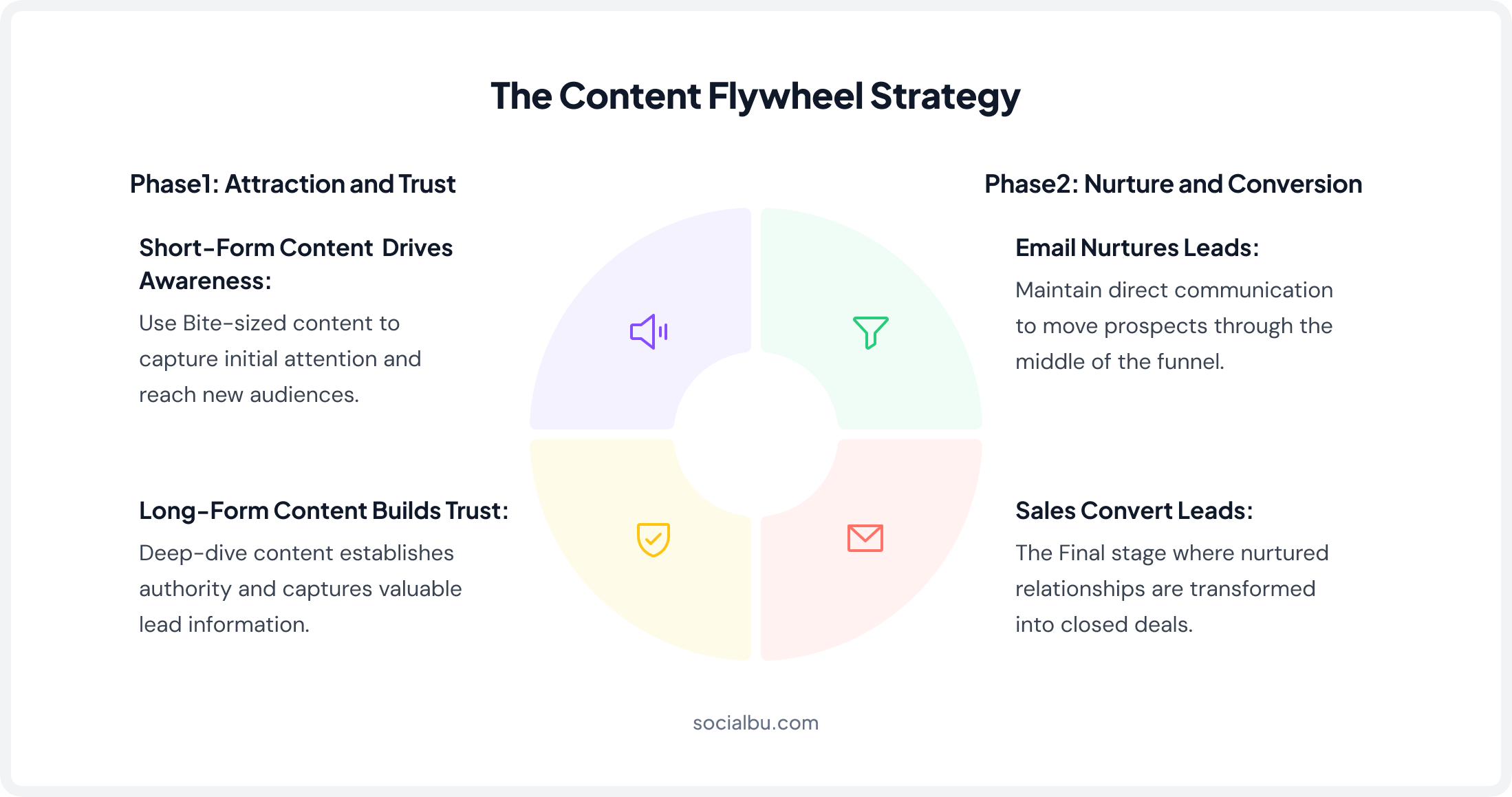
The result? A content flywheel.
- Short-form content drives awareness.
- Long-form content builds trust and captures leads
- Email nurtures those leads
- Sales convert them.
In answering the question, “How to create a hybrid content strategy in 2026,” each format serves a different job, and together they create a self-sustaining growth engine.
Nike: Short-Form for Culture, Long-Form for Story
Nike uses Instagram Reels and TikTok for quick, culturally resonant moments, i.e., athlete highlights, community content, and trend participation. But on YouTube, they invest in longer documentary-style storytelling that deepens the emotional connection to the brand.
Short form = reach and cultural relevance. Long form = brand mythology and emotional depth. Both are essential: short-form content for lead generation and long-form content for authority building, and neither replaces the other.
Saas Brand: Short-Form for Discovery, Long-Form for Conversion
Imagine a SaaS brand, let’s say a social media management tool. Their short-form content strategy might include a quick 30-second tip on Instagram and LinkedIn about social media best practices, educational, bite-sized, and widely shareable. That content reaches new potential customers who don’t yet know the brand.
But the real conversion work happens through long-form: a detailed blog post on “How to Build a 2026 Social Media Content Calendar” that answers every question a marketing manager might have and naturally references how the tool makes that process easier. That post ranks on Google, earns backlinks, and converts readers who are already in research mode.
Hybrid Content Strategy: Stop Choosing, Start Integrating
Here’s the truth that most content debates miss about short-form vs. long-form content: the best content strategies in 2026 don’t choose between short-form and long-form; they integrate both. The question isn’t “which is better?” It’s “how do I make them work together?”
Instead of thinking of it as a choice, they began thinking of it as a system. Short-form for discovery. Long-form content trends 2026 for conversion. Both feeding each other.
This isn’t complicated. But it requires being intentional about which format does what job at each stage, and having a tool that makes execution manageable. Here’s what the full hybrid workflow looks like in practice:
The Hybrid Workflow: Short-Form + Long-Form as a System
- Write one long-form anchor per week: A 2,000-3,000-word blog post, a comprehensive LinkedIn newsletter, or a 20-minute YouTube video. This is your content foundation.
- Extract 5-7 short-form assets from it: Pull the best stat, the most actionable tip, the most counterintuitive insight, the most relatable moment. Each becomes a standalone short-form content trends 2026 piece.
- Schedule short-form content to distribute across platforms: TikTok, Reels, Shorts, LinkedIn posts, and X threads, all repurposed from the same source material.
- Promote the long-form piece through the short-form teasers: A 30-second Reel that answers one question from the full guide and ends with “full breakdown in the link.”
- Recycle your best evergreen content: Set your top-performing long-form promotions to redistribute every quarter automatically.
- Measure and double down: After 30 days, check analytics. Which short-form posts drove the most website clicks? Which long-form content trends 2026 pieces had the highest conversion rate? Invest more in what’s working.
How SocialBu Helps You Execute the Hybrid Strategy?
Managing content across multiple platforms, scheduling Reels, publishing LinkedIn posts, and distributing blog content are where most teams hit a wall. The strategy is clear; the execution is chaotic.
That’s where SocialBu comes in. Instead of juggling five different tools and spreadsheets, SocialBu gives you a single hub to plan, schedule, publish, and analyze your content across every platform.
Whether you’re managing a short-form content calendar for Instagram and TikTok or scheduling out your weekly LinkedIn articles and blog promotions, everything lives in one place.
What a SocialBu-Powered Hybrid Strategy Looks Like |
Plan your monthly content mix: decide on your short-form vs. long-form ratio for each platform. |
Schedule short-form posts (Reels, Shorts, TikToks) weeks in advance; no more last-minute scrambles. |
Auto-schedule your blog promotion posts across LinkedIn, Facebook, and Twitter/X. |
Use SocialBu’s analytics to see which content (short vs. long) is driving the most engagement, clicks, and conversions. |
Set up recurring content campaigns so your evergreen long-form content keeps getting distributed consistently. |
Collaborate with your team on approvals and scheduling without email chains. |
Short-Form vs. Long-Form for Small Businesses and Agencies
If You’re a Small Business
The most common mistake I see small businesses make with short-form vs. long-form content while building their B2B marketing strategy is trying to do everything at once. They publish a 500-word blog, post daily Stories, try TikTok, and then wonder why nothing is getting traction. The answer is usually: not enough depth, not enough consistency, not enough of the right format for the right goal.
Regarding short-form vs long-form for small businesses, here’s my honest recommendation.
- Start with one long-form anchor: A single comprehensive blog post or YouTube video that answers the biggest question your customers have. This is your evergreen asset.
- Use short-form to amplify it: Create 3-5 short pieces of content from that one long-form piece. Post consistently on the 1-2 platforms where your audience actually is.
- Measure before expanding: Use analytics (SocialBu’s built-in analytics make this easy) to understand what’s resonating before you add more platforms or formats.
If You’re an Agency
Agencies managing multiple client accounts face a different challenge: scale. The short-form vs. long-form posting strategy for agencies in 2026 is about building repeatable systems:
- Develop client-specific content mixes: A B2B Saas client needs a very different short/long ratio than a consumer lifestyle brand. Set this up per client, not as a blanket rule.
- Systematize repurposing: Build templates for turning long-form content into short-form content trends 2026 assets. This is where agencies win on efficiency.
- Use scheduling tools to stay consistent: With SocialBu, agencies can manage multiple client accounts, schedule content in advance, and track performance across all of them from a single dashboard, which is the difference between scaling profitably and drowning in client demands.
Does Attention Span Actually Matter? (It’s Complicated)
Every conversation about </span><span style=”font-weight: 400;”>short-form vs. long-form content eventually circles back to the attention span argument: “<b>attention spans are shrinking, so short-form wins.” But this is only half the story, and half that’s often used to justify lazy content strategy.
Yes, 71% of viewers decide within the first few seconds whether to continue watching a video. (Digitalmarketinginstitute) And yes, the average person scrolls through social media at speeds that would make a Formula 1 driver blush.
But here’s what the data also tells us: when content is genuinely valuable, people will absolutely slow down for it. Long-form podcast episodes, YouTube tutorials, and in-depth blog guides have never been more popular. What’s shrinking isn’t attention; it’s tolerance for mediocre, low-value content. That’s actually great news for brands committed to quality.
Here’s the real takeaway on attention span marketing in 2026:
- People don’t have short attention spans. They have zero tolerance for content that doesn’t immediately prove its value.
- Short-form content wins because it delivers value in seconds. Long-form content wins because it delivers value that can’t be compressed. Both are right; for different audiences, at different stages, with different goals.
- The brands that struggle are the ones creating long content that should be short, or short content that requires depth.
How to Measure Your Short-Form vs. Long-Form Content Performance?
A hybrid content strategy is only as good as your ability to measure what’s working. Here are the key metrics to track for each format, and the questions they help answer about short-form vs. long-form content.
Short-Form Metrics to Track
- Video Completion Rate: Are people watching your short videos to the end? Under 50% completion = your hook isn’t strong enough.
- Engagement Rate: Likes, comments, shares, saves. This is your signal that content is resonating emotionally.
- Reach & Impressions: Is your content being distributed? What is the content length’s impact on reach and impressions? Strong reach = the algorithm is pushing your content to new audiences.
- Click-Through Rates (CTR): Are people clicking your links or bio? This bridges short-form awareness to deeper funnel actions.
- Follower Growth: Consistent short-form content trends 2026 should drive steady follower growth over time.
Long-Form Metrics to Track
- Organic Traffic: How much search traffic is your content driving? This is the primary metric for blog and SEO content.
- Time on Page/Watch Time: Are people actually consuming your long-form content? Low time on page means your content isn’t holding attention.
- Backlinks: Are other sites linking to your content? Backlinks are a signal of authority and a driver of SEO rankings.
- Conversion Rate: How many readers/viewers take the next step? (Sign up, book a demo, buy.) This is the ultimate long-form metric.
- Email Opt-In Rate: For gated long-form content (guides, ebooks), what percentage of visitors convert to subscribers?
SocialBu’s analytics dashboard makes it easy to track engagement rate, reach, and click-through rate across all your social platforms in one place, so you can see exactly which format is moving the needle and adjust your strategy accordingly. It also helps you track long-form content for authority building. No more switching between five different platform analytics tabs, trying to piece together a coherent picture.
How Often Should You Post Short-Form vs. Long-Form Content?
This is one of the most frequently asked questions about content frequency when it comes to short-form vs. long-form Content, and the answer depends entirely on resources and goals. Here’s a practical framework:
Business Size | Short-Form Frequencey | Long-Form Frequency | Notes |
Solo Creator/ Small Brand | 3-5 short-form posts/week | 1 long-form piece/week | Quality > Quantity. One great blog beats five mediocre ones. |
Mid-Size Brand | 5-10 short-form posts/week | 2-4 long-form pieces/week | Start batching content and repurposing systematically. |
Agency/ Large Brand | 10-20+ short-form/week across clients | 4-8 long-form pieces/week | Systematize everything. Use scheduling tools for consistency. |
B2B Company | 3-5 posts/week (LinkedIn heavy) | 1-2 in-depth pieces/week | Depth matters more than volume in B2B content marketing. |
Companies publishing 16+ blog posts monthly generate 4.5x more leads than infrequent publishers. (Lureon.AI) But consistency always beats volume. A brand posting 2 high-quality long-form pieces per week, every week, will outperform a brand posting 8 mediocre pieces for a month and then going dark.
Take Control of Your Social Media Content
Create, schedule, and Automate posts, engage smarter, and grow faster with SocialBu.
The Bottom Line: Strategy Over Format!
Here’s what I want you to take away from this guide: the short-form vs. long-form debate is a false choice. It’s the wrong question to be asking.
The right question is, “What job does this piece of content need to do, and what format does the job best?”
Short-form content builds reach, starts conversations, and puts your brand in front of new audiences every day. Long-form content builds authority, earns trust, drives SEO, and converts the people who are actually ready to act.
In 2026, the brands winning at content aren’t the ones who’ve picked a side. They’re the ones who’ve built intentional hybrid strategies. The execution is where most brands stumble, not because of a lack of ideas, but because managing content across multiple platforms and formats is genuinely hard. That’s why having the right tool matters.
SocialBu is built exactly for this: helping brands and agencies plan, schedule, publish, and analyze their entire content strategy, short-form and long-form, from one place.
Try SocialBu free and see how much simpler your content strategy can be.
FAQs
Q: Is short-form or long-form content better in 2026?
Neither is universally better; they serve different purposes. Short-form content excels at reach, awareness, and social engagement. Long-form content drives SEO, authority, and conversions. The best strategy uses both intentionally.
Q: Does short-form content get more reach than long-form?
Yes, on social media platforms. Short-form videos get 2.5x more engagement than long-form on social platforms. For search/SEO, long-form content gets 3x more organic traffic.
Q: Is long-form content still relevant for SEO in 2026?
Absolutely. The average top-10 Google result is 1,447 words. Long-form content earns 77% more backlinks and ranks for significantly more keywords. In 2026, with AI-powered search rewarding depth and expertise, long-form content is more important than ever for SEO.
Q: Which converts better: short-form or long-form content?
For bottom-of-funnel conversions (sales, sign-ups, demos), long-form content typically wins; it builds the trust and depth needed for purchase decisions. For quick conversions, such as social media clicks or impulse purchases, short-form can be highly effective.
Q: How do I balance short-form and long-form posting?
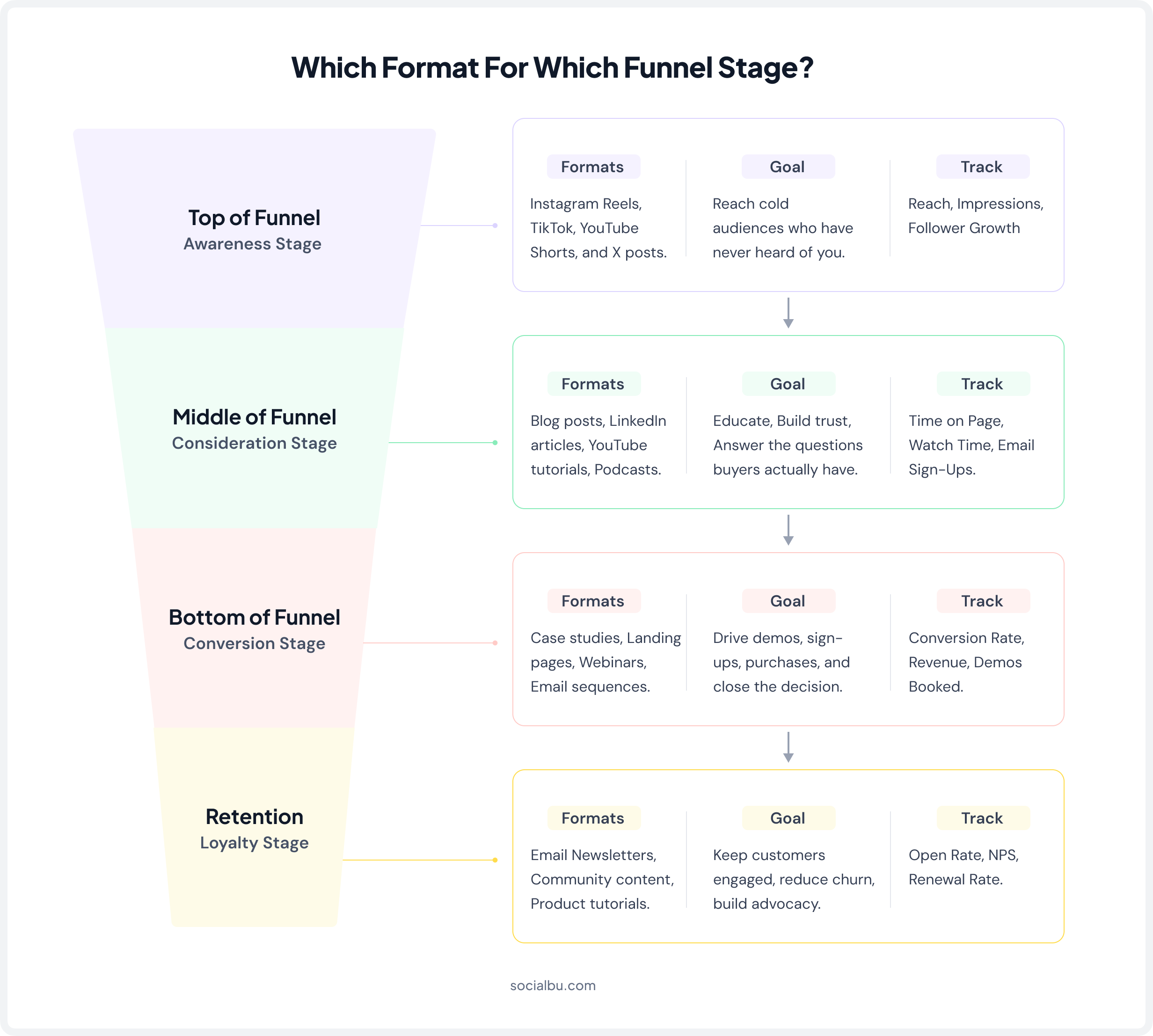
Use a content funnel framework: short-form for top-of-funnel awareness, and long-form for mid- and bottom-of-funnel trust and conversion. A practical starting ratio: 3-5 short-form posts per week plus 1-2 long-form pieces. Use tools like SocialBu to plan and manage your content calendar across both formats.
Q: Is short-form video better for growth?
For rapid audience growth, yes. TikTok, Instagram Reels, and YouTube Shorts all use discovery-first algorithms that can expose your content to millions of new viewers regardless of your follower count. But growth without depth often means low conversion rates.
Q: How do I repurpose long-form content into short clips?
Start with your most valuable insight from the long-form piece and turn it into a standalone short video. Pull key stats for social posts. Create carousels from your main sections. Use quotes as standalone text posts. One long-form piece can become 8-12 short-form pieces.
Q: What is the ideal content mix for brands in 2026?
There’s no single answer, but a common, effective mix is: 60-70% short-form content across social media for reach and engagement, 30-40% long-form content (blogs, YouTube, LinkedIn articles) for authority and conversion. Adjust based on your industry, audience, and funnel stage.
Q: Does long-form content increase watch time?
Yes, when it’s genuinely valuable. YouTube rewards channels that generate high total watch time, and long-form videos are the primary driver. Channels that use both Shorts and long-form content grow 41% faster than those using only one format.
Q: What platforms favor short-form content?
TikTok, Instagram (Reels), YouTube Shorts, Facebook Reels, and Snapchat. These platforms use discovery algorithms that heavily favor short, engaging content.
Q: What platforms favor long-form content?
YouTube (long-form video), Google Search (long-form blog content), LinkedIn (articles and newsletters), and email (in-depth newsletters). These platforms reward depth, expertise, and time investment.