Deciding when to use short-form vs. long-form content is largely based on your business goals, your target audience’s preferences, and your resources. Both short-form and long-form content formats play a key role in helping you achieve your marketing goals.
In this guide, we’ll break down each content format and help you decide when to use each to get better results for your business and brand.
Key Takeaways
- Short-form content is easy to produce and is best when you want to promote your business, grab audiences’ attention, and get more engagement.
- Long-form content takes more time and resources to produce and works well for building brand authority and driving conversions.
- Use short-form content for better reach, brand discoverability, and faster engagement.
- Use long-form content to build a thought leadership image, rank higher in search engines, and attract traffic.
- Use a hybrid approach to get real growth and a balanced content strategy.
- Short-form content attracts audiences’ attention, while long-form content retains it and encourages conversions and sign-ups.

What Is Short-Form Content?
Short-form content is concise, easy to consume, and is best for quick engagement. The length of short-form content varies based on format. For example, short-form videos are under 60 seconds, and written short-form content ranges from 500 to 1000 words.
Short-form content’s goal is to quickly hook audiences’ attention. It works best for audiences who want a quick summary and is ideal for social platforms where attention is fleeting, users scroll quickly, and make instant decisions.
Examples of short-form content:
- Instagram Reels and TikTok videos (often under 60-90 seconds)
- YouTube Shorts
- Short social posts and microblogs
- Tweets and short captions
- Newsletters and Emails
- LinkedIn posts and articles
- Infographics, memes, and carousel snippets
- Brief newsletter blurbs and product updates
Short-form content serves as the top of the funnel in your strategy and as a lead-generation magnet. It delivers value quickly and sparks interaction without overwhelming users.
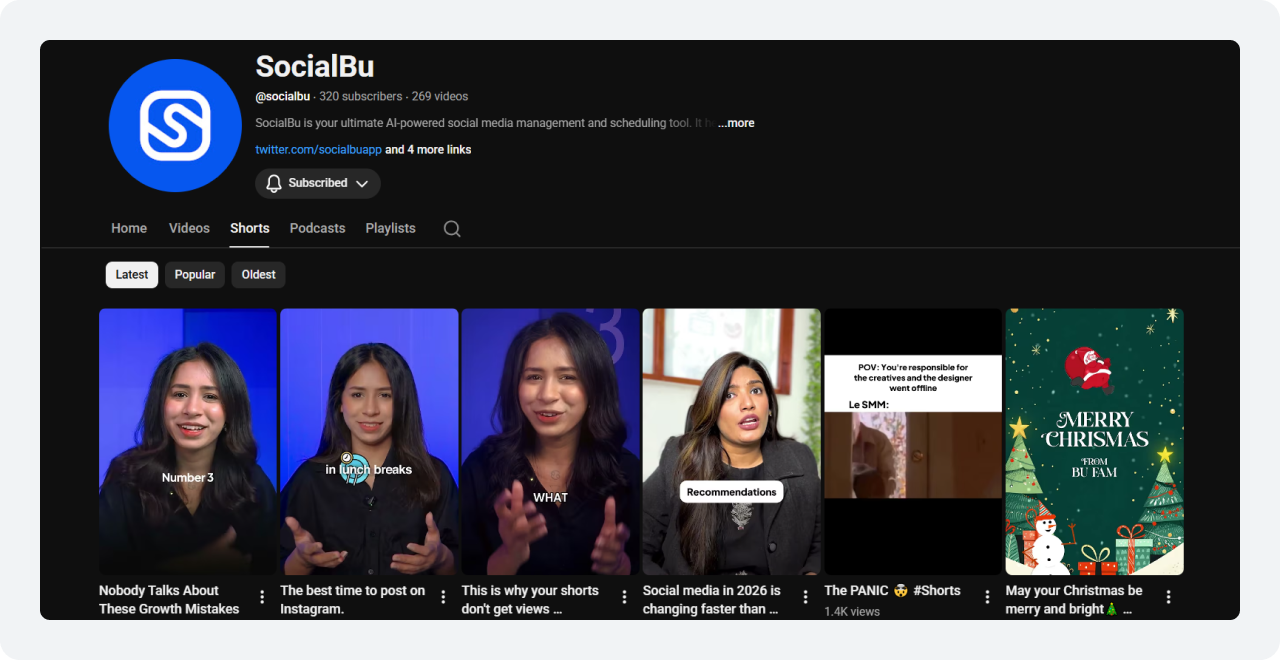
Here’s an example of SocialBu producing short-form content like YouTube Shorts and Instagram Reels for quick engagement and to deliver instant information:
What are the Pros and Cons of Short-form Content?
Some of the potential pros and cons of short-form content are that it is:
Pros
- Easy to produce and scale, requiring fewer resources and energy.
- Easy for the consumer to consume and retain information
- Mobile-screen friendly, hence giving users a better user experience
- Highly shareable because of its punchy bite-sized nature
- Ability to outperform and go viral instantly
Cons
- It lacks depth and detailed explanation, and you may miss some key points due to its short-form nature
- Short lifespan due to fast-moving content feeds
- Limited SEO value and search visibility, as it is not covered in depth
- Requires high posting frequency to stay visible amid all the social media trends popping out daily.
What Is Long-Form Content?
Long-form content delivers comprehensive details of a topic. It is a type of content you sit to consume and often takes more of your time and effort.
For written long-form content, the length varies between 1,500 and 3,000+ words. And for videos, it exceeds the usual 60-90 seconds and falls under 10 minutes to several minutes.
Long-form content aims to offer thought-leadership insights, educate readers, build user trust, and deliver long-term value.
Examples of long-form content:
- In-depth blog posts and guides (1,500+ words)
- YouTube educational videos and tutorials (10+ minutes)
- Webinars, podcasts, case studies, and whitepapers
- Ebooks and research reports
- Long-form newsletters with multiple sections
- Pillar pages
The Content Marketing Institute’s webinars and e-books are the best examples of long-form content, positioning them as thought leaders in the industry and providing in-depth knowledge to their audience.
What are the Pros and Cons of Long-form Content?
Some of the potential pros and cons of short-form content are that it is:
Pros
- Help you establish yourself as a thought leader in your industry and build strong credibility
- Provides in-depth value and complete information about a topic, hence higher chances to rank on search engines
- Increases dwell time, audience retention, and long-term engagement.
- Can get more backlinks, bring in more traffic, and attract potential customers
- Evergreen content has a longer lifespan than short-form content
- Can be easily repurposed into other social media content
Cons
- It takes more time, research, resources, and effort to create and produce
- Not ideal for mobile screens and short attention span audiences who prefer bite-sized content
- Lower immediate engagement compared to short-form content
- Can overwhelm the audience and their interest if not structured well
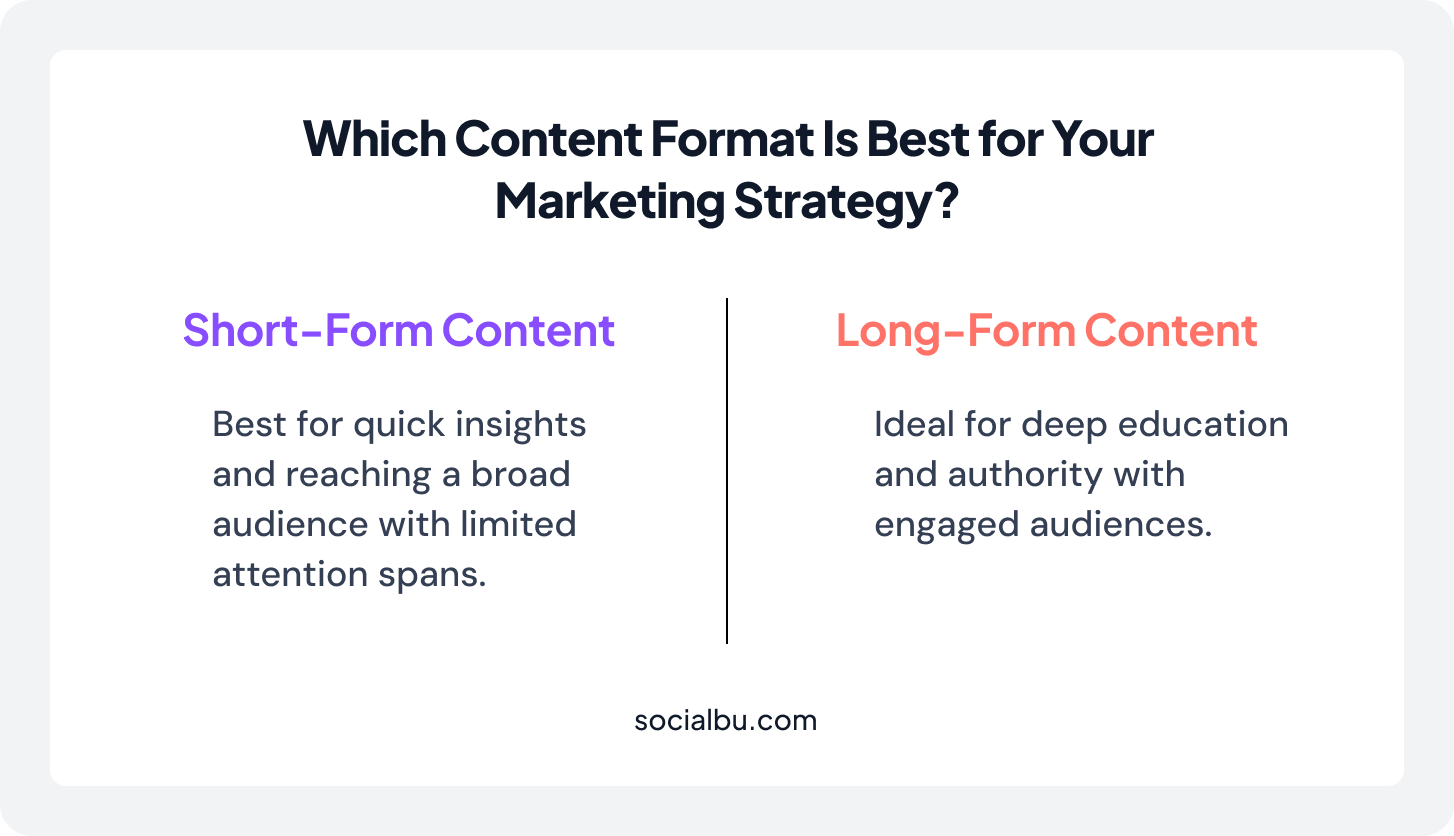
What are the Key Differences Between Short-Form vs Long-Form Content?
Factor | Short-Form Content | Long-Form Content |
Primary Goal | Quickly captures attention and drives reach | In-depth information, drive education, build authority |
Target Audience | Short-attention span and discovery-stage users | High-intent users looking for detailed information |
Length | Short (seconds / <1000 words) | Long (1,500 – 3,000+ words) |
Required Time | Quick to create and consume | Time-intensive to create and consume |
SEO Performance | Limited SEO value, just for a specific keyword | Strong SEO performance and ranks for multiple keywords |
Engagement | High instant engagement | Deeper, sustained engagement |
Conversion | Low to moderate conversions | High conversion potential |
Marketing Funnel Stage | Top-of-funnel (awareness) | Middle to bottom-of-funnel (consideration + decision) |
Ideal Platforms | Social media (Reels, Shorts, TikTok, emails, LinkedIn posts) | Long-form blogs, YouTube, guides, webinars, case studies |
 Also Read: What are the Social Media Content Pillars? to know the core themes for your social media content to get maximum engagement.
 When Should You Use Long-Form vs. Short-Form Content?
It mainly depends on user intent and where the audience is in their customer journey.
Here is the further breakdown of when to use which type of content format:
When to Use Short-Form Content
Use short-form content when your goal is to:
- Create brand awareness and capture the audience’s attention quickly
- Get instant engagement and shares
- Generate top-of-funnel awareness
- Encourage rapid clicks or immediate conversions (e.g., sales or newsletter sign-ups)
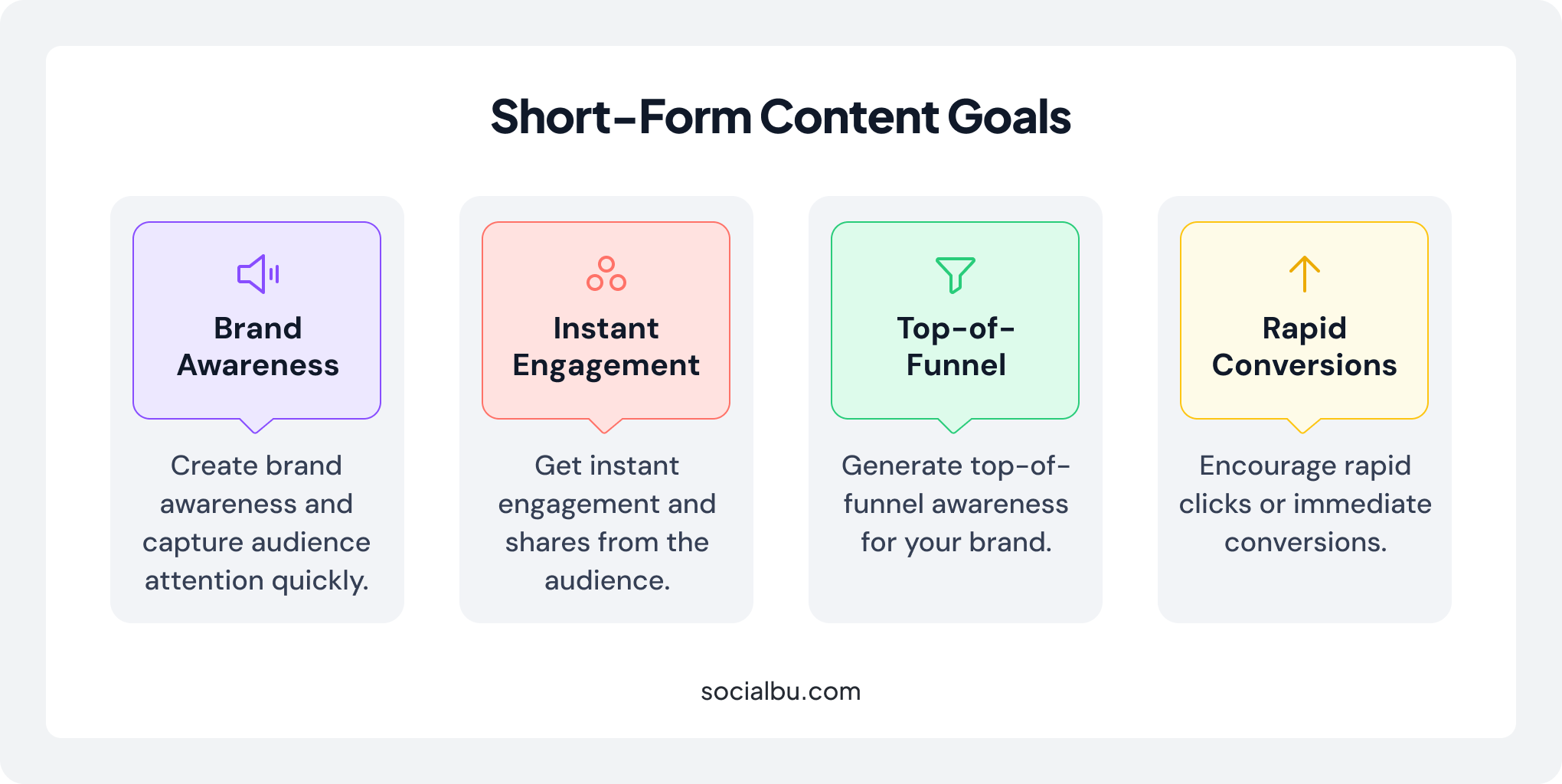
Short-form content is perfect for reach and lead capture, especially on social platforms, and works best when your audience is in discovery mode. It gives the audience a bite-sized, engaging reason to interact.
When to Use Long-Form Content
Use long-form content when your goal is to:
- Build topical brand authority and credibility
- Educate your audience deeply
- Drive conversions and decisions
- Strengthen SEO and domain trust
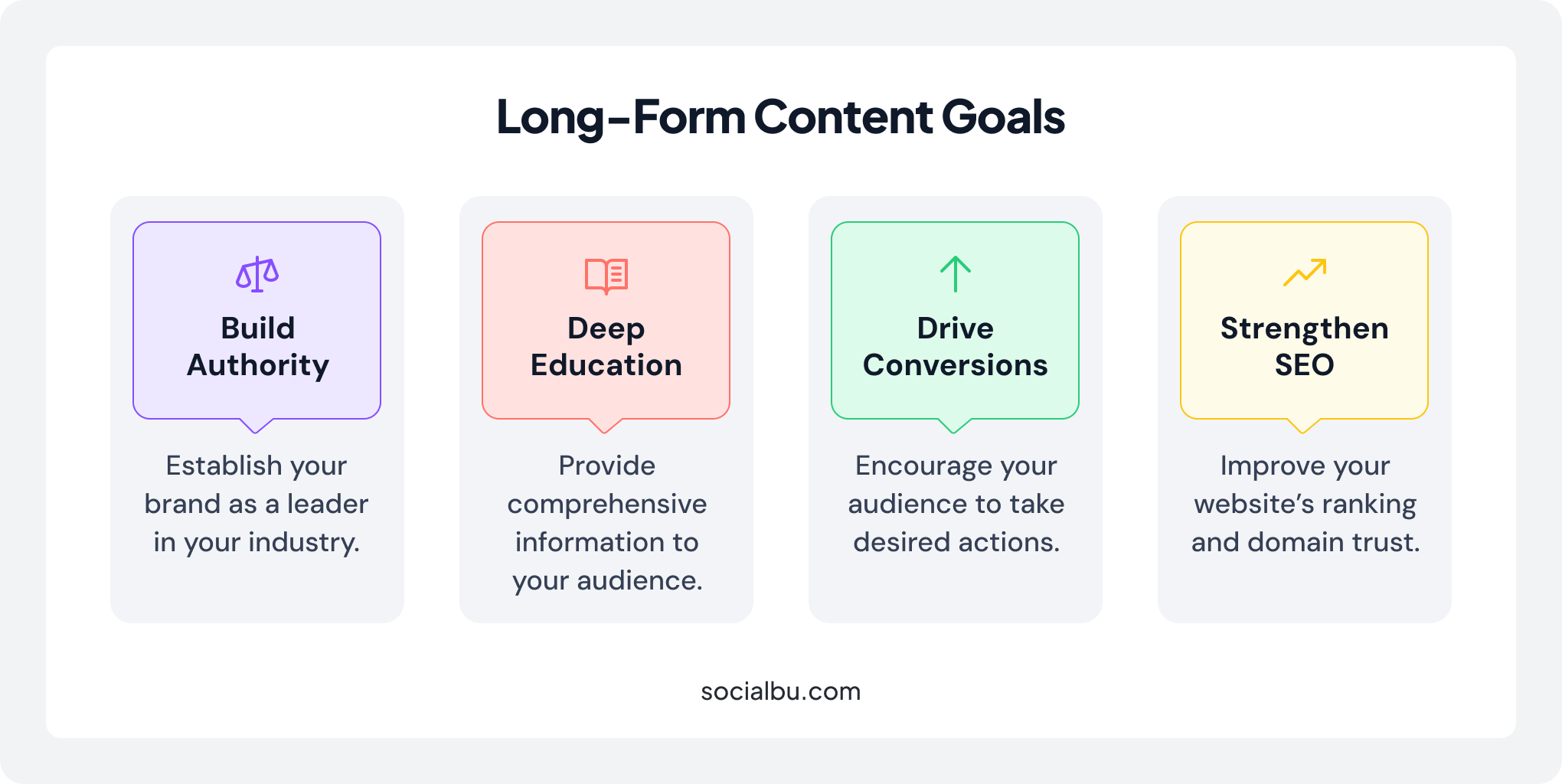
Long-form content performs best when your audience is in evaluation or decision mode and wants in-depth guidance, especially later in the funnel.
In practice, many successful businesses, agencies, and creators use both content formats in their social media content strategies.
So, use short-form content to draw people in and long-form to guide them toward meaningful actions, whether that’s product sign-ups, newsletter subscriptions, onboarding, or conversion.
Short-Form vs Long-Form Content Strategy: Which Approach Works Best?
Both content formats work best when they’re aligned with your audience’s needs and their content-consumption behavior, as well as your overall marketing goals.
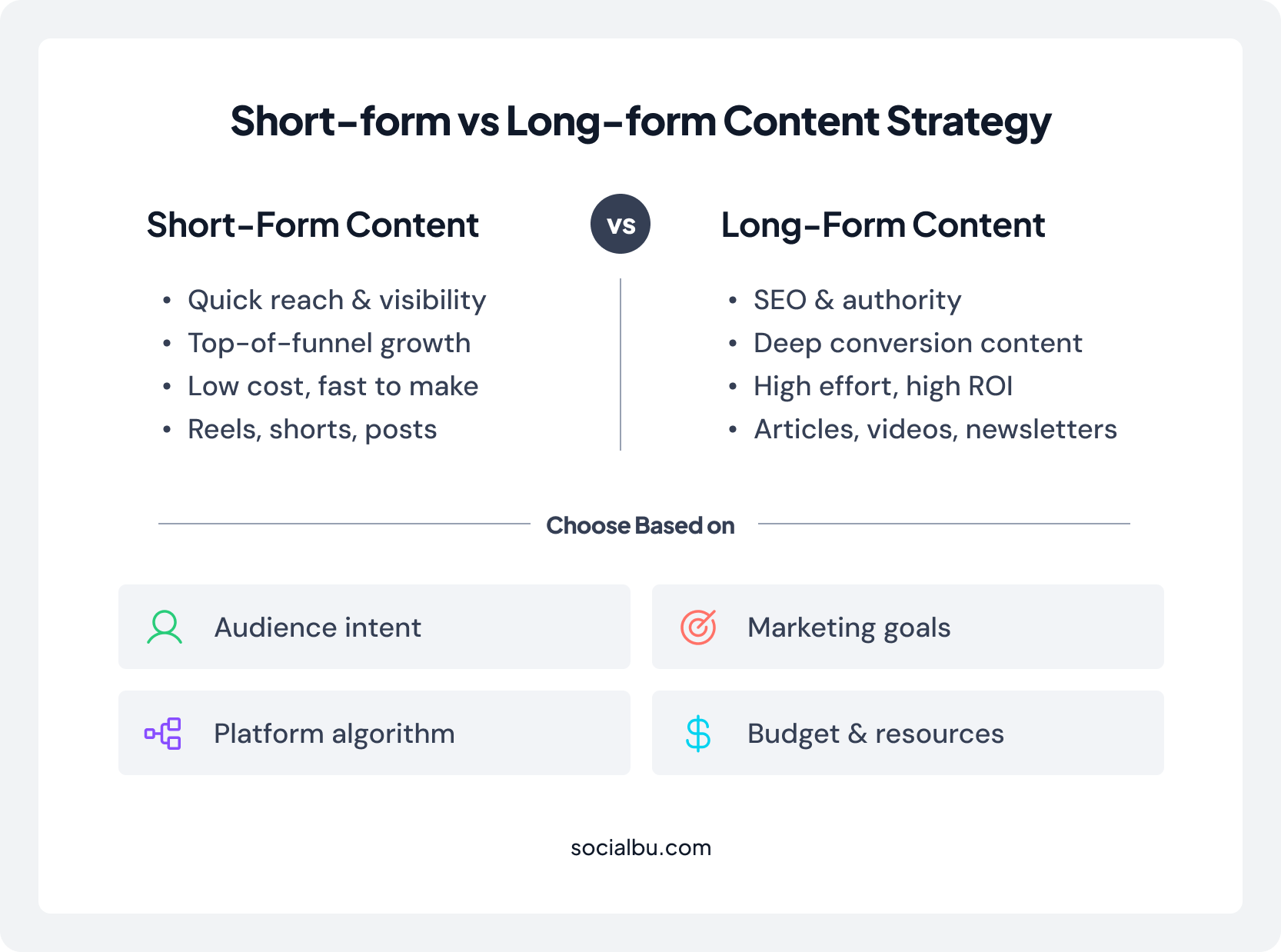
Let’s break down how to choose between short-form and long-form content strategically.
1. Understand Your Audience’s Preferences and Attention Behavior
Before deciding between short-form content for reach or long-form content for authority building, ask:
- Is your audience looking for quick insights or deep education?
- Are they in discovery mode or decision mode?
- Do they prefer snackable content or more detailed content?
In 2026, audiences are less tolerant of irrelevant content. If your audience wants quick inspiration, a short-form video works best. If they want detailed comparisons or case studies, long-form content performs better.
Add these two content formats strategically into your content marketing strategy for maximum output.
Track your engagement rate, watch time, and audience retention metrics to spot patterns and understand what your audience truly prefers.
2. Align Content Length With Your Marketing Goals
Your marketing goals should drive the length of your content formats, not trends.
Use a short-form content strategy when your goal is:
- To increase reach, impressions, and audience retention
- Accelerate organic growth and bring in more leads
- Generate top-of-funnel content
Use a long-form content strategy when your goal is:
- To build SEO authority and gain more visibility
- Produce evergreen content
- Build a thought leadership image and brand authority
- Get a high conversion rate
3. Consider Platform-Specific Algorithms and Distribution
The short-form vs. long-form content strategy for your social media must consider each platform’s algorithm and how your audience prefers to consume content on that platform.
For example:
- Instagram favors short-form Reels for reach, but carousels and longer captions build authority.
- YouTube Shorts drives discovery, while a long-form YouTube growth strategy increases watch time and monetization.
- LinkedIn short posts increase visibility, while long-form newsletters support a B2B marketing strategy.
- Facebook rewards conversation and longer educational posts in communities.
Understanding algorithm distribution is essential. Platforms optimize for different signals such as video completion rate, watch time, click-through rate, and audience retention.
4. Evaluate Your Budget, Resources, and Content Scalability
Short-form vs long-form content for small businesses often comes down to resources.
Short-form content marketing takes the following:
- Faster production
- Lower cost
- Easier content batching
- Scalable for daily posting
Long-form content marketing takes:
- Higher time investment for production
- Deep research
- More time and patience to bring in long-term ROI
- More sustainable SEO impact
If you have limited resources, start with one pillar piece per week and repurpose it into micro content. This supports both content scalability and performance analytics tracking.
Also Read: Learn how you can Repurpose Long-Form Content into Posts and Videos to scale your content creation.5. Implement, Test, Track, and Tweak Your Content Mix
No social media content strategy is complete without testing.
If you are unsure how often to post short-form vs long-form content, start with a balanced model and optimize based on data.
Track:
- Engagement rate
- Reach and impressions
- Watch time
- Conversion rate
- Audience retention
Then adjust your best content mix for social media growth in 2026 accordingly.
However, many brands fail here. They post consistently but do not analyze performance.
Use SocialBu’s analytics tool to:
- Compare short-form vs long-form engagement
- Identify top-performing posts
- Optimize posting frequency
- Repurpose high-performing evergreen content using post recycling
Your ultimate goal must be to post smarter, not more.
Wrap Up!
Your content strategy is ready to hit the next milestone if it combines both short-form and long-form content.
However, the debate over short-form vs long-form content ends when your main focus is on your audience, their preferences, and your business needs.
At the end of the day, your ultimate goal must be to produce content that helps you achieve the desired results and builds a real connection with your audience.
Take Control of Your Social Media Content
Create, schedule, and Automate posts, engage smarter, and grow faster with SocialBu.
FAQs
Q. Is short-form or long-form content better in 2026?
A. Short-form content drives reach, engagement, and top-of-funnel awareness. And long-form content builds SEO authority, audience trust, and traffic and conversions. The best strategy combines both formats into a structured hybrid content ecosystem.
Q. Does short-form content get more reach than long-form?
A. Yes, short-form content usually gets more reach than long-form content on social media platforms. Algorithms prioritize fast engagement, video completion rate, and shareability, so all of these factors make short-form and snackable content more likely to generate higher impressions and organic growth.
Q. Is long-form content still relevant for SEO in 2026?
A. Yes, long-form content remains highly relevant for SEO in 2026. Search engines prioritize intent satisfaction, semantic depth, and comprehensive answers. Long-form blog posts and pillar content rank better for competitive keywords and drive sustainable organic traffic.
Q. Which converts better: short-form or long-form content?
A. Long-form content generally converts better for high-intent audiences because it builds authority, addresses objections, and increases trust. Short-form content supports lead generation at the awareness stage, but long-form content drives stronger bottom-of-funnel conversions.
Q. How do I balance short-form and long-form posting?
A. Balance short-form and long-form posting by aligning content with your funnel stages. Use short-form content for reach and engagement and long-form content for education and conversion. A pillar-cluster model makes it easier to strategically connect both formats.
Q. Does long-form content build more authority?
A. Yes, long-form content builds more brand authority because it provides in-depth insights, supports thought leadership, and improves SEO visibility. Deep-dive content marketing strengthens audience trust and increases content lifespan.
Q. Can short-form content drive leads?
A. Yes, short-form content can drive leads when paired with strong calls to action and links to long-form resources. It works best for top-of-funnel lead generation, as it attracts attention and encourages quick interactions.
Q. How do I repurpose long-form content into short clips?
A. Repurpose long-form content by extracting key insights, statistics, and quotes into short videos, Reels, carousels, and micro posts. This content repurposing strategy increases reach, engagement rate, and content scalability across multiple platforms.
Q. What is the ideal content mix for brands in 2026?
A. The ideal content mix in 2026 is a hybrid model: approximately 60% short-form content for reach, 30% long-form content for authority, and 10% experimental formats. This balance supports organic growth, SEO impact, and conversion rate optimization.
Q. Is long-form blogging still worth it?
A. Yes, long-form blogging is still worth it in 2026. It improves search rankings, builds topical authority, attracts backlinks, and drives long-term conversions through evergreen content.
Q. Does short-form content get more engagement?
A. Short-form content often generates higher immediate engagement rates because it is easy to consume and share. Platforms reward short-form video marketing with greater reach and algorithm distribution.
Q. Does long-form content increase watch time and retention?
A. Yes, long-form content increases total watch time and audience retention, especially on YouTube and blog platforms. These signals strongly influence algorithm performance and long-term visibility.